Picture a procurement lead at an auto-parts brand opening a customer email. A workshop is claiming warranty on a fuel pump that failed in weeks. The part carries the logo, the packaging looks right, the batch code checks out on paper. Except it was never made in that plant. Somewhere between the factory and that workshop, a fake slipped into the channel wearing the brand's face, and now the brand is paying to replace a product it never sold.
That is what counterfeiting actually looks like. Not an obvious knock-off, but a convincing double that sits on the same shelf or the same marketplace listing as the real thing and quietly takes a sale, a warranty payout, or a customer's trust. For a pharma company it can mean a patient taking something the brand never made. For an agrochemical or FMCG brand, it shows up as a farmer or a shopper who blames you for a bad experience that was never yours.
The scale is not rhetorical. In Mapping Global Trade in Fakes 2025, the OECD and EUIPO estimated counterfeit and pirated goods at up to 2.3% of world trade in 2021, around USD 467 billion, based on goods seized at borders. And that is only the fakes caught crossing a border. It does not count the counterfeits made and sold inside a domestic market, which is where most Indian brands actually lose money. The number your business feels is the one that never reaches a customs desk.
So the real question is not whether you need protection. It is what you are protecting and where the fake reaches your customer. That lens is worth carrying into any vendor comparison, including this one.
Two names come up together for brands solving this in India: Acviss and Ennoventure. Both are Bengaluru-based, and both let a shopper confirm a product is genuine with an ordinary smartphone, no special hardware and no visible mark on the pack. That shared starting point is exactly why they get compared. The interesting differences show up the moment you look past the scan.
Where the two overlap, and where they split
Ennoventure's approach is software-first. Its public materials describe a cryptographic signature, essentially an invisible digital watermark, woven into your existing packaging artwork before it goes to print. A standard phone camera reads it and returns a Genuine, Suspect or Duplicate result in a second or two, and it flags duplicates when the same signature turns up being scanned in two places at once. There are no new inks or hardware to add. Around that core, Ennoventure has built two more layers: marketplace monitoring across, by its own account, more than 50 online marketplaces, and Chirper, a reputation-intelligence tool that scores public conversation on Reddit, forums, news and social channels.
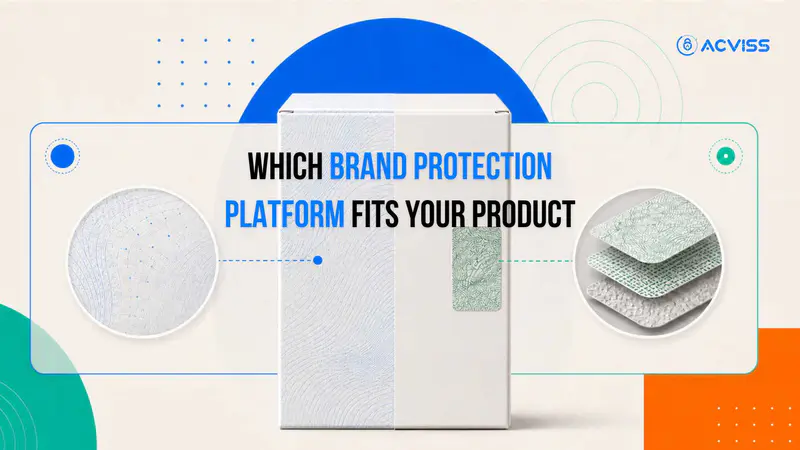
Acviss starts from the same convenience. Its Phantom Code spreads a non-cloneable pattern across your artwork, so a shopper can scan from any point on the pack rather than hunting for a target. The difference in philosophy is what comes next. A signature printed into artwork, however cleverly made, is still information sitting on a surface, and information can be copied. So for products where a copied design would be a serious problem, Acviss leans on a second mechanism that treats copying as a dead end.
That mechanism is worth understanding, because it drives most of the decisions below.
The five questions worth asking before you choose
Feature lists are the wrong place to start. Start with your own product line and work through five questions. The Acviss and Ennoventure differences fall out of the answers.
1. What are you actually putting a mark on?
This is the biggest divider in the category, and it is a physical one. Embedded authentication needs artwork to embed into. Plenty of products do not offer much:
Plywood sheets and bare hardware
Brass taps and bath fittings
Auto spares and lubricant drums
Seed sacks and other minimal packaging

These ship on surfaces a brand often does not print, or with packaging too sparse to hold a hidden signature. If a meaningful share of your revenue sits on unprinted or barely-printed substrates, an invisible-only model may simply have nowhere to live on half your catalogue.
This is where the two diverge in practice. Ennoventure's published approach centres on authentication embedded into printed artwork; for an unprinted drum or a raw component, it is worth asking the company directly what it can cover. Acviss sells physical non-cloneable labels, Axion Label and Uniqolabel, as a first-class product line, and uses Phantom Code on the SKUs where artwork does exist. In other words, the substrate decides the method, rather than the vendor deciding it for you.
2. How hard does the fake have to be to beat?
Here the two approaches genuinely differ, and it is worth being precise about why.
A cryptographic signature protects a design. Clone that design once and, in principle, you have a template you can reuse. For many brands that is an acceptable level of protection. For others, where copying a single design could compromise an entire product line, it is not enough.
Acviss's Axion Label is built so that copying does not help the counterfeiter. Each label carries two things that have to agree:
A cryptographically generated code, and
Beneath it, an AI-read "fingerprint" of the microscopic print variations that occur when that one specific label is manufactured, plus covert layers like guilloche patterning and hidden elements that only the verifier app or web reader can decrypt.
To pass as genuine, both the code and the physical fingerprint have to check out. A counterfeiter can reprint the code perfectly and it still fails, because no two print runs recreate those microscopic variations identically. The fingerprint the code was registered against simply does not survive being reproduced.
This is the "physically unclonable" idea, the same principle used in secure chips, applied to a label. It gives every individual unit its own identity rather than one shared design protecting a whole SKU. A design-level signature, cloned once, is a template; a non-cloneable label has to be defeated one physical unit at a time, and it cannot be, because the thing being checked is the print itself, not the code on top of it.
A note on language, because it matters. No technology makes counterfeiting disappear, and any vendor promising a product that is "100% counterfeit-proof" is selling you a sentence, not a system. What a non-cloneable label does is prevent the label itself from being replicated, which is what stops the unit wearing it from being copied and passed off as real.
3. What is the second problem you need to solve?
Authentication rarely clears a budget committee on its own. A simple yes-or-no on whether a pack is genuine seldom justifies the spend. The project usually gets funded because the same scan does a second job. So name that second problem early, because it narrows the field faster than any spec sheet:
Warranty fraud. The scan that proves a pack is genuine can also register the warranty and block a fraudulent claim on a return. An electrical brand losing margin to bogus warranty claims often funds the whole project on this alone. Acviss handles it with Assist.
Loyalty and first-party data. That same scan can award a loyalty point and capture customer data the brand never had before, which is exactly what a distributor-led FMCG brand or an agrochemical brand chasing farmer engagement tends to be after. Acviss covers this with Bonus.
Supply-chain and regulatory proof. If you need to trace a unit from factory to case to pallet, that is a traceability job (more on it in the next question).
Public reputation. If the loudest problem is an online argument about whether your product is fake, that points somewhere specific, covered further down.
Acviss has named products for the first three, sitting on one shared data layer so a single scan can authenticate, register a warranty and award loyalty at once. Ennoventure's published lineup centres on the authentication and monitoring layers rather than warranty or loyalty tooling, so if those second jobs are central to your case, confirm the scope directly.
4. Where does your connectivity actually break?
Verification is a cloud check for both vendors, so the smartphone scan needs a signal. The place to pressure-test is your traceability data capture at a plant or warehouse in a low-coverage district.
If you need serialisation and track-and-trace, Acviss's Origin is a dedicated product: GS1-compliant serialisation from unit to case to pallet, recall and sales-return tracking scoped to the affected lot rather than a whole month of production, native connectors into SAP, Oracle, Microsoft Dynamics 365 and Salesforce, and the ability to capture traceability data in-house without connectivity and sync it later. Ennoventure's model is built around invisible authentication rather than a standalone track-and-trace product. Whichever you shortlist, ask to see the offline behaviour working somewhere that is not a demo room.
5. What does your compliance actually require?
One clarification saves a lot of confusion here: blockchain does not authenticate a product. It is the single most common misconception in this category.
Origin writes every scan event to a permissioned blockchain, but the value of that is narrow and specific. It creates a tamper-evident, timestamped record that holds up under audit. It does not stop the fake; the label and the embedded code do that. What the ledger gives you is a defensible record of every movement, which is what lets Origin work as a Digital Product Passport and support EUDR and CDSCO-style reporting. Ennoventure makes the same honest point in its own materials: blockchain gives you immutability of the record, not authentication of the item.
Because one scan can feed authentication, warranty, loyalty and traceability at once, the data layer underneath has to be trustworthy. Acviss holds ISO 27001 certification for exactly that reason, which is what makes brands comfortable letting a single verification event flow across all of those systems.
And a practical tip for the paperwork: ask both vendors to map your specific mandates to their specific capabilities, in writing, before you sign anything. Regulations specify outcomes, not vendors. No rule anywhere requires a particular product, and a salesperson who implies otherwise has just told you something useful.
Where Ennoventure is the stronger choice

A comparison that concedes nothing is one nobody believes, so here is the honest part.
If the single biggest problem you are solving is public narrative rather than physical authenticity, Ennoventure packages something for it that Acviss does not sell as a separate product. Chirper watches Reddit threads, trade forums, news and social conversation, scores each on a structured Trust Authority Score, and drafts a response strategy tied back to authentication and marketplace data.
Acviss's Truviss covers the social and digital space too, as part of round-the-clock omnichannel monitoring, and it will find and act on impersonation and brand misuse. What Chirper adds on top is a dedicated, scored workflow purpose-built for reputation intelligence. If a community argument about whether your product is fake is the thing keeping your CMO awake, and it genuinely outranks authentication, traceability, warranty and loyalty on your list, that packaged workflow is a fair reason to weigh Ennoventure seriously.
One question worth putting to them, though: ask how Chirper identifies, reports and removes what it surfaces. Monitoring and resolution are not the same capability.
Side by side
The table below is a quick reference, not a scorecard. Two rows genuinely favour Ennoventure, and they are worth saying out loud: on a dedicated public-conversation product it has one and Acviss folds that work into Truviss, and on marketplace monitoring the two are closely matched.
One clarification to carry into any vendor conversation, both included: authentication and marketplace enforcement are separate layers sharing a data model, not one magic product. A monitoring tool does not authenticate a physical unit, and an authentication tool does not scan marketplaces. Anyone claiming a single product does both is describing a dashboard.
FAQ
Both scans look invisible to a shopper. What actually differs underneath?
The invisible layer is close: both embed authentication into existing artwork and verify with a standard phone. The real difference is what each scan is connected to. Phantom Code lets a shopper scan from any point on the pack, and it sits alongside physical labels, traceability, warranty and loyalty. Ennoventure pairs its signature with marketplace enforcement and Chirper. Match the surrounding stack to your second and third problems, not just the scan itself.
Which one fits a mixed catalogue of printed and unprinted products?
That is precisely why the substrate inventory in Question 1 matters. Ennoventure's published approach embeds authentication into printed packaging, so for plywood, taps, drums or bare components, confirm coverage with the company directly. Acviss handles that category with the applied physical labels Axion Label and Uniqolabel, plus Phantom Code where artwork exists. Most real portfolios end up needing both routes.
Does putting Origin on a blockchain make a product harder to fake?
No, and assuming so is the most common mistake in this category. The blockchain makes the record of scan events tamper-evident and defensible under audit. The counterfeit resistance comes from the label or the embedded code, not the ledger. Ennoventure states the same in its own materials.
How long does deployment realistically take?
Ennoventure cites a 48-hour integration for its authentication layer and a full three-layer rollout in about two weeks. Acviss runs an Origin pilot live in roughly two weeks, with full deployment across all SKUs, nodes and ERP integrations typically in four to six weeks, and smaller rollouts in under a week. Both timelines assume your artwork, SKU data, packaging specs, volumes and ERP details are ready on day one, so the real variable is your readiness, not the vendor's speed.
What is the one thing to insist on in a demo?
Ask each vendor to authenticate a pack from your own production run, not a pristine demo pack. Then ask what the scan does offline, ask to see the raw duplicate-scan alert rather than a summary tile, and ask the exact contractual scope of takedowns: who files, who pays legal costs, and what happens when a seller relists under a new name. Ask which regulatory mandates each will commit to in writing, and ask for two references in your industry rather than two logos. The vendor who answers all of it without escalating is the one whose product actually exists.