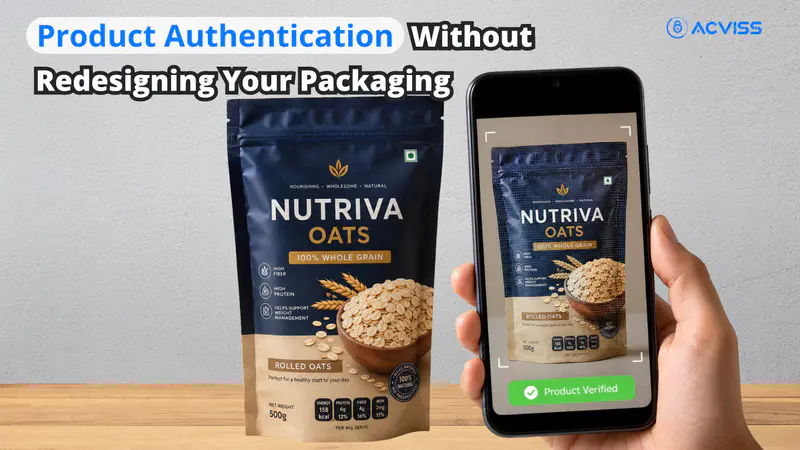
Packaging redesign has become one of the biggest reasons manufacturers postpone product authentication projects. Teams assume adding security features means revisiting artwork, modifying production lines, requalifying packaging, or absorbing weeks of downtime. In reality, modern authentication technologies have evolved to work with existing packaging processes, allowing brands to strengthen product security without disrupting manufacturing operations.
For manufacturers already operating high-speed packaging lines, the challenge is rarely about choosing an authentication technology. It is about finding one that integrates seamlessly into existing workflows, complies with production constraints, and delivers measurable protection without increasing operational complexity. Understanding where authentication fits into the packaging lifecycle is the first step towards making a successful implementation.
Why Packaging Redesign Concerns Delay Authentication Projects
Most authentication initiatives begin with a genuine concern: counterfeit products are entering the market, warranty fraud is increasing, or distributors are reporting unauthorised products. Yet many of these projects never progress beyond internal discussions because operations teams anticipate significant disruption.
The hesitation is understandable. Packaging is a tightly controlled manufacturing process involving multiple stakeholders, including packaging designers, procurement teams, production managers, quality assurance departments, regulatory specialists, and external print vendors. Even a minor design modification can trigger artwork approvals, validation cycles, inventory write-offs, and production scheduling changes.
As a result, authentication often becomes perceived as an expensive packaging project rather than a product protection initiative.
The reality is quite different. Many authentication technologies today are specifically designed to integrate into existing packaging and printing workflows with minimal operational changes.
The Biggest Misconception About Product Authentication

A common misconception is that product authentication always requires visible additions such as holograms, new labels, or redesigned packaging artwork.
While those approaches remain effective for many applications, they represent only one part of the authentication landscape.
Modern product authentication packaging solutions can be introduced without changing product appearance or interrupting existing manufacturing processes. Depending on the technology selected, authentication can be embedded during printing, integrated through variable data, or applied as part of existing label application stages.
The objective is no longer to redesign packaging. Instead, it is to strengthen product integrity while preserving existing production efficiency.
Where Product Authentication Fits Into Existing Packaging Lines
Rather than redesigning packaging, manufacturers should evaluate where authentication naturally fits within their existing production process.
A typical packaging workflow already includes several stages where authentication can be introduced with minimal disruption.
This approach allows manufacturers to leverage existing production infrastructure rather than introducing entirely new manufacturing steps.
For many organisations, the authentication layer becomes an extension of the packaging workflow rather than a separate operational process.
Authentication Methods Compatible with Existing Packaging
Different packaging environments require different levels of security. The best solution depends on product value, counterfeit risk, consumer interaction, and manufacturing capability.
The following comparison provides a practical starting point for evaluating common packaging authentication solutions.
The key takeaway is that packaging redesign is no longer a prerequisite for implementing authentication.
Instead, manufacturers should evaluate technologies based on integration effort, scalability, verification requirements, and long-term operational costs.
Packaging Material Compatibility
Another concern frequently raised during authentication planning is packaging compatibility. Many manufacturers assume that different substrates require entirely different authentication strategies.
In practice, modern authentication technologies are designed to support a broad range of packaging materials.
Common compatible packaging includes:
Folding cartons
Flexible packaging
Pressure-sensitive labels
Corrugated boxes
Plastic containers
Glass bottles
Metal cans
Composite packaging
The important consideration is not the packaging material itself but the printing process and production environment.
Offset, flexographic, gravure, and digital printing technologies can all support authentication features when properly configured. Variable Data Printing (VDP), for example, enables every individual package to carry a unique identifier without changing the base artwork.
This capability has become increasingly important as manufacturers adopt product-level serialisation for authentication, traceability, and regulatory compliance.
Phantom Code: Product Authentication Without Changing Your Packaging
For manufacturers seeking strong security with virtually no impact on packaging aesthetics, Phantom Code offers a fundamentally different approach.
Instead of adding visible security labels or requiring packaging redesign, Phantom Code embeds an AI-generated invisible authentication pattern directly within the existing printed artwork.
To the human eye, the packaging appears completely unchanged. There are no additional labels, visible QR codes, or design modifications that alter shelf presentation.
Behind the scenes, however, every package carries a unique authentication layer that can be verified digitally.
This delivers several operational advantages.
First, brand owners retain their existing packaging design without introducing visual clutter or compromising brand identity.
Second, implementation can often leverage existing printing infrastructure, avoiding expensive production changes or lengthy artwork approval cycles.
Third, the invisible nature of the authentication makes it significantly more difficult for counterfeiters to identify, replicate, or remove the security feature.
For brands operating across hundreds of SKUs, this approach also simplifies deployment because authentication becomes part of the print process rather than an additional packaging component.
Unlike visible security elements that may attract unwanted attention or encourage imitation, Phantom Code works discreetly in the background while maintaining the original customer experience.
For organisations looking to introduce secure packaging without affecting packaging aesthetics or manufacturing efficiency, this represents an attractive balance between security and operational practicality.
Minimising Implementation Costs and Production Downtime

Successful authentication deployments are rarely determined by technology alone.
They succeed because implementation is planned around manufacturing operations rather than forcing manufacturing to adapt to security requirements.
Several best practices consistently reduce implementation risks:
1. Start with High-Risk Product Lines
Rather than attempting enterprise-wide deployment immediately, manufacturers should prioritise products experiencing the highest levels of counterfeiting, diversion, or warranty fraud.
This allows production teams to validate workflows before expanding across the portfolio.
2. Align Authentication with Scheduled Packaging Updates
Artwork revisions already occur periodically due to regulatory updates, branding refreshes, or packaging optimisation.
Introducing authentication during these planned changes significantly reduces implementation effort.
3. Use Existing Printing Infrastructure
Modern security technologies increasingly work with existing printing presses and Variable Data Printing systems, reducing capital expenditure.
Where new hardware is required, manufacturers should evaluate compatibility with existing production speeds and quality inspection systems.
4. Validate Print Quality Early
Authentication quality depends heavily on consistent print execution.
High-speed vision inspection systems capable of inspecting more than 1,000 products per minute now achieve detection accuracies approaching 99.9%, helping identify print defects, registration issues, and serialisation errors before products leave the production line.
Early validation reduces costly rework and prevents defective authentication codes from reaching the market.
Common Deployment Mistakes That Increase Costs
Many authentication projects become unnecessarily expensive because organisations focus solely on technology selection while overlooking operational planning.
Some of the most common mistakes include:
Treating authentication as a packaging redesign project rather than a manufacturing integration project.
Selecting security technologies before assessing production capabilities.
Ignoring existing inspection and quality control systems.
Deploying visible security features where covert authentication would provide greater protection.
Failing to involve print vendors and packaging suppliers during project planning.
Treating authentication as a standalone initiative instead of integrating it with traceability, warranty verification, and online brand protection.
Avoiding these mistakes often delivers greater cost savings than selecting a lower-cost authentication technology.
A Practical Framework for Selecting the Right Authentication Solution

Before selecting any authentication technology, manufacturers should evaluate their operational requirements rather than focusing solely on security features.
The following questions provide a practical decision framework.
The best authentication solution is rarely the one with the most sophisticated technology. It is the one that aligns security objectives with operational realities.
Looking Beyond Authentication
Authentication should not be viewed as an isolated security feature.
The strongest product protection programmes combine multiple layers of integrity throughout the product lifecycle.
These typically include:
Product authentication
Tamper evidence
Product serialization
Supply chain traceability
Online marketplace monitoring
Warranty verification
Consumer engagement
Investigation workflows for counterfeit incidents
This layered approach reflects how modern counterfeit networks operate. They exploit weaknesses across manufacturing, logistics, distribution, retail, and digital marketplaces rather than relying on a single point of failure.
As regulatory requirements such as Digital Product Passports, GS1 standards, and product-level traceability continue to expand, authentication technologies that integrate smoothly into existing operations will become increasingly valuable.
Manufacturers that invest in scalable authentication today are positioning themselves not only to reduce counterfeiting but also to strengthen supply chain visibility, improve consumer trust, and prepare for future compliance obligations.
Final Thoughts
The assumption that product authentication demands expensive packaging redesigns is becoming increasingly outdated. Advances in printing technologies, invisible security features, serialization, and digital verification have made it possible to integrate authentication into existing manufacturing environments with minimal disruption.
The more important question for manufacturers is no longer whether authentication can fit into their packaging. It is how to implement it in a way that supports production efficiency, future regulatory requirements, and long-term product integrity.
Solutions such as Phantom Code demonstrate how security can evolve alongside manufacturing rather than compete with it. By embedding authentication into existing packaging workflows instead of redesigning them, manufacturers can protect their products, preserve operational continuity, and build a stronger foundation for traceability and consumer trust.
Interested in learning how product authentication can be integrated into your existing packaging without disrupting production? Get in touch with the Acviss team to explore the right approach for your products and manufacturing environment.
Frequently Asked Questions
Does product authentication always require new packaging?
No. Many authentication technologies integrate with existing packaging workflows using serialization, authentication labels, or invisible security features such as Phantom Code, avoiding major packaging redesigns.
Can authentication be added to existing production lines?
Yes. Modern authentication solutions are designed to work with existing printing, labelling, and inspection systems, minimising production downtime.
Which industries benefit most from invisible authentication?
Invisible authentication is particularly valuable for pharmaceuticals, FMCG, automotive components, consumer electronics, cosmetics, and other sectors where maintaining existing packaging aesthetics is important while protecting products against counterfeiting.
Is authentication enough to stop counterfeit products?
Authentication is one component of a broader product integrity strategy. Combining authentication with traceability, tamper evidence, online brand protection, warranty verification, and supply chain intelligence provides significantly stronger protection than relying on a single technology.