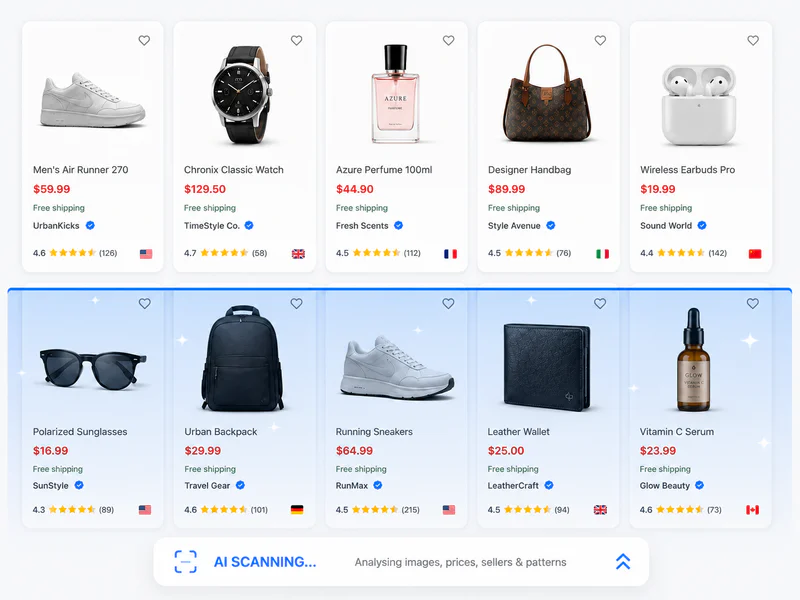
Counterfeit investigations rarely fail because brands cannot find fake listings. They fail because counterfeiters do not operate as isolated sellers. A single fake product on a marketplace is often just one visible endpoint of a much larger network spanning multiple seller accounts, websites, warehouses, payment channels and logistics partners. Removing one listing may create a temporary victory, but it rarely disrupts the operation behind it.
This is where AI counterfeit detection has fundamentally changed online brand protection. Rather than treating every infringement as a standalone incident, modern AI systems correlate thousands of seemingly unrelated digital signals to uncover hidden relationships. The result is not simply a list of counterfeit products, but an intelligence-driven understanding of who is behind them, how they operate, and where enforcement efforts can have the greatest impact.
Why Removing Listings Doesn't Stop Counterfeit Operations
Many organisations still measure the success of their brand protection programmes by counting the number of counterfeit listings removed each month. While takedowns remain an important operational activity, they represent only one stage of a much larger investigation.
Professional counterfeit sellers expect listings to be removed. They build redundancy into their operations by maintaining multiple seller accounts, rotating storefronts, shifting between marketplaces and launching new listings within hours of enforcement actions. As one account disappears, another takes its place, often selling identical products using slightly modified descriptions or imagery.
The challenge becomes even greater when counterfeit operations span multiple digital channels. A product may be advertised on a marketplace, promoted through social media, discussed in messaging groups, redirected through independent websites and fulfilled from entirely different locations. Looking at each channel separately makes it difficult to recognise that they all belong to the same organisation.
For brand protection teams, this creates an endless cycle of detection and removal without addressing the infrastructure enabling the counterfeit trade. Breaking this cycle requires understanding relationships rather than individual violations.
Counterfeit Networks Leave Digital Fingerprints Everywhere

Organised counterfeit networks rarely hide every aspect of their operations. While seller names and storefronts frequently change, operational behaviours tend to remain remarkably consistent.
Artificial intelligence excels at identifying these recurring patterns across enormous volumes of structured and unstructured data. Instead of analysing listings individually, AI builds connections between digital assets that would be almost impossible for investigators to recognise manually.
Some of the strongest indicators are surprisingly subtle. A seller may alter product titles, create new accounts and even change marketplace platforms, yet continue using the same warehouse address, shipping partner or payment details. Product photographs may be cropped differently or edited with new backgrounds while still originating from the same source image.
The more signals that are connected, the clearer the picture becomes.
The objective is not simply to discover more counterfeit listings. It is to understand how those listings fit into a broader ecosystem of digital infrastructure supporting illicit trade.
How AI Connects Thousands of Listings into a Single Seller Network

Modern AI counterfeit detection combines multiple analytical techniques, each contributing a different layer of intelligence. Individually, these technologies provide useful signals. Together, they create a far more complete investigative picture.
1. Image Recognition Goes Beyond Exact Matches
Many assume image recognition simply detects duplicate product photographs. In practice, sophisticated computer vision models identify visual similarities even after counterfeiters deliberately modify their content.
Images may be resized, cropped, mirrored, colour corrected or compressed to avoid traditional duplicate detection systems. Backgrounds are frequently replaced, watermarks removed, and logos repositioned to make products appear unrelated.
AI analyses far deeper visual characteristics than pixel similarity alone. Packaging layouts, typography, colour distribution, object positioning and even subtle manufacturing defects can reveal common origins across hundreds of listings.
This capability becomes particularly valuable when counterfeiters distribute the same inventory across multiple marketplaces under different seller identities. While each listing appears unique to human reviewers, AI recognises recurring visual signatures that point towards a shared source.
2. Natural Language Processing Identifies Behavioural Similarities
Counterfeit listings are constantly rewritten to avoid keyword-based detection. Product titles change, descriptions are translated into multiple languages, and promotional claims are rephrased to appear original.
Natural Language Processing (NLP) enables AI to understand meaning rather than simply matching identical words.
Instead of searching for exact phrases, AI evaluates writing style, sentence construction, recurring marketing claims, technical terminology and semantic relationships. Listings that appear unrelated on the surface often reveal consistent behavioural patterns when analysed collectively.
For global brands, this becomes particularly valuable because counterfeit operations frequently reuse translated content across different countries and marketplaces. AI can identify these linguistic similarities even when listings are written in different languages.
3. Behaviour Analysis Reveals Organised Operations
One of AI's greatest strengths lies in recognising behaviour over time.
Every counterfeit seller leaves operational patterns, even when attempting to remain anonymous. AI continuously analyses these activities to determine whether apparently independent accounts are behaving as part of a coordinated network.
Typical behavioural indicators include:
Listings appear at similar times across different marketplaces.
Repeated pricing strategies and discount patterns.
Common inventory refresh cycles.
Identical responses to customer enquiries.
Migration to new seller accounts following enforcement actions.
Similar shipping timelines and fulfilment locations.
Repeated product launches across multiple digital channels.
Each indicator may appear insignificant on its own. When thousands of these signals are combined, however, clear organisational structures begin to emerge.
4. Threat Correlation Transforms Monitoring into Intelligence
Perhaps the biggest shift in online brand protection is moving from monitoring individual incidents to understanding entire threat networks.
Traditional investigations often stop after identifying counterfeit listings. AI-driven threat correlation continues much further by linking sellers, domains, social media profiles, payment infrastructure, logistics partners and customer interactions into a unified intelligence model.
Instead of reporting:
"500 counterfeit listings were detected this month."
An intelligence-led investigation may conclude:
500 listings originated from 41 seller accounts.
Those accounts were linked to four primary payment identities.
Three warehouse locations fulfilled the majority of shipments.
Two domain registrars hosted associated websites.
The network expanded across seven marketplaces in four countries within six months.
This level of correlation enables enforcement teams to prioritise the infrastructure sustaining counterfeit operations rather than continuously responding to individual listings.
For enterprise brand protection teams, this distinction is increasingly important. Success is no longer measured by the volume of listings removed, but by the ability to identify repeat offenders, uncover hidden relationships and build actionable intelligence that supports long-term enforcement strategies.
The most effective programmes recognise that every counterfeit listing is not an isolated problem. It is a data point within a much larger network waiting to be connected.
Why Counterfeit Networks Are Also Supply Chain Problems
Counterfeit products do not suddenly appear on an online marketplace. Long before a listing goes live, the product has typically moved through a complex chain of manufacturers, intermediaries, logistics providers, warehouses and distributors. Treating counterfeiting purely as an online marketplace issue ignores the operational infrastructure that enables it to scale.
Global supply chains can involve as many as 25 different entities, creating numerous opportunities for counterfeit goods to be diverted, relabelled or mixed with legitimate inventory before reaching consumers. The larger and more fragmented the supply chain, the harder it becomes to identify where genuine products end and counterfeit products enter.
For brand owners, this changes the investigation entirely. The objective is no longer limited to identifying where fake products are being sold, but also understanding how they reached those channels in the first place.
Supply Chain Weaknesses Counterfeiters Exploit
Counterfeit organisations deliberately exploit the same efficiencies that legitimate businesses rely on. They take advantage of global trade routes, outsourced logistics and fragmented supplier ecosystems to obscure the origin of illicit products.
Some of the most common vulnerabilities include:
Origin laundering, where goods are transshipped through multiple countries to disguise their true source.
Free Trade Zones (FTZs), where weak customs oversight can allow products to be repackaged, relabelled or assembled before entering legitimate markets.
Commingling, where counterfeit products are mixed with genuine inventory during transportation or warehousing.
False customs declarations, including incorrect product descriptions, values or country-of-origin documentation.
Small parcel shipping, which makes enforcement more challenging due to the sheer volume of e-commerce deliveries.
Anonymous fulfilment networks, allowing counterfeit sellers to distance themselves from physical inventory.
These weaknesses become even more significant as online commerce continues to grow. TRACIT notes that postal services and express couriers have become major conduits for illicit trade because counterfeit products increasingly move as individual parcels rather than bulk shipments. In fact,63% of customs seizures of counterfeit goods involved small parcels, highlighting how e-commerce has reshaped the counterfeit landscape.
The challenge is not simply one of visibility. It is one of the correlations. A suspicious listing, an unusual shipping address and a questionable warehouse may appear unrelated until analysed together. AI helps bridge these gaps by connecting operational data across the entire counterfeit ecosystem.
Why Online Brand Protection Cannot Operate in Isolation
Many organisations invest heavily in monitoring marketplaces, social media platforms and websites, expecting this to solve their counterfeiting problem. While online monitoring is essential, it answers only one question:
"Where are counterfeit products being sold?"
It does not answer equally important questions, such as:
Where did these products originate?
Are multiple sellers connected?
Is this counterfeit activity or grey market diversion?
Which distributor or supply chain partner may have been compromised?
Which networks present the greatest commercial risk?
Which incidents should be investigated first?
Without additional layers of intelligence, enforcement teams risk becoming trapped in an endless cycle of detecting and removing listings without addressing the underlying network.
Modern brand protection programmes therefore rely on multiple intelligence sources working together rather than operating as standalone systems.
Connecting the Dots withTruviss: From Online Monitoring to Actionable Intelligence

Effective online brand protection is no longer about collecting more alerts. It is about transforming fragmented data into intelligence that investigators, legal teams and supply chain leaders can act upon.
This is where platforms such as Truviss extend beyond conventional monitoring by connecting digital investigations with broader product protection strategies.
Rather than viewing counterfeit listings in isolation, Truviss continuously analyses signals across marketplaces, e-commerce websites, social media platforms, domains, mobile applications and other digital channels. AI-powered correlation helps identify relationships between sellers, listings, digital assets and behavioural patterns that would otherwise remain hidden.
However, online intelligence becomes significantly more valuable when combined with additional sources of product data.
Layer 1: Online Brand Protection
The first layer focuses on identifying where brand abuse is occurring across the digital landscape.
This includes monitoring:
Independent websites
Social media platforms
Mobile applications
Domain impersonation
Unauthorised advertisements
Rather than producing isolated alerts, AI prioritises incidents based on risk, helping investigation teams focus on the counterfeit operations likely to cause the greatest commercial damage.
Layer 2: Product Authentication
Online evidence alone cannot always confirm whether products are genuine or counterfeit.
By integrating product authentication data, investigators gain additional context. Authentication events can reveal where consumers are scanning products, where verification failures are occurring and whether suspicious geographic clusters are emerging.
For example, repeated authentication failures from a particular region may indicate that counterfeit products have entered a local distribution network. Combined with online seller intelligence, this creates a far more complete investigative picture.
Layer 3: Supply Chain Visibility
Counterfeit investigations become considerably stronger when supported by supply chain intelligence.
Track-and-trace systems provide visibility into legitimate product movement, allowing organisations to distinguish between counterfeit activity, grey market diversion and genuine distribution anomalies.
Questions that become easier to answer include:
Has inventory been diverted from authorised channels?
Are products appearing in markets where they were never intended to be sold?
Which distributor supplied a suspicious batch?
Is the issue related to counterfeiting or unauthorised resale?
Supply chain visibility shifts investigations from assumptions to evidence.
Layer 4: Intelligence-Driven Enforcement
The final layer brings all available intelligence together.
Rather than overwhelming investigators with thousands of individual alerts, Truviss correlates marketplace data, authentication records, supply chain information and behavioural analysis into a prioritised threat model.
This enables organisations to:
This integrated approach supports faster investigations, more targeted enforcement and stronger collaboration between brand protection, legal, compliance and supply chain teams.
Common Reasons AI Brand Protection Programmes Fail

Artificial intelligence is only as effective as the operational strategy supporting it. Many organisations invest in sophisticated monitoring tools but fail to achieve meaningful disruption because they continue to approach counterfeit investigations reactively.
Some of the most common pitfalls include:
Measuring success by the number of listings removed rather than the networks disrupted.
Investigating individual sellers instead of analysing relationships between multiple entities.
Treating marketplace monitoring, authentication and supply chain visibility as separate initiatives.
Ignoring regional marketplaces, social commerce platforms and independent websites where counterfeit activity often migrates.
Operating without consistent evidence collection makes legal enforcement more difficult.
Failing to share intelligence between digital risk, legal, compliance and supply chain teams.
Prioritising every alert equally instead of focusing on the highest-risk networks.
Technology alone cannot overcome fragmented governance. Organisations that achieve the strongest results combine AI with well-defined investigation workflows, cross-functional collaboration and continuous intelligence sharing.
A Practical Framework for AI Counterfeit Detection
As counterfeit operations become more sophisticated, organisations need a structured approach that moves beyond reactive monitoring.
A practical framework consists of four interconnected stages:
This progression shifts brand protection from a tactical activity to an intelligence-led business function.
Looking Beyond Listings to Intelligence
Counterfeit operations have evolved into highly organised digital ecosystems that exploit fragmented marketplaces, complex logistics networks and disconnected data. Responding to one listing at a time is no longer sufficient for brands operating across multiple regions and sales channels.
The organisations making the greatest progress are shifting from reactive enforcement to intelligence-led brand protection. Combining AI-powered online monitoring, product authentication, supply chain visibility and behavioural analytics, they gain a clearer understanding of how counterfeit networks operate, where risks originate and which interventions will have the greatest impact.
As regulatory expectations increase and illicit trade continues to adapt, connected intelligence will become a defining capability rather than a competitive advantage. Brands that can link digital evidence with operational and supply chain insights will be better equipped to protect consumers, safeguard revenue and strengthen trust across their entire ecosystem.
Interested in learning how connected brand intelligence can uncover hidden seller networks and strengthen your online brand protection strategy? Get in touch with the Acviss team to discover how Truviss helps transform counterfeit detection into actionable intelligence.
Frequently Asked Questions
How does AI counterfeit detection differ from traditional monitoring?
Traditional monitoring identifies suspicious listings based on predefined rules or keywords. AI counterfeit detection analyses relationships between listings, sellers, images, behavioural patterns and digital assets, helping uncover organised counterfeit networks rather than isolated infringements.
Can AI identify counterfeit sellers across multiple marketplaces?
Yes. AI can correlate shared signals such as product imagery, language patterns, pricing behaviour, shipping details and other digital identifiers to reveal connections between sellers operating across different marketplaces and regions.
Why is supply chain visibility important for online brand protection?
Online monitoring shows where counterfeit products are being sold, but supply chain visibility helps explain how they entered the market. Combining both enables organisations to distinguish between counterfeit goods, grey market diversion and legitimate distribution anomalies.
Is removing counterfeit listings enough to protect a brand?
No. Listing removal addresses visible symptoms but rarely disrupts the underlying network. Sustainable brand protection requires identifying the infrastructure, relationships and supply chain pathways supporting counterfeit operations.