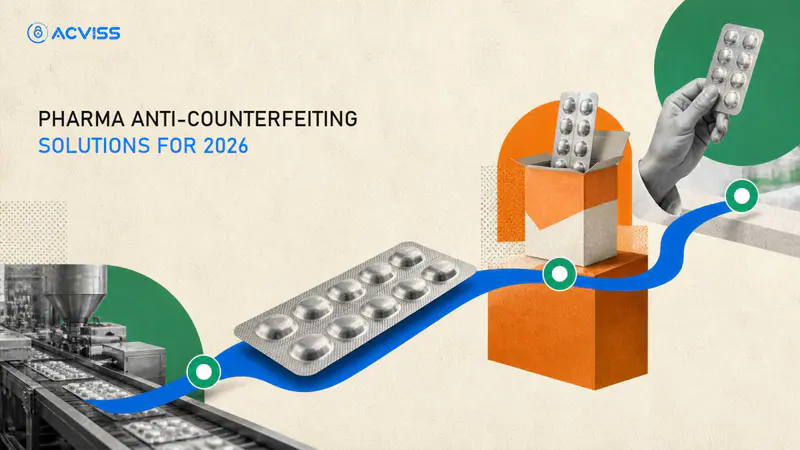
Anti-counterfeiting solutions for pharma combine four capabilities: unit-level serialisation and track-and-trace, non-cloneable product authentication on the pack, invisible marks a patient can verify with a phone, and AI-driven online monitoring that finds fakes across marketplaces. No single layer stops counterfeit medicines alone, so pharma companies in 2026 buy platforms that pair a physical pack identity with digital verification and supply-chain visibility. The stakes are clinical as well as commercial: the World Health Organisation estimates that at least 1 in 10 medicines in low- and middle-income countries is substandard or falsified (WHO, updated 2024, from a 2017 study), so patients swallow the wrong dose while brands lose revenue and trust.
TL;DR: Pharma anti-counterfeiting requires a layered approach: supply chain serialisation, pack authentication, and online monitoring. Driven by global regulations like US DSCSA, EU FMD, and India’s CDSCO, this guide compares five top solutions, including Acviss, across core security criteria.
Why Counterfeit Medicines Are Both a Patient-Safety and a Business Problem
Counterfeit medicine is a public-health crisis before it is a brand problem, and the two consequences travel together. When a patient takes a falsified antibiotic with no active ingredient, the infection goes untreated while the genuine manufacturer absorbs the blame, the recall, and lost prescriptions. The World Health Organisation estimates that low- and middle-income countries spend an additional USD 30.5 billion a year on substandard and falsified medical products (WHO), money drained from health systems that patients fund.
The trade is large and hard to trace. OECD and EUIPO put the global trade in counterfeit pharmaceuticals at up to 4.03 billion euros, about USD 4.4 billion, on 2014 to 2016 customs seizure data (OECD/EUIPO, 2020), and in that study 96% of seizures were small postal or courier parcels, with India and China named among the top producing economies. Fakes now reach patients as single parcels that skip wholesale checks, so protection has to live on the individual pack, not only in the warehouse.
India, named among those top producing economies, has measured its own drug-quality problem directly. The Government of India's national drug survey, run for the Ministry of Health and Family Welfare, tested 47,012 samples drawn from 654 districts and found 3.16% Not of Standard Quality and 0.0245% spurious (Government of India, PIB, 22 February 2017). Spurious means a deliberately falsified drug, and Not of Standard Quality means a batch that failed its specification, so an Indian protection system addresses both risks.
What Regulations Now Require Pharma Companies to Trace and Authenticate Drugs
Three regulators have turned traceability into a legal requirement, making 2026 a buying year. In the United States, the FDA's Drug Supply Chain Security Act requires an interoperable, electronic system to trace prescription drugs at the package level through the supply chain. In Europe, the EU's Falsified Medicines Directive has required a unique 2D-barcode identifier and an anti-tampering device on most prescription packs since February 2019, which pharmacies verify against a central repository.
India moved on its highest-volume brands. India's CDSCO has required a barcode or QR code carrying a unique product-identification code on the top 300 drug formulation brands for batches made on or after 1 August 2023. A printed barcode or QR code still copies as easily as any image, which is where authentication has to move beyond compliance.
What to Look for in an Anti-Counterfeiting Solution for Pharma
A pharma buyer is choosing capabilities, not one feature: the strongest platforms cover the pack, the supply chain, and the internet at once.
Unit-level serialisation and traceability. Serialising from unit to carton to pallet with parent-child aggregation lets a recall or diversion alert reach exact units, the DSCSA and CDSCO baseline that batch-only tracking cannot meet, and shortens the window a diverted lot stays in circulation.
Non-cloneable authentication, not a copyable code. A plain QR code or barcode is the vulnerable baseline anyone can photograph and reprint, so every copy scans as valid, while a pharma-grade mark carries a non-cloneable unit identity a photocopy cannot reproduce. That difference decides whether a scan in a patient's hand proves authenticity or clears a fake.
Frictionless consumer verification. Patients should confirm a pack in seconds by web, app, or WhatsApp with no app download, in local languages and offline, since a parcel-borne fake skips wholesale checks and makes the patient or pharmacist the last line of defence. In India, that reach matters most in Tier 2 and Tier 3 markets.
Online brand protection. Counterfeit medicines sell through marketplaces, social channels, and rogue domains beyond the physical supply chain, so the platform should monitor those channels and drive takedowns. A brand can secure every pack it ships and still lose patients to fakes bought online.
The Best Anti-Counterfeiting Solutions for Pharma Companies in 2026
The five platforms below cover the market from different angles, and the right pick depends on where a company sells and what it defends. The ranking favours breadth across physical and digital protection, then names where a specialist fits better.
1. Acviss: Omnichannel Protection With Unit-Level Non-Cloneable Identity
Acviss is an omnichannel brand protection platform that helps manufacturers protect products through non-cloneable authentication, supply chain traceability, AI-powered online brand protection, warranty management, and consumer engagement. For pharma, the Acviss Origin platform serialises products from unit to carton to pallet with parent-child aggregation and integrates with SAP, Oracle, and Microsoft Dynamics 365, so a recall reaches exact units. That granularity meets CDSCO's barcode mandate on India's top 300 drug brands, in force for batches made on or after 1 August 2023 (CDSCO, reported by Mint), which batch-only tracking cannot.
An Acviss non-cloneable identity gives each pharma unit an on-pack identity a photocopy cannot reproduce, which makes replication economically and physically impractical, not merely hard to fake. The Acviss Phantom Code mark hides that identity inside existing artwork for smartphone verification with no carton redesign, in regional languages including Hindi, Telugu, Marathi, and Punjabi, while Truviss monitors marketplaces, domains, and social channels with takedown workflows. Where a manufacturer's sole need is a large United States serialisation network at enterprise scale, a network-first compliance platform fits that one job more directly than the Acviss stack does.
2. TraceLink: Enterprise DSCSA Serialisation at Network Scale
TraceLink runs a SaaS serialisation and compliance network that it says connects more than 290,000 members and 3,500 manufacturing and distribution partners across two dozen-plus regulated markets (TraceLink). For a large multi-market DSCSA programme, that member reach makes TraceLink a strong fit at the case and pallet level. What TraceLink leaves to a dedicated layer is the covert, patient-checkable unit mark and the marketplace monitoring that catches fakes sold online.
3. Systech: Serialisation Paired With Brand Protection for Large Manufacturers
Systech, a Markem-Imaje company, brings pharmaceutical serialisation and track-and-trace for DSCSA and EU FMD together with product authentication and brand protection on one platform (Systech). A large US or EU manufacturer or CMO wanting serialisation and authentication from one vendor is Systech's natural buyer. Its lighter side for an India-first brand is CDSCO-specific depth and the WhatsApp and regional-language verification Tier 2 and Tier 3 markets rely on.
4. Ennoventure: Invisible Cryptographic Authentication in Artwork
Ennoventure embeds a patented invisible cryptographic signature into existing pack artwork that a smartphone verifies in seconds without an app, and says it works across 200-plus material combinations and 160-plus countries (Ennoventure). On invisible, no-redesign authentication, Ennoventure is the closest peer to the Acviss Phantom Code mark and a capable specialist where a covert mark is the whole requirement. The gap is the operational layer around a mark: unit-to-pallet traceability for targeted recalls, diversion alerts, and the marketplace monitoring Acviss runs around the same invisible principle.
5. Sproxil: Mobile Consumer Verification in Emerging Markets
Sproxil focuses on mobile product authentication, letting consumers verify a unique code to confirm a medicine is genuine, and adds a GS1-certified traceability product; it says it serves more than 200 brands over 15 years with strength in Africa (Sproxil). For African and emerging-market retail, that consumer-verification footprint is a genuine Sproxil strength. What it does not carry for pharma is a non-cloneable unit identity behind the code, or the marketplace monitoring and unit-to-pallet traceability a diversion alert or targeted recall depends on.
How a Pharma Pack Gets Verified Down to the Individual Unit
Acviss unit-level authentication is an auditable sequence. At production, each pack receives an Acviss non-cloneable identity, a Phantom Code mark hidden in the existing artwork or an Axion Label built into the pack, while Origin ties that unit to its carton and pallet. That unit-to-pallet chain delivers the package-level traceability the FDA's Drug Supply Chain Security Act requires across the US supply chain (FDA).
A pharmacist or patient then scans the pack with a standard smartphone, by app, web, or WhatsApp, with no download and even offline. That scan runs a cryptographic check against secure backend records, confirming the unit's own digital identity rather than a copyable pattern. When a lot moves off its route, Acviss Origin flags a diversion alert, so a recall reaches the exact units affected rather than a whole batch.
FAQ: Anti-Counterfeiting Solutions for Pharma
What are anti-counterfeiting solutions for pharma?
Anti-counterfeiting solutions for pharma are the technologies that prove a medicine is genuine and trace it through the supply chain, and the strongest deployments layer four. Unit-level serialisation gives every unit, carton, and pallet a serial identity so recalls reach exact units. Non-cloneable authentication gives each unit an identity a copied code alone cannot carry, consumer verification by app, web, or WhatsApp lets patients confirm a pack in seconds, and AI-powered online brand protection monitors marketplaces for fakes. Acviss delivers all four as one omnichannel platform.
Why is a QR code alone not enough to stop counterfeit medicines?
A QR code or barcode alone is not enough because it authenticates a reproducible design, not the individual unit. When a counterfeiter photographs a genuine code, that image reprints across a run of fake packs, since a printed code carries no secret a copier cannot duplicate. A compliance identifier proves where a pack should have come from, yet does not by itself stop a determined copier. Non-cloneable authentication answers this by giving each unit an identity a copy cannot reproduce, the principle behind Acviss marks such as the Axion Label security label and Phantom Code invisible authentication.
What regulations require pharma serialisation and traceability?
Three major regulations require pharma serialisation and traceability, all in effect for 2026. The US Drug Supply Chain Security Act requires an interoperable, electronic system to trace prescription drugs at the package level per the FDA, and the EU Falsified Medicines Directive has required a unique 2D-barcode identifier and an anti-tampering device on most prescription packs since February 2019 per the EMA. India's CDSCO has required a barcode or QR code on the top 300 drug brands for batches made on or after 1 August 2023, per Mint. Because a printed code still copies easily, manufacturers add non-cloneable authentication on top of compliance.
How big is the pharmaceutical counterfeiting problem?
The pharmaceutical counterfeiting problem is a public-health issue, not only a commercial one. The World Health Organization estimates that at least 1 in 10 medicines in low- and middle-income countries is substandard or falsified, based on a 2017 study, and that these countries spend an additional USD 30.5 billion a year on such products. OECD and EUIPO valued the global trade at up to 4.03 billion euros, about USD 4.4 billion, on 2014 to 2016 seizure data, with 96% of seizures small postal or courier parcels. Clinical impacts include untreated illness and drug resistance, business impacts recall costs and lost prescriptions.
What should a pharma company look for when comparing anti-counterfeiting vendors?
A pharma company should judge vendors against where it actually sells, not on a feature checklist alone. Map each option to the pack a patient holds, the supply chain a recall has to reach, and the marketplaces a fake sells through, then see which vendor covers all three rather than one. Acviss covers all three in one omnichannel platform, while several specialist vendors go deep on a single layer, so the honest question is whether one strong layer or full-stack breadth fits the channel.
Which anti-counterfeiting solution suits pharma companies in India?
For pharma companies selling mainly in India, the strongest fit is a platform aligned with CDSCO track-and-trace that also reaches Tier 2 and Tier 3 markets where fakes concentrate. That means unit-level serialisation for the top 300 brand mandate, non-cloneable authentication beyond a copyable QR code, and consumer verification by WhatsApp, web, or app with no download, in regional languages and offline. Enforcement is live: since December 2022, India's CDSCO and state regulators have run risk-based inspections of drug manufacturing and testing firms, inspecting 905 units and taking 694 enforcement actions such as Stop Production Orders and licence cancellations (Government of India, PIB, 12 August 2025).