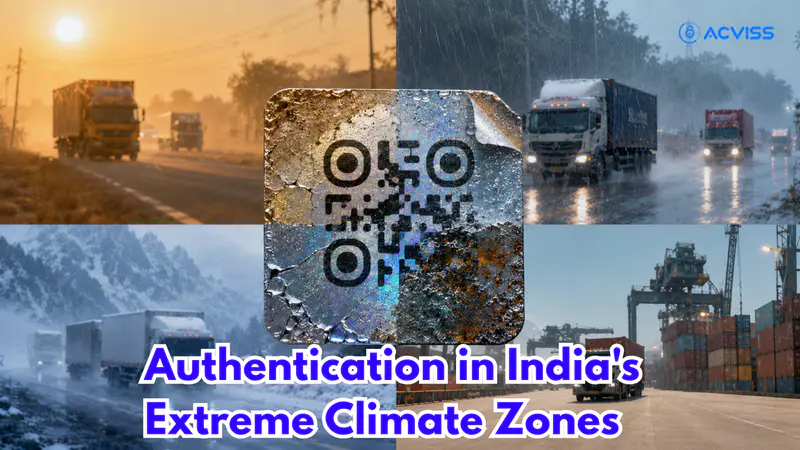
Authentication systems are often discussed as digital infrastructure problems. Yet across India, many authentication failures begin long before a QR code is scanned, a serial number is verified, or a counterfeit is identified.
They begin when the label itself stops functioning.
For brands operating across Rajasthan's deserts, Kerala's monsoon corridors, Himalayan cold chains, and India's extensive coastal distribution networks, authentication effectiveness is frequently determined by something far less glamorous than cloud platforms or AI-driven analytics: whether a label remains physically intact long enough to reach the consumer.
This is not merely a packaging issue. It is a brand protection, product authentication, compliance, and supply chain management challenge with direct implications for traceability, customer trust, warranty verification, recall readiness, and anti-counterfeiting performance.
The Assumption Most Authentication Programmes Get Wrong
Many authentication deployments begin with an assumption that once a label is applied, its physical integrity remains constant throughout the product journey.
Reality looks very different.
A pharmaceutical product manufactured in Gujarat may travel through ambient warehouses exceeding 50°C, move through humid logistics hubs in southern India, enter cold storage facilities, and finally reach retailers located in coastal environments with elevated salinity.
Throughout that journey, the authentication labels experience:
Thermal expansion and contraction
Humidity-driven adhesive degradation
Mechanical abrasion
UV exposure
Salt-induced corrosion
Condensation cycles
Packaging surface contamination
The result is often a gradual decline in label integrity in climate conditions rather than a sudden failure.
Authentication programmes frequently focus on digital security while overlooking environmental durability engineering.
Unfortunately, counterfeiters only need one weak point.
Why India's Climate Diversity Creates Unique Authentication Challenges
Few countries present environmental conditions as varied as India.
A single national supply chain may simultaneously operate across climate zones that would require completely different packaging specifications if assessed independently.
Most authentication labels are designed under laboratory conditions that do not adequately replicate these environments.
The consequence is predictable.
Labels that perform perfectly during pilot programmes often fail after national deployment.
The Desert Heat Problem: When Authentication Labels Encounter 45°C and Beyond

Packaging engineers have long recognised that heat affects adhesive behaviour. Authentication teams often underestimate how quickly these effects appear in real distribution environments.
Truck trailers, non-air-conditioned warehouses, container yards, and retail storage areas across northern and western India routinely experience temperatures well above ambient weather readings.
Internal package surface temperatures can exceed 60°C during peak summer periods.
What Happens to Authentication Labels in Extreme Heat?
Several failure mechanisms emerge simultaneously.
Adhesive Softening
Pressure-sensitive adhesives depend on carefully balanced viscoelastic properties.
At elevated temperatures:
Adhesive cohesion weakens
Edge lifting begins
Label migration occurs
Permanent adhesion strength decreases
What starts as a minor edge lift can eventually expose security features to tampering.
QR Code Substrate Distortion
Many authentication systems rely on printed QR codes.
However, heat affects substrate stability.
Common issues include:
Shrinkage
Surface warping
Print distortion
Scanner readability reduction
Even slight geometric distortion can affect scan reliability, particularly when low-cost smartphone cameras are used for verification.
Hologram Delamination
Multi-layer security labels often incorporate holographic foils.
These constructions depend on adhesive bonds between several material layers.
Extended heat exposure can lead to:
Foil lifting
Optical distortion
Surface bubbling
Complete layer separation
A hologram designed to demonstrate authenticity may become unreadable before the product reaches the consumer.
The Operational Impact
Authentication failure creates more than customer inconvenience.
It introduces:
Customer service escalations
Increased warranty disputes
Distributor complaints
False counterfeit reports
Reduced consumer confidence
Ironically, authentic products may begin appearing suspicious simply because environmental conditions damaged their authentication features.
The Monsoon Problem: Humidity Is Often More Destructive Than Heat

Heat is visible. Humidity is deceptive.
Across Kerala, coastal Karnataka, West Bengal, Assam, and other high-moisture regions, authentication systems face a different threat profile.
Relative humidity levels frequently exceed 80%. During monsoon periods, packaging materials absorb moisture continuously throughout storage and transportation.
Understanding QR Code Humidity Failure
QR code humidity failure is becoming an increasingly relevant concern in authentication packaging in extreme weather environments.
The mechanism is relatively straightforward.
Moisture exposure causes:
Paper swelling
Surface roughening
Ink diffusion
Print contrast reduction
Authentication systems depend heavily on optical precision. As print quality degrades, scan reliability decreases. Consumers encountering repeated scan failures often abandon verification attempts entirely.
The authentication workflow effectively collapses.
Moisture-Driven Adhesive Failure
Humidity affects both labels and the surfaces they adhere to.
Moisture can migrate between:
Label layers
Adhesive interfaces
Packaging substrates
This often leads to:
Label lifting
Curling
Corner peeling
Reduced tamper-evidence effectiveness
For anti-counterfeiting solutions, this becomes particularly problematic because tamper indicators may activate unintentionally.
A genuine product can appear compromised despite never being opened.
Ink Bleeding and Variable Data Loss
Serialisation programmes rely on precise printing.
Batch numbers, unique identifiers, serial codes, and verification data must remain legible.
Excessive moisture exposure can cause:
Ink migration
Character distortion
Reduced contrast
Data readability issues
When serialised identifiers become unreadable, product traceability suffers.
That creates downstream challenges for recalls, audits, investigations, and compliance reporting.
Cold Chain Authentication: The Temperature Cycling Problem Nobody Talks About

Cold chain products introduce a distinct set of authentication challenges.
Vaccines, biologics, speciality pharmaceuticals, diagnostics, premium food products, and certain chemicals regularly move between refrigerated and ambient environments.
The focus usually remains on preserving product temperature.
Authentication durability receives far less attention.
Why Temperature Cycling Is So Damaging
Many cold chain products experience repeated transitions between:
Refrigerated storage
Transportation
Distribution centres
Retail environments
End-user handling
Every transition creates thermal stress.
Different materials expand and contract at different rates.
Labels, adhesives, packaging substrates, and security foils rarely behave identically.
Over time, this creates cumulative mechanical strain.
Condensation: The Silent Authentication Killer
The greatest threat is often condensation.
When cold products enter warmer environments:
Water forms on package surfaces
Adhesive interfaces become compromised
Security layers absorb moisture
Print quality deteriorates
Repeated condensation cycles accelerate failure significantly.
A label may pass factory inspection and warehouse quality checks yet fail during the final stages of distribution.
Implications for Pharmaceutical Compliance
Pharmaceutical authentication increasingly intersects with regulatory expectations around product safety, traceability, and verification.
The World Health Organisation has repeatedly highlighted the risks posed by substandard and falsified medicines. World Health Organization guidance on falsified medical products
When authentication systems become unreadable due to environmental degradation, distinguishing genuine products from suspect products becomes more difficult for pharmacists, regulators, distributors, and consumers.
Coastal Salt Air: An Underestimated Threat to Security Features

India's extensive coastline exposes products to conditions rarely considered during authentication design.
Salt-laden air accelerates degradation processes that conventional environmental testing often overlooks.
The issue affects:
Maharashtra
Goa
Kerala
Tamil Nadu
Andhra Pradesh
Odisha
Gujarat
Among others.
Metallic Security Features Face Unique Risks
Many authentication labels incorporate:
Holographic foils
Metallic threads
Reflective elements
Security laminates
Salt exposure accelerates:
Oxidation
Surface corrosion
Reflectivity loss
Optical degradation
Security features that rely on visual inspection become progressively harder to validate.
Distribution Reality Makes the Problem Worse
Coastal exposure rarely occurs in controlled laboratory conditions.
Products frequently encounter:
Open loading docks
Non-climate-controlled warehouses
Marine transportation
Extended port storage
Security features designed without salt-resistance considerations often degrade faster than expected.
The lesson from corrosion engineering is well established. Standards such as ISO 12944 corrosion protection framework increasingly emphasise cyclic environmental testing because traditional static testing does not accurately replicate real-world exposure conditions.
Authentication labels should follow the same philosophy.
The Material Science Layer: Designing Labels for India's Climate Extremes
Authentication performance depends heavily on material selection.
This is where many procurement decisions go wrong.
Brands frequently evaluate labels based on:
Unit cost
Print quality
Visual appearance
Initial adhesion
Long-term environmental durability often receives insufficient weighting.
Matching Materials to Environmental Exposure
Why Paper-Based Authentication Labels Often Struggle
Paper remains attractive due to cost and sustainability considerations.
However, paper labels face greater vulnerability to:
Moisture absorption
Dimensional instability
Surface damage
Print degradation
For high-risk authentication programmes, synthetic constructions often deliver superior durability.
The decision should be based on lifecycle performance rather than procurement cost alone.
Why Authentication Deployments Fail After Scale
Many pilot programmes succeed. National rollouts frequently expose weaknesses. Several recurring mistakes appear across industries.
Environmental Testing Is Too Limited
Authentication systems are often validated under ideal conditions.
Testing should simulate:
Heat exposure cycles
Humidity cycling
Salt fog conditions
Cold chain transitions
Mechanical handling
The packaging industry has already embraced accelerated environmental testing principles. Similar rigour should apply to authentication infrastructure.
Security Teams and Packaging Teams Operate Separately
Authentication decisions frequently sit within:
Digital transformation groups
Compliance departments
Label material decisions often belong to packaging procurement.
The disconnect creates risk.
Security architecture may be robust while physical deployment remains fragile.
Counterfeit Risk Assessments Ignore Environmental Variables
Many anti-counterfeiting strategies assess:
Parallel imports
Online marketplace risks
Supply chain leakage
Few explicitly evaluate environmental degradation risk.
Yet a damaged authentication system creates opportunities for counterfeit infiltration.
When verification reliability declines, counterfeit detection effectiveness declines alongside it.
The Digital Resilience Layer: Why Cloud-Based Authentication Matters

Physical labels will always face environmental limitations. The objective is not to eliminate degradation entirely. The objective is to maintain verification capability despite degradation. This is where cloud-connected authentication architectures provide significant advantages.
Physical Security Alone Has Limitations
Traditional security features often rely on visual inspection.
Examples include:
Holograms
Watermarks
Microtext
Colour-shifting inks
Once damaged, these features become difficult to evaluate.
The verification process depends heavily on human judgment.
Digital Authentication Adds Resilience
Modern authentication platforms can continue functioning even when labels experience partial degradation.
Capabilities may include:
Dynamic verification records
Cloud-based serial number validation
Consumer verification logging
Distributor authentication workflows
Acviss Certify combine non-cloneable label technology with cloud-based authentication infrastructure, allowing brands to maintain product verification capabilities even when physical labels experience environmental stress. When integrated with broader brand protection initiatives, customer engagement programmes, loyalty mechanisms, and track and trace systems, authentication becomes more resilient than purely physical security approaches.
The strategic lesson is clear.
Physical durability remains essential, but authentication resilience increasingly depends on combining material engineering with digital verification infrastructure.
Best Practices for Pan-India Authentication Deployments
Organisations deploying authentication at scale should incorporate environmental resilience into programme design from the outset.
Recommended practices include:
Before Deployment
Conduct climate-zone-specific testing rather than generic validation.
Simulate actual transportation and storage conditions.
Test multiple adhesive systems and substrate combinations.
Include scanner performance testing after environmental exposure.
During Rollout
Monitor authentication failure rates geographically.
Capture scan failure analytics by region.
Establish distributor reporting mechanisms.
Review warranty and customer service trends for verification issues.
After Deployment
Continuously refine label specifications.
Conduct periodic field audits.
Benchmark environmental performance annually.
Update the authentication architecture as climate exposure patterns evolve.
Authentication Infrastructure Must Be Designed for Geography, Not Just Security
The future of brand authentication will not be determined solely by stronger encryption, smarter AI models, or more sophisticated anti-counterfeiting technologies.
It will also be shaped by whether authentication systems can survive the environments in which products actually move.
As supply chains become more distributed, regulatory scrutiny around product traceability increases, and consumers rely more heavily on digital product verification, label integrity becomes a strategic component of brand protection rather than a packaging afterthought.
The brands that succeed will treat authentication as an integrated system combining material science, product authentication, track and trace infrastructure, supply chain management, and digital verification. Those that continue viewing labels as static packaging components may discover that their authentication programme fails long before the counterfeiters do.
Interested in learning more? Get in touch with us.
Frequently Asked Questions
Why do QR codes fail in humid environments?
High humidity can cause paper swelling, ink diffusion, reduced contrast, and substrate distortion. These changes reduce scan reliability and increase verification failure rates.
Are holograms sufficient for authentication in extreme climates?
Holograms remain valuable security features but can experience delamination, optical degradation, and corrosion under harsh environmental conditions. They work best when combined with digital authentication systems.
How does climate affect product traceability?
When serial numbers, QR codes, or authentication identifiers become unreadable, traceability records become harder to verify. This can complicate recalls, investigations, warranty validation, and compliance reporting.
Should authentication labels be tested differently for different regions of India?
Yes. Rajasthan, Kerala, Himalayan cold chains, and coastal regions present fundamentally different environmental conditions. Authentication packaging extreme weather testing should reflect actual deployment environments.