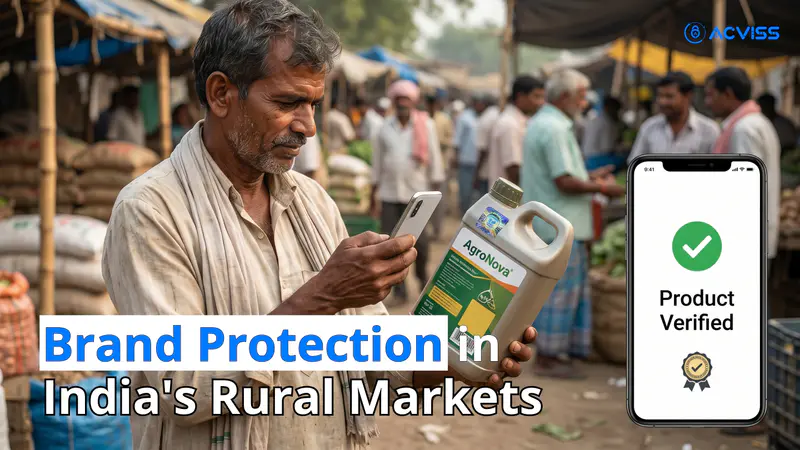
For most urban brand managers, what happens beyond the regional distribution in a supply chain is a genuine blind spot. The worst part is, in that blind spot, there’s one of the largest retail channels in the country.
India has roughly 47,000 weekly rural markets commonly known as haats or mandis. These markets collectively generate ₹50,000 crore in annual trade and serve close to half the rural population. Each haat draws between 4,000 and 10,000 buyers from 10 to 50 surrounding villages, once a week, for a few hours. Alongside haats, agricultural mandis serve as the primary channel through which seeds, pesticides, and fertilisers reach farmers at scale.
This is where real rural consumption happens. It is also where the haat market counterfeiting is most concentrated, most profitable, and least visible to brands.
The Market Your Brand Manager Has Never Visited
The gap in perception is significant. A brand team tracking sell-out data from organised retail has no view into what moves at a haat in Madhya Pradesh or a mandi in western Uttar Pradesh. The data does not flow back. There are no POS systems, no digital invoices, no return records. The products land, change hands, and are consumed, without leaving any traceable signal.
Rural India accounts for over 64% of national consumption expenditure. A meaningful share of that moves through haats and mandis, where brands have built distribution networks but have almost no authentication presence.
Surveys consistently show that farmers believe around 30% of agro products available in rural markets are counterfeit. FMCG brands collectively lose an estimated ₹2,500 crore annually to fake products in rural India alone. The question is whether your brand is doing anything about it at that level.
Why Haats and Mandis Are a Counterfeiter's Perfect Environment

Understanding the structural vulnerabilities of haats is the starting point for any serious rural market brand protection strategy.
Vendor anonymity is built into the format: A haat is a temporary market. Vendors arrive, set up makeshift stalls, and leave the same day. There is no permanent shop to raid, no licence to revoke, no address to trace. Between 2018 and 2025, Uttar Pradesh, Rajasthan, and Madhya Pradesh together accounted for roughly 46% of all counterfeiting cases reported across India. It is important to note that these are the states where haat density is highest.
Cash transactions eliminate the paper trail: No GST invoices. No digital payment footprints. No records linking a product to its point of origin in the counterfeit supply chain. Counterfeit FMCG products are typically priced about 19% cheaper than genuine ones, giving local vendors a margin advantage they can pocket or pass on.
Complaint rates are close to zero: If a fake pesticide fails to protect a cotton crop from whitefly, the farmer is likely to attribute the failure to weather, soil condition, or the crop itself. The brand never learns that the product failed, because there is no accessible helpline number and no consumer forum to approach. The brand never learns that the product was fake.
Seasonal demand removes scrutiny: Counterfeit networks are sophisticated enough to time their distribution. Fake agro inputs flood rural markets just before sowing season, when demand is at its peak, and farmers are buying urgently. Urgency compresses verification behaviour to almost nothing.
The Product Categories Most Exposed
Rural markets concentrate risk in specific product categories. The pattern is consistent: high purchase frequency, necessity-driven buying, and packaging that can be closely mimicked.
Agro inputs: This is the highest-stakes category. The bad part is, these agro inputs like counterfeit seeds, diluted pesticides, and adulterated fertilisers cost our farmers money as well as destroy an entire season's income.
In 2025, raids across Rajasthan uncovered over 30 factories manufacturing fake fertilisers using marble slurry, stone dust, and carcinogenic dyes, with fake products packaged under well-known brand names and destined for rural markets ahead of the sowing season. A single bad batch reaching a mandi can ripple across dozens of villages.
FMCG staples: They are targeted for their volume and brand recognition. Products like salt, edible oil, shampoo, soap, and packaged tea are counterfeited through two methods: lookalike brands with near-identical packaging (Eg, "Clinic Pluss" instead of "Clinic Plus"), or genuine empty packaging refilled with substandard product. The fake FMCG packaged food market is currently growing at 15% annually, faster than the legitimate market. The most targeted high-volume products include water, salt, flour, sugar, toothpaste, soap, and shampoo.
Personal care products: Products like fairness creams, hair oils, and skincare move heavily through haats and are counterfeited through near-identical packaging. The consumer base has limited brand verification behaviour, making detection unlikely at the point of purchase.
Electrical goods: Products like extension cords, bulbs, switchgear, and MCBs are sold in haats to rural contractors and households. Counterfeit electricals carry real safety risks, including fire hazards, but the purchase decision is made entirely on price.
What Works When Nothing Does
Most brand protection strategies are designed around urban assumptions. The consumer scans a QR code on the packaging. The app opens. The product is verified. Clean, fast, digital.
At a haat in rural Bihar or a mandi in Vidarbha, this breaks down at every step. Smartphone penetration is growing but uneven in deep rural pockets. 4G connectivity is patchy. Many buyers, particularly in older demographics, still use feature phones. Asking a farmer to download a verification app in a noisy, crowded market in the middle of a transaction is not realistic.
What rural market brand protection actually requires is authentication built for the lowest common denominator of both technology and connectivity.
A few mechanisms that hold up to these are:
Non-cloneable physical labels: It delivers a visual authentication signal without any device at all. A colour-shift or micropattern feature on a label that a trained eye, or a field rep's eye, can check on the spot. This is the baseline that works even where all other technology fails.
SMS and missed-call verification: This easily functions on feature phones over 2G. The consumer sends an SMS with a code printed on the pack. The system returns a simple text response, genuine or suspect. No app, no data connection required beyond basic SMS reach.
WhatsApp-based verification bots: They can operate on minimal data, available on even entry-level smartphones, and can return a response in the consumer's regional language. WhatsApp has over 500 million users in India and is the most accessible digital touchpoint in rural contexts.
Offline-capable field rep apps: Apps can have pre-synced product verification data and do not require live connectivity to authenticate a label in the field.
The critical principle here: the verification mechanism must work at the technology level that exists in the market, not the level that would be convenient to build for.
Equipping Field Reps to Verify at Haat Scale
Field sales representatives and territory managers are the most underutilised assets in rural brand protection. They are the only brand actors who actually visit haats and mandis with any regularity. With the right tools and the right incentive structure, they become the brand's primary verification layer in markets where consumer-side authentication is difficult.
Equipping reps for haat-level authentication.
First, an offline-capable verification app with pre-loaded product data, so connectivity gaps do not prevent a spot-check.
Second, visual authentication training. Teach reps to identify non-cloneable label features that distinguish genuine products from a superfake at a glance.
Third, structured reporting: every haat visit where a rep encounters a suspect product is a counterfeit intelligence event. Which market? Which SKU? Which price point? Which vendor type?
The incentive structure matters as much as the tool. If a rep's performance is measured purely on sales, there is no reason to spend time running authentication checks on a competitor's stall or flagging suspect products at the mandi. Incorporating haat authentication events into rep KPIs changes that calculation. The reps and the organisation must feel that rural market brand protection is a real job, not an afterthought.
Verified authentic sales recorded by the field rep at a haat can also trigger a consumer-side loyalty reward, creating a closed loop between field action and consumer engagement.
Consumer Education at the Point of Purchase
Consumer-side verification in low-literacy rural contexts is not just because of their literacy. Since the brands know their TG, it is the brand’s responsibility to design and structure the technology and process, keeping the situation in mind. The standard approach is "scan to verify authenticity", printed in small English text on the back of a pesticide bottle. They are functionally useless for a significant portion of the target audience.
What works is different in structure and in medium.
Visual authentication signals: Teach at the point of purchase rather than assume to be known. A haat-visiting consumer can be shown what a genuine label looks like, its colour, its texture, and a specific marking. That knowledge is retained and shared within the buying group. In haat environments, social proof travels fast. One literate buyer in a group who authenticates a product verbally validates the purchase for everyone around them.
Simplified response design: When doing SMS or WhatsApp verification, the return message should not be a paragraph of legal text. It should be a green tick or a clear statement in the consumer's language: "This product is genuine." Voice-note responses in the regional language work particularly well in low-literacy contexts, since they remove the reading requirement entirely.
Trust anchoring through local intermediaries: The local agro-dealer, the cooperative society, the village-level entrepreneur, these are the trusted figures in rural purchase decisions. Brand authentication messaging that comes through or is endorsed by a known local actor lands more effectively than direct brand communication.
Incentive design at the point of verification: The hard truth is that a consumer in a hat will not scan a code to check for fraud. They will scan a code to potentially win something. This is a user behaviour design, and a brand needs to capitalise on this.
How Rural Scan Data Becomes Brand Intelligence

In a rural supply chain, you know what leaves the factory, but tracking what actually reaches a remote mandi or village is incredibly difficult. Field authentication changes this and turns a security cost into a live market intelligence tool.
GPS Footprint: Every time a product is scanned by a field rep or a farmer, it creates a location-tagged data point. This maps exactly where your genuine stock is moving on the ground.
The "Zero Scan" Warning: If a high-volume territory suddenly shows zero scan activity during peak season, it acts as an early warning. It tells you that counterfeiters have hijacked the local demand.
Predictive Demand Tracking: Scan timestamps show you exactly when consumption happens. If distributor shipments are high but field scans stay flat, you can instantly spot product diversion or fake stock substitution.
Targeted Raid Allocation: Instead of guessing where fakes are sold, brands can use this scan density data to launch precise, targeted legal raids exactly where fraudulent activity is spiking.
How Acviss Helps
Certify
Certify by Acviss is a security solution that gives every single product a unique, un-copyable digital identity (like a highly secure QR code). It allows anyone to instantly verify it's 100% genuine with a quick smartphone scan.
Non-cloneable QR codes and physical labels that serve as a visual authentication layer, even without connectivity
Field rep and consumer-facing verification that works across low-tech environments
Real-time scan data with location tagging, feeding directly into brand intelligence dashboards
Bonus
Bonus by Acviss is a "scan-to-earn" loyalty program that instantly rewards customers, mechanics, or retailers with UPI cash payouts or points when they scan the Certify label to authenticate the product.
A loyalty reward engine that converts authentication scans into cashback or reward triggers
Works in cash-dominant markets through SMS and WhatsApp verification flows
Turns every verified rural consumer into an active participant in the brand's anti-counterfeit network
Value Outcomes
Fewer fake products are reaching farmers and rural consumers
Field rep scans events, building a verifiable map of genuine product reach
Counterfeit pattern intelligence feeds enforcement and distribution decisions
Consumer loyalty anchored to a verified, authentic purchase

Frequently Asked Questions
What makes haats and mandis more vulnerable to counterfeiting than urban retail?
Haats operate on cash, with rotating vendors who have no fixed address or traceable identity. There is no digital payment trail, no enforcement presence, and consumer complaint rates are close to zero. This combination gives counterfeiters near-total operational anonymity that organised retail does not offer.
Can product authentication work in areas with poor internet connectivity?
Yes, but the mechanism has to match the environment. SMS-based verification works on feature phones over 2G. WhatsApp bots function on minimal data. Non-cloneable physical labels provide a visual authentication layer that requires no device at all. The key is designing for the tech baseline that exists in the market.
How can brand field sales teams contribute to anti-counterfeiting efforts?
Field reps are the only brand presence that regularly visits haats and mandis. Equipped with offline-capable verification apps and visual authentication training, they can run spot-checks, flag suspect products, and generate counterfeit intelligence — location, SKU, price point — that feeds back into enforcement decisions.
Which product categories face the highest counterfeit risk in rural Indian markets?
Agro inputs (seeds, pesticides, fertilisers) carry the greatest danger because crop failure masks the fraud. FMCG staples like salt, edible oil, soap, and shampoo are targeted for volume. Personal care and electrical goods follow, with electrical counterfeits posing an additional safety risk.
How does rural scan data help brands make better distribution decisions?
Each verified scan is a GPS-tagged data point confirming genuine product reach. Patterns across scan timing and geography reveal where the authentic product is landing and where it is absent. Flat scan activity in a high-volume distribution zone signals either counterfeit capture or supply diversion.
What is the role of loyalty programmes in rural brand protection? Loyalty rewards — cashback triggered by an authentication scan — give the rural consumer a concrete reason to verify. The scan drives authentication in the background. If the product is fake, the reward is denied, and the consumer knows immediately. This converts price-sensitive rural buyers into an active verification network.