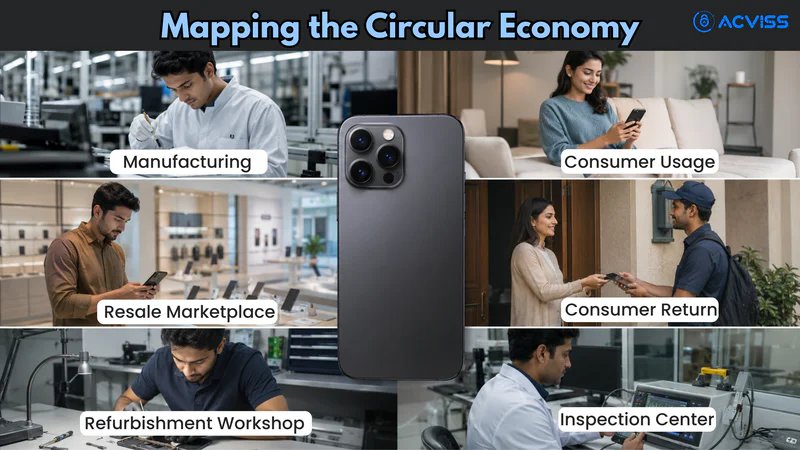
Most conversations about supply chain traceability follow a familiar script. A product is manufactured, packed, shipped, and sold. The job of traceability is to make sure it gets from point A to point B without being tampered with.
Today is the era of the circular economy, where products are designed to come back. Brands are building take-back programmes, refurbishment cycles, and recycling initiatives at scale. The global reverse logistics market was valued at USD 841 billion in 2024 and is projected to grow at a CAGR of 7.2% through 2034. But the traceability infrastructure brands rely on is built for a one-way journey.
When products start moving in loops, the traceability system can’t really trace returns or the backward cycle. Units come back. No one can confirm which are genuine, which have been tampered with, or which components were swapped. The platform, designed for forward flow, has nothing to say.
In this blog we will talk about why circular economy models create a fundamentally different traceability problem, where the gaps are, and what brands actually need to build to close them.
The Supply Chain Assumption That Circular Economy Breaks
Every traditional traceability system is built on one core assumption: a product moves from factory to consumer and stays there. The record ends at the point of first sale.
This works fine for a linear supply chain. But in the circular economy, which is based on the rules of reuse, refurbishment, remanufacturing, and recycling, it requires a product to maintain a verifiable identity across multiple use cycles. That is a structurally different problem.
Let’s take an example of a returned smartphone. When it enters a refurbishment centre, components are assessed, and some are replaced. The device is re-certified and resold. That single unit has now passed through at least five additional custody events after its original sale. A traceability system that closes its record at checkout has no visibility into any of them.
Here is what separates the two approaches:
The gap is not a minor technical detail. Running a circular economy on a linear traceability platform is like using a one-way street map to navigate a roundabout.
Traceability Goes Dark at The Reverse Logistics

The moment a product leaves its first consumer and enters a return, take-back, or resale flow, most traceability systems lose it. The product is no longer "new." Its serial number is no longer active in any forward-facing system.
This is where financial exposure begins. According to Deloitte, retailers lost more than USD 100 billion to return fraud in a single year, from customers returning used or counterfeit items and exploiting loose return policies. When the traceability infrastructure cannot authenticate what is coming back, the brand is exposed at exactly the point where the risk is highest.
The consequences stack up. Brands cannot verify whether a returned item is the same unit originally sold. They cannot confirm the condition's history. They cannot prove provenance to the next buyer. And if a refurbished version ends up back in the market, there is no chain of custody connecting the original manufacture to the resale.
For brands building circular economy programmes around sustainability commitments, this is not just a financial problem. The inability to verify what comes back undermines the programme's credibility with regulators and consumers alike.
Refurbishment and Remanufacturing: Where Counterfeits Get a Second Life
Most counterfeiting discussions focus on the forward supply chain. The circular economy opens a second entry point that gets far less attention: the point of disassembly.
When a product is broken down for refurbishment, its components enter an untracked pool. Batteries, chipsets, screens, mechanical parts- they all become individual items that can be assessed, replaced, or quietly swapped. If a third-party refurbishment partner handles this process, the brand is relying entirely on that partner's honesty and their own (often limited) component-level traceability.
This is where sophisticated supply chain fraud happens. A rogue refurbishment centre strips genuine high-value components, replaces them with cheaper counterfeits, and sends the "refurbished" unit back to the brand. The outer housing retains its authentic appearance, its original label, its real serial number. By the time the brand resells it as a certified refurbished product, a counterfeit component is already inside.
The Authentication Challenge for Returned Products
Authenticating a brand-new product in sealed, factory-fresh packaging is manageable. Authenticating a product that has already been used is a different challenge.
The packaging is gone. The printed serial number may be scratched or faded. The product has aged. If authentication depends on the outer box, the secondary market is completely unprotected. Most brands have not confronted this directly because their authentication infrastructure was built for the primary market.
For circular economy models to work, authentication markers need to be physically integrated into the product itself, designed to survive years of use. But durability is only half the requirement. The more important question is what that marker connects to.
A QR code or NFC chip on a returned product is only as useful as the record behind it. If that record is linear, it shows the product's origin and first sale, and nothing else. It tells you nothing about which components were replaced, how many times the product was returned, or whether it passed its last inspection. That is the information that makes a returned product trustworthy.
Verified returned product authentication requires event history, not just point-of-origin.
Persistent Digital Product Identity is the Infrastructure Circular Economy Actually Needs

A persistent digital product identity is a unit-level record that does not close when the product reaches its first consumer. It continues to log every custody and condition event across every use cycle.
This is different from standard serialisation, which records a unit's journey to the point of sale and stops. Persistent digital identity keeps the record open and adds new events every time the product returns, is inspected, is repaired, or is resold.
What that record needs to capture at each stage:
Manufacture: Materials, components, production batch, quality checks
Distribution: Custody chain, inspection records, geo-stamps
First sale: Point of sale, retailer, date
Return: Consumer scan, condition at return, reason for return
Inspection: What was checked, what was found, by whom
Refurbishment: Which components replaced, with what, sourced from where
Resale: Certified refurbished status, warranty, new owner registration
Regulators have already recognised this gap and are mandating the infrastructure to address it. The EU's Ecodesign for Sustainable Products Regulation (ESPR) introduces Digital Product Passports (DPPs) as a mandatory requirement across product categories including batteries (from 2027), textiles, electronics, and furniture, rolling out through 2029. The DPP is designed to carry exactly this kind of persistent lifecycle data so that recyclers, regulators, and consumers can make informed decisions at every stage of a product's life.
Blockchain is the right architecture for this layer. It provides immutable, multi-stakeholder write access with no single point of failure. Each new event in a product's circular journey can be added by a different party — the refurbishment centre, the logistics provider, the resale platform — and no single actor can retroactively alter the record.
What Take-Back Programme Operators Need from Their Traceability Stack
Running a credible take-back programme requires traceability infrastructure built for loops. Here is what it actually needs to do:
1. Unit-level serialisation that survives the first sale
Batch-level tracking is not enough. Every unit needs a unique digital identity that remains live after it leaves the first consumer.
2. Consumer-facing authentication at the point of return
When a customer brings a product back, a scan should immediately confirm what that unit is, when it was made, and whether it has been returned before. This closes the fraud loop and builds programme confidence.
3. Inspection event logging
Every time a returned product is assessed, the outcome needs to be recorded: condition grade, components checked, anomalies flagged. This makes refurbishment decisions auditable.
4. Refurbishment status records
What was replaced, what was retained, where replacement components were sourced. This is the layer that closes the counterfeit entry point at disassembly.
5. Resale certification trail
When a refurbished product returns to market, the buyer should be able to verify its entire history with a single scan. This is what makes "certified refurbished" a verifiable claim rather than a marketing label.
This infrastructure is most critical for electronics brands with certified refurb programmes, FMCG brands managing packaging take-back under Extended Producer Responsibility rules, and pharmaceutical companies with returns and waste compliance obligations.
The ESG Reporting Bonus: Circular Traceability as a Disclosure Asset

There is a secondary benefit to building circular traceability infrastructure. It automatically generates the auditable data that ESG frameworks require.
The EU's Corporate Sustainability Reporting Directive (CSRD), effective from January 2025, now applies to approximately 50,000 companies and mandates verifiable disclosures on circular economy practices. The operative word is verifiable. Stating that 40% of products were successfully recovered is a claim. Showing the scan records, inspection logs, and refurbishment events for each recovered unit is evidence.
Traceability data from a take-back programme directly populates the metrics that CSRD and GRI ask for: units recovered, refurbishment and reuse rates, recycled material volumes, and carbon saved per recovered unit. Product lifecycle data from DPPs feeds sustainability disclosures required under frameworks including GRI and CSRD, covering circular economy indicators, end-of-life waste metrics, and environmental impact data.
Without traceability infrastructure, circular economy commitments stay in the narrative column of an ESG report. With it, they move into the verified data column, which is where regulators and investors are now looking.
How Acviss Helps
We discussed about the problem and the solution. Now it is time to discuss about the medium through which you can get the solution. Acviss is India’s top counterfeit and brand protection brand with a suite of products in its library.
Acviss Origin
Acviss Origin is a blockchain-based supply-chain traceability product that gives you a microscopic view of your entire supply chain.
Here’s how Acviss Origin can help you with circular economy traceability.
Blockchain-enabled supply chain visibility at the unit level
Persistent product identity that tracks every custody and condition event across the full lifecycle, including returns, refurbishment, and resale
Tamper-proof, immutable records for audits and regulatory compliance
Multi-stakeholder write access so that every party in the circular supply chain can contribute to the record without any actor being able to alter it
Acviss Certify
Acviss Certify helps you with product authentication. When clubbed with Acviss Origin, your brand’s circular economy traceability becomes absolutely invincible.
Non-cloneable QR codes for on-product authentication designed to survive multiple use cycles
Consumer-facing verification at the point of return, enabling take-back programmes to authenticate products before they enter the refurbishment pipeline
Value Outcomes
Fewer counterfeit components entering the refurbishment pipeline
Certified refurbished claims backed by verifiable unit-level history
Audit-ready data for CSRD and ESPR circular economy disclosures
Full circular supply chain visibility from manufacture through resale
Securing the Full Lifecycle of Your Product
Circular economy commitments are accelerating across FMCG, electronics, pharma, and automotive. The ESPR, CSRD, and Extended Producer Responsibility frameworks are removing the option of treating this as a voluntary initiative.
The brands that will execute credibly are not necessarily the ones with the biggest take-back programmes. They are the ones who built their traceability infrastructure to handle a product's full life cycle, not just its first sale. Start with unit-level identity. Make sure that identity survives the product's first consumer. Log every event in the reverse flow with the same rigour you apply going forward. When you can do that, the circular economy becomes something you can prove, not just claim.
Interested in learning more? Get in touch with us
Frequently Asked Questions
What is circular economy traceability and how is it different from linear supply chain traceability?
Linear traceability tracks a product from manufacture to first sale and closes the record there. Circular economy traceability keeps that record open across the product's full lifecycle, logging every return, inspection, refurbishment, and resale event so that authenticity and provenance can be verified at any point.
Why does reverse logistics create a traceability problem?
Most traceability systems are built for forward flow and stop recording once a product reaches the first consumer. When that product re-enters the supply chain through a return or take-back programme, existing systems have no active record for it, making it impossible to verify the product's identity, condition history, or whether it is genuine.
How do counterfeit components enter refurbished products?
During disassembly for refurbishment, genuine high-value components can be replaced with counterfeits before the unit is reassembled. Without component-level traceability that logs which parts were inspected and replaced, the brand has no visibility into whether the refurbished product it is selling contains authentic components.
What is a Digital Product Passport and how does it support circular traceability?
A Digital Product Passport (DPP) is a mandated digital record under the EU's Ecodesign for Sustainable Products Regulation carrying persistent product lifecycle data including material composition, repair history, and end-of-life guidance. It ensures that product identity and data survive the full lifecycle rather than ending at first sale.
How does circular traceability support ESG reporting?
Circular traceability generates the verifiable, unit-level data that frameworks like CSRD and GRI require for circular economy disclosures. Scan records, inspection logs, refurbishment events, and recovery rates become auditable evidence rather than narrative claims, directly satisfying reporting obligations under CSRD and the ESPR working plan.