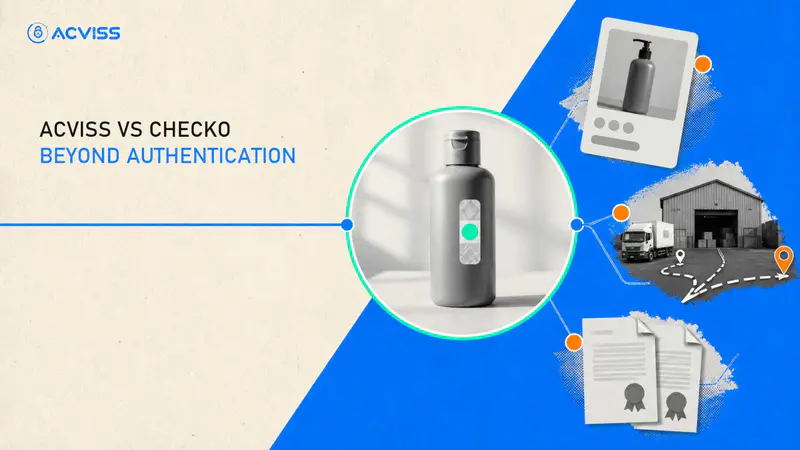
A brand ships every pack with a secure, non-cloneable label. Months later, the fakes are still out there. Not on the shelf where the label sits, but on a marketplace listing nobody approved, in a territory a distributor was never meant to supply, and on a warranty claimed twice against the same unit.
Here's the uncomfortable part: every time someone scanned the real label, it worked exactly as promised. The counterfeits simply showed up everywhere the label was never asked to look.
That gap is really the whole story of choosing an anti-counterfeiting vendor. A good label proves the pack in a buyer's hand is genuine. It does not tell you which unit this is, where it travelled, or what is being sold under your name in places where no label exists. Those are separate jobs. They just tend to get sold to you as one word.
Acviss and Checko are two names that land on most Indian brands' shortlists. Both make a physical, unit-level label that a smartphone can verify and that resists copying. The interesting question is not whose label is better, because both are strong. It is what each vendor does about the half of the problem the label never touches.
Follow one bottle off the line, and the job quietly splits in two
Picture a single bottle leaving your production line. Two different things need to be true about it, and it is easy to assume they are the same thing. They are not.
Identity: which bottle is this? It needs a code that says which unit it is, which case and pallet it belongs to, and every checkpoint it has passed since it was made. That is what lets you pull back one lot in a recall instead of a whole month's output, prove the chain of custody to a regulator, and notice when a unit meant for Chennai gets scanned in Delhi.
Genuineness: is this bottle real? Someone holding it needs to confirm the label itself is authentic by testing a physical property of the label, not just the data printed on it. That is the part that survives a photograph and a reprint.
Miss either one and a counterfeiter walks straight through the gap. A code on its own can be copied onto ten thousand fakes, and they will all pass a scan until duplicate-detection flags the collision, which is usually after the goods have already sold. And a label can be perfectly genuine while telling you nothing about which warehouse a batch moved through or which distributor broke territory.
One bottle, two jobs. That split is the frame for everything below.
The first half: proving the pack in someone's hand is real

This is the half most vendors lead with, and for good reason. It is visible, it is provable in a demo, and it is where the clever engineering lives. It is also where Acviss and Checko are closest to a tie.
How Checko approaches it. Checko is the label brand of Transpacks Technologies, with roots in IIT Kanpur and technology developed at the National Centre for Flexible Electronics. Its label combines randomly generated three-dimensional physical features with a two-dimensional cryptographic code, printed in a proprietary ink. The three-dimensional part is built on what's called a physically unclonable function, or PUF. In plain terms: because the microscopic structure comes from randomness during manufacturing, it can't be reproduced deliberately, and a flat photocopy fails because the depth simply isn't there in a two-dimensional copy. The label goes on each unit at the packaging line, on paper, plastic, or paperboard, and can be applied by hand or by machine. Checko publishes a specific hardware floor for verification through its app, on smartphone cameras as low as 4 megapixels, working online or offline.
How Acviss approaches it. Acviss, a Bengaluru brand-protection company operating since 2016, builds the same guarantee into its Axion label but stacks it deeper. A cryptographically generated code is bound to an AI-derived fingerprint of the microscopic print variation unique to that one physical label, and the label carries more on top: guilloche engraving, hidden patterns, encrypted micro-textures, and more than a dozen covert layers that only the Acviss app or web verifier can read. Verification passes only when the layers agree independently, so a convincing visual copy with the wrong fingerprint fails. For premium SKUs where a visible sticker is itself a design cost, Phantom Code embeds the same protection directly into existing packaging artwork at prepress, with no sticker and no line change. Where a brand wants a visible holographic mark instead, Uniqolabel covers that. A shopper can check a pack through the app, a web page, or WhatsApp, with nothing to download, on an entry-level phone.
Both approaches are sound. Both make copying an individual identity economically impractical at scale, which is the honest way to describe any label of this class. If your requirement genuinely stops at proving a pack is real, you are choosing between two capable options, and the decision can come down to details like a published minimum-device spec or built-in augmented reality, both of which Checko documents openly.
For most brands, though, the requirement does not stop there. And that is where the two vendors stop looking alike.
The second half: everything the label never sees
Here is the half that rarely makes it into a product demo, because it is harder to show in five minutes. It is also the half that quietly costs brands the most.
The listing that was never labelled. Think about how a counterfeiter actually sells online. They don't try to beat your label, because they never bother applying one. They just post a product on a marketplace, spin up a lookalike domain, or run an ad, all for goods that carry no label at all. No amount of on-pack authentication reaches that listing. Clearing it is a completely different discipline. This is what Acviss Truviss is built for: 24/7 monitoring across marketplaces, lookalike domains, social platforms, app stores, and search ads, scoring each listing against more than 500 signals such as image matching, price, and seller history, then filing takedowns with the platforms, registrars, and ad networks. If you are watching fakes move on marketplaces and social feeds, the label and the takedown are two separate purchases, and only one vendor here runs both off the same data.
The audit you can't afford to fumble. When a regulator or an export customer asks who scanned what and when, "our sales dashboard says so" is not an answer that survives scrutiny. Acviss Origin handles the serialisation side of this: it issues GS1-compliant serial codes per SKU, links each unit to its case and pallet, pushes codes to line-speed industrial printers (working with existing Zebra, Domino, TSC, and Videojet hardware), and connects into SAP, Oracle, Microsoft Dynamics 365, and Salesforce. Every scan event is written to a permissioned blockchain, producing a tamper-evident, timestamped custody record, and that record exports in the formats used for EUDR, CDSCO, and GS1 reporting. Worth being precise about one thing: blockchain does not stop a counterfeit. It makes it hard to alter the record of events after the fact, so the audit trail holds up. The label stops the fake; the ledger defends the paperwork.
The recall that shouldn't cost you a month. Because Origin knows exactly which units belong to which lot, a recall can be scoped to the affected lot instead of a whole production run. It also keeps working when connectivity doesn't, capturing and verifying scans locally at a plant or field site and reconciling to the server once the network returns, so a scan is never lost just because the line kept moving. Most deployments reach a working pilot in about two weeks.
The scan that could be doing more. The same scan that proves a unit is genuine can also earn its keep. Acviss Bonus turns a verification into a loyalty interaction and first-party data capture, while Assist handles warranty registration and, importantly, warranty fraud, so the same check that proves a unit is real also stops it being claimed twice. Checko publishes a comparable set here too, with a loyalty and marketing automation platform, warranty validation, and augmented-reality content triggered after a scan. The practical difference is upstream: with Acviss, the scan that awards a loyalty point also writes a geo-tagged event into the custody record and feeds duplicate detection, so engagement and supply-chain intelligence run on one layer instead of two.
The questions that actually settle the decision

Since both labels resist copying, the physics is close to a tie, and the real choice lives in the second half. A short, honest checklist does most of the work:
Serialisation, spelt out. If GS1-level serial codes, unit-to-case-to-pallet aggregation, recall scoping, and ERP reconciliation are on your list, ask each vendor to demonstrate them directly, not describe them. This is exactly what a procurement buyer or export customer means when they ask to "see the serialisation."
Who holds your data. Ask where the reference database lives and what happens to your records if you ever leave the vendor. Get the export format and the data-return terms into the contract, not the sales deck.
The worst phone, the worst coverage. Test verification on the cheapest handset your customer actually owns, in the weakest signal your distributor actually works in. Not on the demo device in a boardroom.
The unlabelled listing. Ask plainly what happens to a fake listing that never carried a label. If the answer is that the label solves it, the vendor hasn't understood the online half.
Regulation in writing. No regulation requires a specific vendor, and any salesperson implying otherwise has just told you something useful about themselves. Confirm the current status, scope, and deadline of any rule with the issuing authority before you build a business case on it, and ask each vendor which export formats it actually produces.
Acviss and Checko, side by side
So which one fits?

The honest answer depends on where your problem actually stops.
If your need is authentication and little else, especially on very low-end devices or where augmented reality is meant to double as a marketing surface, Checko's published 4MP floor and documented AR engagement are specific, real strengths, and its academic lineage is genuine if that carries weight on your scorecard. Confirm the current scope directly, since consumer-engagement features move release to release.
If the requirement runs past the label, and for most mid-market and enterprise brands it does, the picture shifts. The moment you need units serialised for CDSCO or EUDR, a custody record that survives an audit, fakes cleared off marketplaces, and verification that doesn't die at the app store, you are buying the second half of the problem. Acviss covers that full scope on a single data layer and publishes the ISO 27001 and GS1 certifications an InfoSec team will ask for before it clears the purchase.
The deciding question isn't "whose label wins." It's whether proving a pack is genuine is the finish line, or just the start.
Frequently asked questions
What's the real difference between serialisation and authentication?
Serialisation gives each unit, case, and pallet a unique identifier and records its movements, so you know which unit this is and where it has been. Authentication tests a physical property of the item to prove it is genuine. The catch people miss: a serial number is only data, so it can be copied onto fakes, while a non-cloneable label resists copying but carries no custody history on its own. Brands facing both counterfeiting and channel diversion need both working together.
Are both labels genuinely impossible to copy?
No honest vendor should claim that, and neither of these does. Both build on the physically unclonable function idea, where identity comes from randomness in manufacturing rather than printed data, which makes copying an individual identity economically impractical at scale. That is the accurate way to say it. Any vendor promising a 100% guarantee is describing marketing, not a security property.
Does blockchain actually make a product harder to counterfeit?
No, and assuming it does is the most common mistake in this category. Blockchain doesn't authenticate a physical object. It creates a tamper-evident, timestamped record of events that is hard to alter later, which is what makes a custody trail defensible under audit. The counterfeit resistance comes from the label and its embedded code, not the ledger.
Can shoppers verify a pack without installing an app?
With Acviss, yes, through a web page or WhatsApp as well as the app. This matters more than it first sounds, because verification rates drop off sharply at the app store and a shopper deciding whether a pack is real usually won't install software to find out. Checko verifies through its own app and, to its credit, publishes support for cameras as low as 4 megapixels, which is a real accessibility commitment on the hardware side.
Which vendor fits CDSCO or EUDR compliance better?
Acviss Origin provides GS1-compliant serialisation, parent-child aggregation, and audit exports in the formats used for EUDR, CDSCO, and GS1, backed by a permissioned-blockchain custody record. Ask any vendor you shortlist which export formats it produces, and confirm the current status, scope, and deadline of any regulation with the issuing authority first, because no regulation requires a specific vendor and a product page is not a regulatory notification.