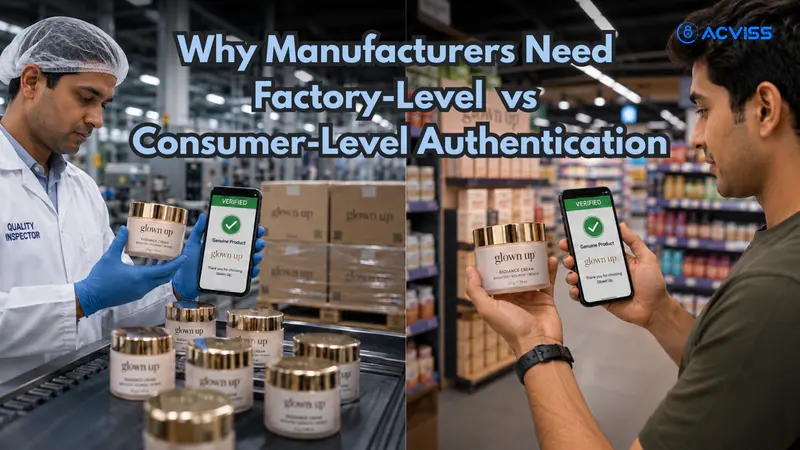
Product authentication is often viewed as the moment a consumer scans a code to confirm whether a purchase is genuine. While that final verification is important, it represents only one point in a product's journey. By the time a product reaches the consumer, it has already passed through multiple stages of production, packaging, warehousing and distribution, each presenting opportunities for errors, diversion or counterfeit infiltration that consumer verification alone cannot address.
Manufacturers that rely solely on consumer-facing authentication miss valuable opportunities to strengthen quality control, improve supply chain visibility and generate operational intelligence. A comprehensive authentication strategy begins inside the factory and continues until the product reaches the end user. Together, factory-level and consumer-level authentication create a continuous chain of trust that protects both the product and the brand.
Why Authentication Should Begin Before Products Leave the Factory
Many organisations associate product authentication with marketing initiatives or consumer engagement programmes. In reality, the greatest operational value often comes much earlier.
Factory-level authentication verifies products as they move through manufacturing, packaging and dispatch. Every authentication event confirms that the correct product, packaging and security label are being applied before the product progresses to the next stage.
This approach transforms authentication from a reactive exercise into a preventive control. Instead of waiting for counterfeit reports from the market, manufacturers can identify production anomalies before products leave the facility.
Factory authentication can support several operational objectives:
Verify that unique product identities are correctly assigned
Confirm that authorised security labels are applied
Prevent duplicate or invalid serial numbers from entering circulation
Record production, packaging and dispatch events
Build a reliable audit trail for compliance and investigations
For industries such as pharmaceuticals, automotive, electronics and agrochemicals, these controls improve both operational efficiency and regulatory readiness.
Factory-Level Authentication Creates Operational Intelligence

Authentication data collected during production serves purposes well beyond counterfeit prevention.
Every verified product provides information on when it was produced, where it originated, which production line handled it, and when it entered the distribution network. When combined with existing ERP or manufacturing systems, authentication events create an additional layer of supply chain intelligence.
For example, if a distributor reports suspicious inventory, manufacturers can compare authentication records against production and dispatch data to determine whether the products genuinely originated from their facility or entered the market through unauthorised channels.
Similarly, if multiple products carrying identical identities appear in different locations simultaneously, manufacturers can investigate potential cloning or diversion before the issue spreads further downstream.
Authentication, therefore, becomes part of operational governance rather than simply a customer-facing feature.
Consumer Authentication Completes the Visibility Chain
Factory verification establishes confidence during production, but it cannot confirm what happens once products enter the market.
Products pass through warehouses, distributors, wholesalers, retailers and, in many industries, parallel distribution channels before reaching consumers. Each handover increases the possibility of counterfeit substitution, grey-market diversion or unauthorised resale.
Consumer product authentication serves as the final verification step, allowing buyers to confirm authenticity via a smartphone or a web-based verification platform. At the same time, every successful verification generates valuable information for the manufacturer.
Rather than acting solely as an authenticity check, consumer authentication can reveal:
Where genuine products are being purchased
Unexpected geographical scan locations
Repeat verification attempts indicating possible duplication
Potential grey-market diversion
Customer engagement patterns
Warranty activation and post-purchase interactions
These insights allow manufacturers to monitor products beyond the factory gate and identify emerging risks much earlier than they can by relying on complaints or enforcement actions alone.
Factory-Level vs Consumer-Level Authentication

Although both approaches focus on product verification, they address different operational challenges and deliver different business outcomes.
Neither approach replaces the other. Instead, they create complementary layers of verification across the product lifecycle.
Why One Authentication Layer Is Never Enough
Manufacturers occasionally invest only in consumer-facing authentication because it delivers visible benefits such as increased customer engagement and product verification. While valuable, this strategy leaves significant gaps within production and distribution.
If authentication begins only after purchase, manufacturers lose visibility into what occurred during manufacturing, packaging and dispatch. Production errors, duplicate serialisation, or unauthorised label use may go undetected until products have already entered the market.
Conversely, relying only on factory authentication provides confidence that products left the manufacturing facility correctly, but offers little visibility into diversion, counterfeit substitution or unauthorised resale occurring further along the supply chain.
This distinction is particularly important for industries with complex distribution networks. Genuine products intended for one market may be diverted to another, discounted inventory may enter unauthorised retail channels, or counterfeit goods may replace authentic products during distribution. None of these scenarios can be identified solely through factory controls.
An effective brand protection strategy, therefore, treats authentication as a continuous process rather than a single verification event. Every authenticated interaction contributes another piece of evidence, helping manufacturers understand not only whether a product is genuine, but also whether it is moving through the supply chain as intended.
In the next section, we'll explore how combining factory-level and consumer-level authentication into a single end-to-end strategy enables stronger product protection, better supply chain visibility and actionable intelligence across the entire product lifecycle.
Building an End-to-End Authentication Strategy
An effective authentication programme connects verification events across the entire product lifecycle rather than treating them as isolated checkpoints. Every scan, whether it occurs inside the factory or in the hands of a consumer, contributes to a single source of truth that helps manufacturers make informed operational decisions.
The objective is not simply to prove that a product is genuine. It is to understand where it has been, whether it has followed the intended distribution path, and whether any unusual activity requires investigation.
A practical end-to-end authentication strategy typically includes:
Secure product identity: Assign a unique, non-cloneable identity to every product unit.
Factory verification: Authenticate products during production, packaging and dispatch to ensure correct labelling and serialisation.
Supply chain visibility: Capture verification events at warehouses, distribution centres or other critical checkpoints where feasible.
Consumer authentication: Enable end users to verify authenticity through a simple and trusted verification process.
Continuous monitoring: Analyse authentication data to identify suspicious patterns, duplicate scans or unexpected product movements.
This layered approach provides manufacturers with visibility that extends beyond individual transactions, allowing them to identify risks before they become larger operational or commercial problems.
Strengthening Product Authentication with Acviss Certify
A successful authentication strategy depends on more than just assigning a unique code to a product. If the product identity itself can be copied, the verification system offers limited protection.
Acviss Certify addresses this challenge by combining non-cloneable security labels with digital product authentication and enterprise-grade data intelligence. Instead of relying on standard QR codes that can be photographed or reproduced, Certify uses patented security technology that makes duplication significantly more difficult while giving every product a unique digital identity.
Authentication begins inside the factory, where labels are applied and verified during production. This creates confidence that the correct security identity is attached to the correct product before it leaves the manufacturing facility.
Once products enter the market, consumers can authenticate them through a simple verification process. Each authentication event contributes additional intelligence, allowing brands to monitor product movement, identify unusual scan behaviour and understand how products are interacting with the market.
The value extends beyond counterfeit detection. Authentication data generated through Certify can support:
Supply chain visibility across production and distribution
Early detection of duplicate or suspicious verification attempts
Warranty verification using authenticated product identities
Consumer engagement and loyalty initiatives
Investigation of suspected product diversion
Data-driven decision-making based on real-world authentication activity
By combining physical product security with digital intelligence, manufacturers gain greater confidence in both product authenticity and supply chain integrity.
Common Mistakes That Limit Authentication Programmes

Many authentication initiatives underperform because they focus on technology without considering operational execution. Even sophisticated solutions can produce limited value if they are deployed without clear governance or defined business objectives.
Some of the most common challenges include:
Treating authentication purely as a marketing initiative. Product verification should support manufacturing, quality, supply chain and compliance teams, not just consumer engagement.
Using easily replicated identifiers. Standard QR codes or barcodes improve identification but offer limited protection against determined counterfeiters.
Collecting authentication data without acting on it. Verification events should trigger investigation workflows, risk assessments or operational reviews when anomalies are detected.
Ignoring supply chain partners. Distributors and logistics providers play a critical role in maintaining product integrity and should be included where appropriate.
Viewing authentication as a standalone solution. Effective brand protection combines authentication with traceability, online brand protection, investigation processes and warranty verification.
Technology is only one component of a successful programme. Governance, operational discipline and cross-functional collaboration ultimately determine its effectiveness.
A Framework for Enterprise Authentication
Manufacturers evaluating or expanding authentication programmes can use the following framework to assess their current capabilities.
Organisations that develop each of these capabilities create a far stronger foundation than those relying on a single authentication checkpoint.
Looking Beyond Authentication
Counterfeiters continue to adapt, while supply chains become increasingly complex and geographically distributed. As a result, authentication is evolving from a simple verification tool into a broader source of operational intelligence.
Manufacturers are beginning to use authentication data alongside traceability, online brand protection and warranty management to build a more complete picture of product integrity. Authentication events can reveal emerging counterfeit hotspots, identify unusual distribution patterns and support faster investigations when problems arise.
This shift also aligns with increasing regulatory expectations around product traceability, transparency and accountability. Businesses that invest in integrated authentication strategies today will be better positioned to respond to future compliance requirements while strengthening consumer trust and operational resilience.
Factory-level and consumer-level authentication should not be viewed as competing approaches. Together, they establish continuous product visibility, helping manufacturers protect their products long before they reach consumers and long after they leave the production line.
Interested in building an end-to-end product authentication strategy that strengthens brand protection and delivers actionable supply chain intelligence? Get in touch with the Acviss team to learn how Certify can help secure every stage of your product journey.