Electric mobility is no longer a future ambition. It is a present-day reality reshaping global transport, energy systems, and manufacturing. Governments are mandating electrification timelines, automotive giants are phasing out internal combustion engines, and consumers are increasingly embracing electric vehicles as the default choice.
Yet beneath this rapid transformation lies a largely underreported and deeply systemic risk. Counterfeit EV batteries, fake EV components, and unverified electronic systems are quietly entering the ecosystem at scale. Unlike counterfeit handbags or apparel, these are not products that merely dilute brand value. They are components that can fail catastrophically, endanger lives, and undermine trust in the entire EV transition.
This is not just a quality problem. It is a product safety crisis, a brand protection challenge, and a supply chain management failure unfolding in real time.
Why EV Components Are the Newest High-Value Counterfeit Target
The rise of counterfeit EV components is not accidental. It is driven by a perfect convergence of economics, complexity, and urgency.
Electric vehicle batteries represent one of the most expensive components in any EV. A genuine battery pack can account for 30% to 40% of the vehicle’s total cost. Replacement modules can run into thousands of pounds, making them prime targets for counterfeiters offering seemingly identical alternatives at a fraction of the price.
Global counterfeit trade already exceeds $467 billion, accounting for over 2.3% of global trade. Within this, high-value electronics and automotive components are among the fastest-growing segments. As EV adoption accelerates, counterfeiters are shifting focus from traditional sectors like fashion to high-tech domains where margins are significantly higher.
The secondary EV market is further amplifying this problem. Used EV sales have surged by over 50% in recent years, creating a growing demand for replacement parts, refurbished batteries, and aftermarket components. This demand is increasingly being met through informal and unregulated channels where product verification is virtually non-existent.
For counterfeiters, EV components present an ideal opportunity. High price gaps, limited consumer awareness, and technical opacity make it easy to replicate appearance while compromising functionality.
The Counterfeit Battery Cell Problem: When Visual Inspection Fails
Battery cells are the core of any electric vehicle. They store and release energy, regulate performance, and directly influence safety. However, they are also among the most difficult components to authenticate using conventional means.
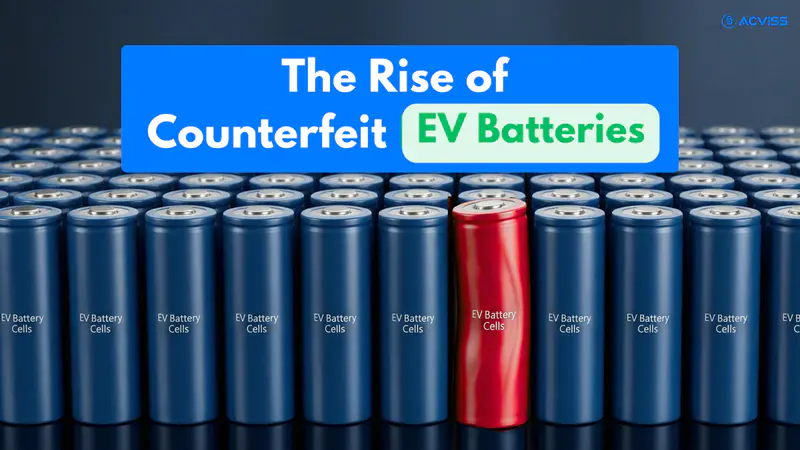
A counterfeit EV battery cell can look identical to a genuine one. Packaging, labels, and even serial markings can be convincingly replicated. For retailers, repair technicians, and end users, visual inspection offers no reliable method of product authentication.
The real differences lie beneath the surface.
Authentic lithium-ion cells incorporate multiple safety mechanisms. These include Current Interrupt Devices that disconnect circuits under pressure, Positive Temperature Coefficient systems that regulate current under heat stress, and precisely engineered anode and cathode alignments that prevent internal short circuits.
Counterfeit cells often eliminate or compromise these features to reduce manufacturing costs. Studies have shown defect rates as high as 15% in low-cost battery cells, particularly in critical parameters such as cathode alignment. These defects significantly increase the risk of internal short circuits.
When such failures occur, the consequences are severe. Thermal runaway events can cause temperatures to rise from 100°C to over 1000°C in a matter of seconds. These incidents are difficult to control, release toxic gases, and can reignite even after initial suppression.
From a product safety perspective, this represents one of the most dangerous forms of counterfeiting currently affecting global supply chains.
BMS and Charging Equipment: The Invisible Fire Risk

While battery cells receive the most attention, equally critical are the electronic systems that manage and support them.
Battery Management Systems (BMS) regulate voltage, temperature, and charging cycles. Charging equipment controls the flow of electricity from the grid to the vehicle. Both systems play a vital role in preventing overcharging, overheating, and electrical faults.
Counterfeit BMS units and charging components are increasingly entering the market, often labelled as “OEM compatible” or “equivalent replacements”. These components may function under normal conditions but fail under stress.
A compromised BMS may misread temperature data, fail to balance cell loads, or ignore early warning signs of failure. Similarly, substandard charging equipment can deliver inconsistent current, leading to overheating or electrical surges.
The result is not always immediate failure. In many cases, the damage accumulates over time, weakening battery integrity until a critical event occurs.
This makes detection even more challenging. Failures are often attributed to general wear and tear rather than counterfeit components, allowing the problem to persist undetected.
The Grey Import Channel
How Fake EV Components Enter the Market
The distribution of counterfeit EV components has evolved significantly in recent years. Traditional bulk shipments are increasingly being replaced by decentralised, small-parcel logistics.
Approximately 65% of counterfeit seizures now involve small parcels, making inspection more difficult and enforcement less effective. Components are often shipped in parts and assembled closer to the end market, reducing the risk of detection.
Online marketplaces play a central role in this ecosystem. Listings for “OEM compatible” EV battery modules have increased by over 50% year on year on several platforms. These listings often use AI-generated images, professional descriptions, and fabricated certifications to create an illusion of legitimacy.
Grey import channels further complicate the issue. Components enter markets through informal trade routes, bypassing regulatory checks and standard compliance mechanisms. Independent garages and repair centres, under pressure to reduce costs and turnaround times, may unknowingly source from these channels.
This creates a fragmented and opaque supply chain where product traceability is lost, and accountability becomes nearly impossible.
What OEMs and EV Brands Are Doing, and What Most Aren’t

Original Equipment Manufacturers are aware of the risks posed by counterfeit components, but responses remain inconsistent.
Some OEMs have introduced proprietary controls such as software encryption and VIN-based locking systems. These measures are designed to prevent unauthorised component integration and ensure that only approved parts are used.
While effective in theory, these approaches have unintended consequences. They increase repair costs, limit access to genuine parts, and push consumers and independent garages towards alternative sources. In doing so, they inadvertently fuel the counterfeit market.
A few forward-looking brands are exploring digital battery passports, blockchain-enabled product traceability, and advanced diagnostic tools. These initiatives aim to create a transparent and verifiable history for each component.
However, adoption remains limited. Most brands still rely on traditional compliance frameworks that do not address the authentication of individual components.
The gap between risk and response continues to widen.
The Certification Failure: Why Standards Are Not Enough
The EV industry is governed by a range of safety and performance standards. These include certifications for battery design, manufacturing processes, and operational safety.
However, these standards are not designed to address counterfeiting.
Certification frameworks validate products at the point of manufacturing. They do not ensure that the same product reaches the end user without substitution. Nor do they provide mechanisms for real-time product verification in the field.
Counterfeit components can carry forged certifications or reuse legitimate identifiers, making it difficult to distinguish them from genuine products.
This creates a false sense of security. Compliance does not equate to authenticity.
For industries such as pharma, where product authentication and track and trace systems are more mature, this gap has been recognised and addressed through regulatory mandates. In the EV sector, similar frameworks are still in their infancy.
What Part-Level Serialisation and Traceability Should Look Like
Addressing the counterfeit EV battery problem requires a fundamental shift in how components are identified, tracked, and verified.
Part-level serialisation is the starting point. Each battery cell, module, and electronic component must carry a unique, non-replicable identity that can be verified at any stage of the supply chain.
This identity must be linked to a digital record containing manufacturing details, quality certifications, movement history, and ownership data. Such a system enables end-to-end product traceability, ensuring that every component can be tracked from production to installation.
Track and trace technologies play a critical role here. By integrating serialisation with real-time data capture, brands can monitor component movement, detect anomalies, and prevent unauthorised substitutions.
Product verification must extend beyond internal systems to include external stakeholders. Repair centres, distributors, and even end consumers should be able to authenticate components using simple, reliable methods.
This is where advanced anti-counterfeiting solutions become essential. Solutions such as Certify, built on non-cloneable technology, provide a robust framework for electric vehicle parts authentication. By embedding secure, tamper-proof identifiers into components, brands can enable instant verification while ensuring that identifiers cannot be duplicated or reused.
When combined with broader supply chain management systems, such technologies create a unified approach to brand protection, product safety, and customer satisfaction.
Beyond Safety: The Broader Impact on Brand and Industry
The implications of counterfeit EV components extend beyond immediate safety risks.
For brands, the presence of fake components erodes trust, damages reputation, and exposes them to liability. Even when the counterfeit product is not manufactured by the brand, failures are often attributed to it.
From an IP protection and trademark protection perspective, counterfeit EV components represent a direct violation of intellectual property rights. However, enforcement alone is insufficient without proactive authentication mechanisms.
For consumers, the risks are both financial and physical. Lower upfront costs can translate into higher long-term expenses, reduced vehicle performance, and potential safety hazards.
At an industry level, widespread counterfeiting threatens to slow down EV adoption. Incidents involving battery failures or fires can undermine public confidence, particularly in emerging markets where awareness is still developing.
The Path Forward: Building a Secure EV Ecosystem

The transition to electric mobility is one of the most significant industrial shifts of our time. Ensuring its success requires more than innovation in battery chemistry or vehicle design.
It requires trust.
Trust that every component within an EV is authentic, safe, and compliant. Trust that supply chains are transparent and accountable. Trust that brands are actively protecting their products and customers.
Achieving this will require collaboration across manufacturers, regulators, technology providers, and marketplaces. It will require the integration of product authentication, product traceability, and brand verification into the core of EV supply chains.
Most importantly, it will require a shift in mindset. Counterfeiting is not a peripheral issue. It is a central challenge that must be addressed with the same urgency as technological innovation.
Conclusion
The counterfeit EV battery problem is not a distant threat. It is already here, growing alongside the very transition it threatens to undermine.
As electric vehicles become mainstream, the need for robust product authentication, supply chain traceability, and anti-counterfeiting technologies will only intensify. Brands that act early will not only protect their IP and reputation but also play a critical role in safeguarding public safety.
Solutions exist. Technologies such as non-cloneable identifiers, track and trace systems, and advanced product verification frameworks are already enabling a new standard of trust in complex supply chains.
The question is no longer whether this problem will escalate. It is whether the industry will respond in time.
Interested in learning more about how to secure your EV supply chain with advanced brand protection solutions? Get in touch with us.