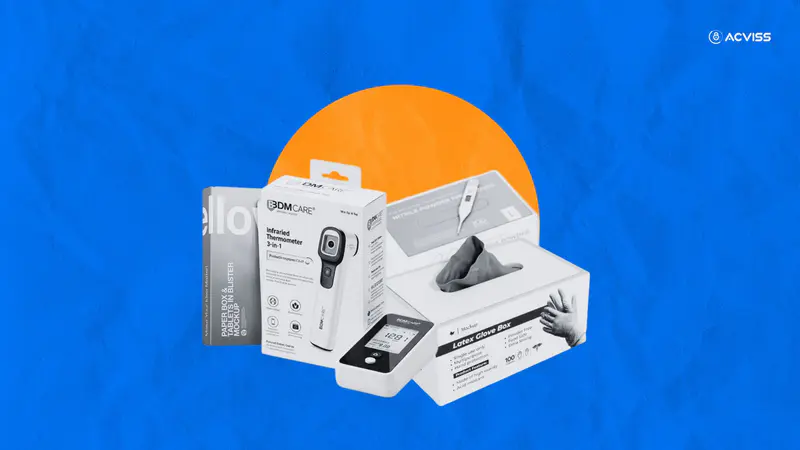
Introduction: Counterfeiting Is No Longer a Big Brand Problem
For years, counterfeit medical devices were seen as a problem limited to global giants and blockbuster product lines. That assumption no longer holds.
In the US, counterfeit medical devices are increasingly targeting mid-sized manufacturers.
Not because these companies are careless, but because they are growing faster than their infrastructure.
As production scales, distribution expands, and third-party logistics multiply, visibility weakens.
Counterfeiters follow these gaps.
For founders and supply chain leaders, the real risk is not whether counterfeiting will happen.
The risk is whether it will be detected before patients, regulators, or hospitals discover it first.
Why the US Market Is Especially Attractive to Counterfeiters
The US medical device market combines three factors that counterfeiters actively seek:
High unit value
Complex multi-tier distribution
Fragmented procurement across hospitals, clinics, and distributors
Add ecommerce channels, secondary resellers, and surplus markets, and the attack surface grows rapidly.
US FDA enforcement actions show a clear pattern.
Counterfeit devices are rarely detected at the manufacturing site.
They are discovered downstream, after distribution, when damage is already done.
Why Mid-Sized Manufacturers Are Now the Primary Targets

Counterfeiters are strategic.
They no longer focus only on the largest brands.
Mid-sized manufacturers are attractive because:
Brand recognition is strong enough to sell, but not strong enough to trigger constant scrutiny
Distribution networks are expanding quickly
Traceability systems are often partial or manual
Packaging security relies on serial numbers or static labels
Supply chain teams are stretched thin during growth phases
Scaling creates complexity.
Complexity creates blind spots.
Blind spots invite exploitation.
The Hidden Scaling Trap Most Founders Miss
Growth introduces risks that do not show up on revenue dashboards.
Common patterns seen in mid-sized medical device companies include:
Outsourced packaging or contract manufacturing without unit-level visibility
Batch-level tracking that stops at the warehouse
Limited visibility once products enter distributor or hospital inventory
Manual reconciliation between ERP, WMS, and shipping partners
No reliable way to verify whether a returned device is genuine
At a small scale, these gaps feel manageable.
At the national scale, they become systemic vulnerabilities.
Counterfeiters do not need to breach factories.
They exploit distribution ambiguity.
How Counterfeit Medical Devices Enter the US Supply Chain

Contrary to popular belief, most counterfeit devices do not enter through direct imports labelled as fake.
They enter through legitimate-looking paths:
Unauthorised resellers are mixing counterfeit units with genuine stock
Reuse of original serial numbers on cloned products
Refurbished or rejected units reintroduced as new
Diversion across regions with weak tracking controls
Hospital returns and secondary market leakage
Without unit-level traceability, these activities are nearly impossible to detect early.
The Regulatory and Business Impact Is Severe
When counterfeit devices surface, the consequences are not limited to lost revenue.
Mid-sized manufacturers face:
US FDA investigations and warning letters
Mandatory recalls that disrupt operations
Hospital trust erosion
Legal exposure related to patient safety
Damage to long-term brand credibility
Unlike large enterprises, mid-sized companies have limited buffers.
One major enforcement action can stall growth for years.
Why Traditional Controls Are No Longer Enough
Many manufacturers believe that compliance equals protection.
It does not.
Common controls that fail under scale include:
Paper-based batch records
ERP systems without field verification
Visual inspection at warehouses
Static serial numbers that can be copied
Distributor reporting without digital proof
Compliance ensures documentation. Traceability ensures control.
Without traceability, compliance becomes reactive instead of preventive.
Traceability as the Missing Infrastructure Layer
Traceability changes how risk is managed.
Instead of asking whether products are genuine after a problem appears, traceability allows manufacturers to:
Verify each unit digitally at any point in the supply chain
Detect duplicate serials or abnormal scan patterns
Identify where and when a suspicious unit entered circulation
Isolate affected lots without recalling everything
Provide regulators with verifiable, time-stamped evidence
This is not an IT upgrade. It is a risk management upgrade.
Why This Matters Specifically for Mid-Sized Companies
Large enterprises build traceability early because scale demands it.
Small companies rely on simplicity.
Mid-sized manufacturers sit in between.
They scale revenue first and infrastructure later.
This timing gap is exactly when counterfeit risk peaks.
Founders often assume traceability is something to implement after reaching a certain size.
In reality, it is needed during the transition phase.
Once counterfeits appear, implementing traceability becomes defensive and expensive.
Practical Signals That Risk Is Already Present
If any of the following are true, the risk is no longer theoretical:
You cannot verify a returned device at the unit level
You rely on distributors to confirm authenticity
You cannot see where individual units are after dispatch
You have multiple packaging partners without unified tracking
Your products appear on secondary resale platforms
These are early warning signs, not edge cases.
How Traceability Reduces Risk Before Regulators Get Involved

Traceability systems such as Acviss Origin allow manufacturers to establish unit level digital identity for every device.
This enables:
Authentication at any scan point
Real-time visibility across distributors and logistics partners
Detection of counterfeit or duplicated units
Evidence-based reporting during FDA audits
Faster and narrower recalls
The difference is timing.
Problems are detected internally instead of publicly.
Call to Action
Counterfeit medical devices in the US are no longer a future threat.
They are a scaling risk that mid-sized manufacturers face today.
If your growth has outpaced your traceability infrastructure, the question is not whether counterfeit risk exists.
The question is whether you will detect it first or the FDA will.
Acviss Origin helps medical device manufacturers build unit-level traceability across production, distribution, and post market channels, without disrupting operations.
Explore how Acviss Origin can help you stay ahead of counterfeit risk while you scale.