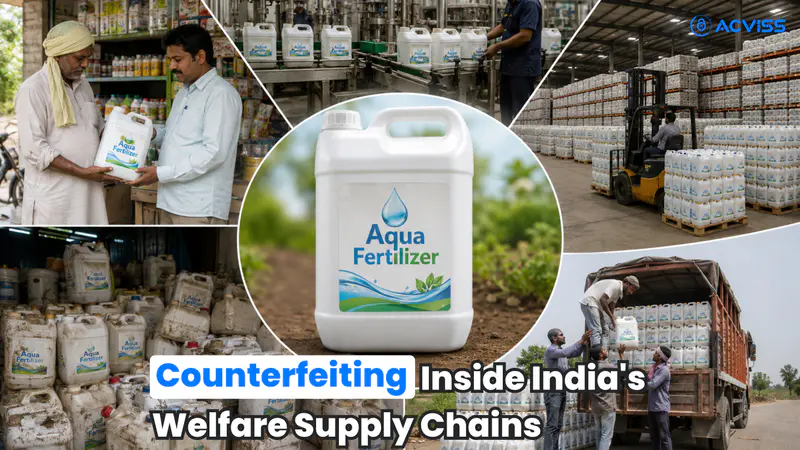
There are two parts in the world of counterfeiting. One is the most common one, where a luxury brand whose signature is replicated at scale; a pharmaceutical company whose medicines appear in grey markets; or a food company whose packaging is cloned for cheap shelf space. In this case, the victim is identifiable, the loss can be measured, and the complaint lands somewhere.
Now the other part of this world. Fraud has a way of finding spaces where complaints don't land. Where no one holds a receipt, no brand manager tracks returns, and where the signal for something going wrong is a failed crop or a ration bag that weighs less than it should. That space is larger than most people in supply chain and brand protection realise. And the supply chains it operates in are some of the most funded, most policy-backed, and least product-authenticated in the country.
This blog is about what happens when the money is genuine, the intent is real, and the product is not, and we will deep dive into another world of counterfeit that mostly goes unnoticed.
How Welfare Product Fraud Actually Works
When counterfeiting enters a government welfare supply chain, it operates through two distinct mechanisms. Understanding them separately matters because the response to each is different.
1. Substitution model: Genuine subsidised product is diverted out of the welfare chain and sold at a higher price elsewhere. A fraudulent or adulterated product is inserted. Everything like the packaging and weight is correct, but the product is not original.
2.Skimming model: Product is removed at one of the many nodes between procurement and distribution. A portion disappears at a warehouse, a vehicle, or a retail counter. The beneficiary receives less than they are entitled to. The product here is original, but not full quantity. The stolen quantity is then sold in the grey market.
Both models have one common thing. There is no unit-level traceability between the point where a product enters the government supply chain and the point where it reaches a beneficiary.
How is Subsidised Fertiliser Fraud Done
The economics of fertiliser fraud are straightforward. A 45-kg bag of subsidised urea is capped at ₹242 by the government. The same urea, redirected to industrial use in plywood, resins, or synthetic products, commands nearly three times that price. Cross-border markets in Bangladesh and Nepal add further premium. There is a huge price difference, and on top of that, there is no product-level tracking, which makes it quite an easy choice for the intermediaries to divert the products.
How diversionworks
Subsidised fertiliser exits the official chain at multiple points:
from wholesale depots before reaching retailers,
from retailers before reaching registered farmers, and
through registered farmers who may not cultivate at all.
The government's Integrated Fertiliser Management System (iFMS) and Aadhaar-linked Point of Sale devices capture who bought the bag. They do not capture what was inside it.
Some Opening Facts That Show the Problem is Serious
Raids across Rajasthan in July 2025 exposed over 30 factories producing counterfeit fertilisers from marble slurry, stone dust, and carcinogenic dyes, repackaged under legitimate-looking labels.
Factories in Jaipur, Kishangarh, and Sriganganagar were manufacturing products that degraded soil fertility on application. Separately, quality testing showed 60% of Diammonium Phosphate (DAP) samples failed to meet regulatory standards.
The Centre responded by filing 30 FIRs, cancelling 112 licences, and seizing 70,000 bags of suspected urea in a single enforcement sweep.
A new bill against fake agri-inputs was announced for the next Parliament session in December 2025. The enforcement machinery is active. The product authentication layer is absent.
What is PDS Counterfeiting
The Public Distribution System (PDS) counterfeiting is when the government supplies standard-quality grains like wheat or rice to the lower-income group via Fair Price Shops, but these products are either adulterated or replaced with sub-standard products when sold to the end beneficiary.
The Public Distribution System feeds over 800 million people through subsidised grain. Wheat at ₹2 per kg, rice at ₹3 per kg, or free under special schemes: these are products the bottom of the income pyramid depends on entirely, with no alternative market to turn to when quality fails.
The fraud mechanism inside PDS follows the substitution model closely. The Food Corporation of India (FCI) procures grain at standard quality. By the time it reaches a Fair Price Shop counter, dealers may have replaced the good stock with inferior grain and sold the original in the open market at a profit. Research by ICRIER and IFPRI found that 28% of grains distributed under PDS in 2022-23 did not reach intended beneficiaries, amounting to 20 million metric tonnes and a financial gap of ₹69,108 crore in a single year.
On the brighter side, technology has played its part. Digitisation has improved outcomes. Bihar reduced its leakage from 68.7% to 19.2% between 2011 and 2023. Even at 19.2%, nearly 1 in 5 units is still missing its intended destination, but this is proof that technology and the right solutions can solve this problem.
Why Government Supply Chains Are Structurally More Vulnerable

The reason there are frauds in the welfare supply chain frauds is not just because of enforcement gaps, but one of the major reasons is the poor structural characteristics.
Three factors consistently make government-linked supply chains more exposed than commercial ones:
Reverse incentive structure
No product authentication
Price difference
Let’s take a look at them one by one.
Reverse incentive structure
In a commercial supply chain, every node has a financial stake in delivering the correct product. A brand's margin depends on genuine products reaching consumers. When fraud occurs, revenue drops and the complaint chain activates.
In a government welfare supply chain, the intermediary carries no equivalent stake. A Fair Price Shop dealer earns a fixed margin regardless of product quality. A fertiliser retailer under government-mandated MRP operates on thin margins with light accountability. Ironically, there is an unsaid financial incentive if the intermediaries divert or substitute, but there is no financial incentive to protect product integrity.
No product authentication
This is the most critical structural gap. The DBT fertiliser system verifies buyers through Aadhaar-linked PoS devices. The NITI Aayog confirmed this reduced diversion in pilot districts. But Aadhaar verifies that a registered farmer stood at the counter. It does not verify that the bag handed over was genuine, correctly formulated, or untampered. This makes it easy for counterfeiters to deliver or substitute the product.
Price difference
Well, this one is mostly non-controllable, as the entire meaning of welfare depends on subsidising pricing for lower-income groups, which they otherwise can't afford. But this is the problem that one must know, and the only way to solve it is by good intent and active use of technology to control other factors that can be controlled.
The subsidy architecture creates structural arbitrage. Subsidised urea at ₹242 per bag, industrial urea at roughly three times that price, cross-border markets at higher still. The wider this gap and the lower the per-unit traceability, the more rational diversion becomes for those handling the product.
Who Gets Affected with Welfare Counterfeiting?
To put it in one simple line, the people who get affected by this are farmers.
When a counterfeit product enters a commercial supply chain, the feedback loop is short. A consumer complains. Returns spike. The brand investigates. The damage is documented.
When a counterfeit fertiliser, pesticide, or seed enters a welfare supply chain, the feedback loop spans an entire crop cycle. By the time the farmer understands an input has failed, the growing season has narrowed, the credit is spent, and the opportunity is gone. There is no return counter. And no complaint reaches back to the product's origin.
The aggregate damage from this delay is large:
A government-endorsed study by the Indian Chamber of Commerce found that India loses approximately 10.6 million tonnes of food annually due to counterfeit pesticides.
In 2017, 60% of Punjab's cotton crop was destroyed by fake or ineffective pesticides.
Cotton farmers in Sriganganagar and Hanumangarh reported lakhs of acres rendered unproductive by inputs that cleared every checkpoint before reaching them.
The human cost is deeper:
233 deaths from pesticide poisoning were recorded in Punjab between 2015 and 2018.
Farmer suicides in Odisha were attributed to crop failure caused by spurious inputs.
The government's subsidy funds the scheme, but the absence of product authentication funds results in fraud. The farmer absorbs the cost of both, while the fraudsters fill their pockets.
What Serialisation and Traceability Would Actually Change

Here’s what will happen if serialisation and traceability are actively inculcated in the welfare supply chain.
Product-level serialisation assigns a unique, unforgeable digital identity to each unit, like a fertiliser bag, a grain lot, a seed packet, at the point of manufacture.
Every movement through the supply chain is logged: manufacturer to depot, depot to district warehouse, district warehouse to retailer, retailer to beneficiary. Each scan creates an immutable record.
The substitution model will automatically break when every genuine unit carries a digital identity a counterfeit cannot replicate. A fake bag cannot carry a valid authenticated code. When a retailer presents a product for beneficiary delivery, the product itself is verifiable, independent of who is buying it.
The skimming model will break when every node handoff is recorded. A bag that leaves a depot must appear in a downstream scan. Its absence triggers a traceable discrepancy across the chain.
The supply chain traceability solutions that work on blockchain are extremely important, as these records make the entire trail tamper-proof. No single node can alter a transaction after the fact. Central ministries, state agencies, and audit bodies access the same data simultaneously, without intermediary curation.
Here are some implementation barriers that may occur:
Rural retailers in under-connected districts face genuine challenges with real-time verification.
Beneficiary-level scan verification requires smartphone access and basic digital literacy.
Inter-agency data sharing across central and state systems adds technical complexity.
Per-unit serialisation costs rise with coverage, and current procurement frameworks rarely account for this.
These are the same implementation barriers that pharmaceutical and FMCG serialisation mandates progressively resolved over a decade. The solution is there and has already been implemented in other industries. It has not yet been applied to welfare supply chains at scale.
What is Government Already Doing for this Problem and What's Still Missing
1. DBT in fertilisers, introduced in October 2016 and fully rolled out by March 2018, covers 14 crore farmers and 2.25 lakh retailers through Aadhaar-linked PoS. The NITI Aayog confirmed diversion fell in pilot districts. The problem is that it authenticates buyers, not products.
2. The One Nation One Fertilizer programme introduced uniform "Bharat" branding for all subsidised fertilisers. Without unit-level codes, a generic brand carries the same reproducibility risk as a named one.
3. Neem-coating on urea, mandated since 2015, reduced agricultural urea's value for industrial diversion. It works within its scope. When fraud migrates to DAP, NPK, and micronutrients, the gap opens again.
4. Jharkhand launched a blockchain-based seed traceability platform for government scheme seed distribution. It is early-stage and a meaningful proof of concept at state level.
The major missing factor:
The pattern across all of these is consistent. They address distribution efficiency and beneficiary identity. Product identity at the unit level is the layer that remains incomplete across every current intervention.
What is the Solution to the Welfare Counterfeit Problem?
Well, it is now well-established that the problem that we are discussing is not something for which the solutions need to be invented or discovered. There is a technology that works and has been deployed at scale in pharmaceuticals, food exports, and premium FMCG. What welfare supply chains are missing is the application of the same product-level authentication standard that commercial supply chains have been building toward for a decade.
The moment a subsidised fertiliser bag or a PDS grain lot carries an unforgeable unit-level identity, the substitution model loses its core advantage: invisibility. Diverted genuine product becomes traceable. Counterfeit products become identifiable. Skimmed quantities produce auditable discrepancies.
The infrastructure for beneficiary identity is largely in place. Product identity is the next, necessary step. And the longer it takes, the more profitable the gap between those two things becomes for everyone except the person the scheme was designed to protect.
Whether you operate in government-linked distribution, agri-input supply, or branded product channels, product traceability is the solution that keeps your supply chain protected.
Explore Acviss for end-to-end supply-chain and brand protection
Frequently Asked Questions
What is welfare product diversion in India's supply chains?
Welfare product diversion is the removal of genuine subsidised goods from government distribution channels, where products are sold in open or industrial markets at higher prices. The beneficiary either receives a counterfeit substitute or receives nothing, while fraudulent intermediaries capture the price differential.
How is subsidised fertiliser diverted or counterfeited before reaching farmers?
Subsidised fertiliser exits the official chain at depots, retail outlets, and registered farmer nodes. The price gap between subsidised rates and industrial markets drives diversion. Counterfeit stock made from marble waste, stone dust, or synthetic dyes is repackaged to resemble genuine products and substituted at the last mile.
What percentage of PDS grain does not reach intended beneficiaries?
An ICRIER-IFPRI study found 28% of grains distributed under PDS in 2022-23 did not reach intended beneficiaries. That amounts to 20 million metric tonnes of rice and wheat and a financial gap of approximately ₹69,108 crore in a single year.
How does product serialisation prevent counterfeiting in government schemes?
Serialisation assigns a unique, unforgeable digital identity to each unit at manufacture. Every supply chain movement is logged. A counterfeit product cannot carry a valid authenticated code, making substitution detectable at any scan point. Missing units in handoff records create traceable discrepancies that expose skimming.
What technology pilots are already underway to secure welfare supply chains?
Active initiatives include DBT in fertilisers with Aadhaar-linked PoS since 2016, the One Nation One Fertilizer branding programme, neem-coating mandates on urea, and Jharkhand's blockchain-based seed traceability platform. Each addresses distribution or beneficiary identity. Unit-level product serialisation remains the gap no current intervention has fully closed.