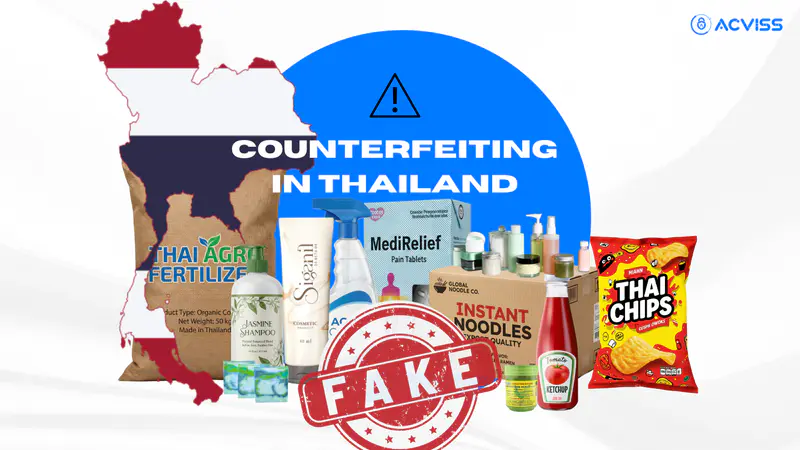
In August 2025, Thai authorities seized over 2.9 million counterfeit items worth more than 1 billion THB. But here's what didn't make headlines: a rice farmer in Isan lost an entire season's harvest to fake pesticides purchased from a seemingly legitimate distributor. The bottle was real. The label looked authentic. The chemical inside? Diluted and deadly to crops.
Thailand's reputation as the "Kitchen of the World" has made it ASEAN's food and manufacturing powerhouse. The same logistics infrastructure that powers exports also creates vulnerabilities. Between January and August 2025, counterfeit seizures increased by 27.11% compared to 2024. Enforcement is now targeting larger distributors rather than street-level sellers.
In this article, we're breaking down three specific counterfeit vectors hitting Thai manufacturers right now: refill syndicates, grey market leakage, and e-commerce impersonation, and what you can do beyond outdated holograms.
Thailand's Unique Position: A Double-Edged Sword
The Logistics Hub Paradox
Thailand sits at the centre of Greater Mekong Subregion trade, sharing 5,656 kilometres of land borders and 3,151 kilometres of coastline. This makes Thailand the distribution hub for Cambodia, Laos, Myanmar, and Vietnam, and creates entry points for counterfeit goods. Border zones like Mae Sot and Aranyaprathet process thousands of shipments daily, where counterfeit products slip through alongside genuine cargo.
The E-Commerce Explosion
Thailand's e-commerce market hit 1.1 trillion THB in 2024, projected to reach 1.6 trillion THB by 2027. Shopee commands 49% market share, Lazada holds 30%, and TikTok Shop has captured 21% with aggressive live-commerce strategies.
Research shows 62% of Thai consumers worry about counterfeit goods when shopping online, while 41% express concern about fake reviews. TikTok Shop presents unique challenges, like 83% of Thai consumers make purchases based on influencer recommendations, and live commerce formats make real-time verification nearly impossible.
The Traditional Trade "Lookalike" Culture
In rural Talad markets, "copycat brands" mimic packaging design and colour schemes while changing one or two letters in the brand name. These target consumers rely on visual recognition rather than verification. Products affected include instant noodles, beverages, personal care sachets, and agricultural inputs, where low-literacy consumers make decisions based on colour, shape, and familiarity.
The Three Critical Counterfeit Risks in Thailand
Based on recent enforcement data and market intelligence, three counterfeit methods are causing the most revenue loss and brand damage for Thai manufacturers. Each exploits a different weakness in the supply chain.
Risk #1: The "Refill" Syndicates (Agro-Chemicals & Liquids)

How the Scam Works
Criminals collect genuine used bottles of premium pesticides, fertilisers, or engine oils. They refill these containers with diluted or fake formulations, then reseal them with counterfeit tamper-evident labels. The scheme succeeds because the bottle is authentic, the weight feels right, and the label appears intact. Detection only happens after crops die or engines fail.
The Scale
The global counterfeit pesticide trade generates approximately €4.4 billion annually. Thailand ranks 18th globally in pesticide consumption and 5th in Asia. As recently as August 2023, counterfeit pesticides were detected on Lazada.
Impact
Revenue loss is immediate. Every refilled unit displaces a genuine purchase. Reputational damage follows when "your" product causes crop failure. Legal liability emerges even though the harmful product is counterfeit, and distributor trust erodes.
Risk #2: The Grey Market "CLMV Boomerang"
How the Scam Works
Manufacturers produce goods for the Vietnam, Cambodia, Laos, or Myanmar markets at lower price points. Criminals purchase these products legally in the designated market, then smuggle them back into Thailand through 5,656 kilometres of border. Once back, products are sold to distributors at "discount prices" that undercut Thailand's MSRP.
Why It Works
Products pass every authenticity check because they're real. Labels scan correctly. Quality matches expectations. The practice destroys authorised distributor pricing structures and creates internal competition between genuine products meant for different markets.
Impact
Grey market flow undermines price integrity across Thailand's distributor networks. When grey market products appear at lower prices, authorised distributors lose a competitive advantage. Compliance issues compound the problem; products sold outside their intended market often violate regional trade agreements. Supply chain visibility breaks down because these units never appear in official Thailand distribution records.
Risk #3: The E-Commerce Flood (Platform Impersonation)

How the Scam Works
Counterfeiters create seller accounts on Shopee, Lazada, and TikTok Shop that mimic authorised brands. They steal product imagery, copy descriptions, and claim "factory direct pricing" or "clearance stock." Some deliver counterfeits. Others collect payment and never ship.
Advanced operations create professional storefronts complete with purchased reviews, influencer endorsements, and polished live-commerce presentations.
Why It Works
Platform dynamics favour fast-moving sellers. TikTok Shop's live commerce creates urgency through countdown timers and influencers demonstrating products in real-time. Consumers make quick decisions based on social proof rather than verification. While platforms improved takedown tools in 2024-2025, sellers create new accounts faster than brands can report violations.
Impact
E-commerce counterfeiting creates direct revenue loss, customer experience damage when fakes fail, and platform management becomes a full-time job. IP infringement becomes difficult to prove when sellers use slightly altered logos. The challenge intensifies during 11.11 or 12.12 sales when order volumes surge.
Why Traditional Stickers and Holograms No Longer Work
Walk through Bangkok's Sampeng Market, and you'll find holographic stickers sold by the roll for 50 baht. If your security feature is accessible to counterfeiters at commodity prices, it's a decoration, not security.
Traditional methods fail on four levels:
1. Easy to Replicate: Standard holograms come from the same suppliers serving legitimate manufacturers and counterfeit operations. Without unique serialisation, there's no way to verify authenticity.
2. No Digital Verification: A shiny sticker provides one-way security. Consumers have no mechanism to verify authenticity, and manufacturers gain zero data about where products are scanned.
3. Tampering Without Trace: Heat guns remove even "tamper-evident" labels without visible damage. Without backend systems to track whether a label has been scanned multiple times, the tamper-evidence provides false assurance.
4. Zero Supply Chain Visibility: Static labels cannot enable geo-fencing or provide blockchain audit trails. As Thailand's exporters face stricter EUDR due diligence, static labels offer no documentation for regulatory requirements.
The Thai FDA has intensified enforcement throughout 2024-2025. For manufacturers, regulatory violations create "Loss of Face", where public scandal proves more damaging than official fines. Traditional security cannot protect against this modern landscape.
The Technology Shield: Moving from Protection 1.0 to 4.0
Thailand is positioning itself as an Industry 4.0 leader in ASEAN. Your brand protection strategy should match that ambition. Modern authentication and traceability technologies directly address refill syndicates, grey market leakage, and e-commerce impersonation.
Non-Cloneable Authentication: The Digital "Phra Kruang"
Thais understand authenticity verification intuitively. Sacred amulets (Phra Kruang) are examined under magnifying glasses for microscopic details counterfeiters cannot replicate. Modern product authentication applies the same principle digitally.
How Acviss Certify Works
Every product gets a unique, non-cloneable QR code.
Codes include hidden variations that can’t be copied by photos or reprints.
Customers scan with their phone camera—no app needed.
In seconds they see: genuine or suspicious, plus product info and warranty options.
What You Gain
Instant proof of authenticity for buyers.
Alerts when the same code appears in multiple locations.
Refill prevention: codes turn red after first use.
A scan page that doubles as a loyalty and engagement channel.
Blockchain Traceability: Your "Export Visa" for Trust
For Thai exporters, traceability functions as your product's passport. Just as an export visa proves you're authorised to enter the EU, blockchain traceability proves your product is authorised to be wherever it is.
How Acviss Origin Works
Tracks each unit from production to the end customer.
Records every supply-chain step on an immutable ledger.
Links units, cases, and pallets through serialisation.
Compliance Outcomes
Thailand received a "Low-Risk" designation under EUDR in May 2025, but exporters still need due diligence systems for rubber, palm oil, coffee, and timber. Deadlines are December 30, 2025 (large companies) and June 30, 2026 (SMEs).
Thai FDA inspections benefit from:
Faster recalls with precise batch tracking.
Clear chain-of-custody proof for Thai FDA checks.
Stronger due-diligence support for EUDR-covered exports.
Anti-Counterfeit Outcomes
Geo-fencing flags products in the wrong market.
Alerts for diversion outside authorised distributors.
Verified origin data for global buyers and partners.
Online Brand Monitoring
Automated online brand monitoring systems are necessary.
��Counterfeits now spread fastest online. Automated monitoring scans Shopee, Lazada, and TikTok Shop continuously.
Detects fake listings, pricing anomalies, and unauthorised sellers.
Spots issues within hours—not weeks.
Helps remove listings before large-scale damage occurs.
Bottom line:
You move from reacting to counterfeits to preventing them. Authentication, traceability, and monitoring work together to protect revenue, support compliance, and build consumer trust, at scale.
Actionable Steps for Thai Manufacturers
A phased approach works for both large conglomerates and mid-sized exporters.
Step 1: Audit Your Vulnerability

Map your distribution network. How many authorised distributors do you work with? Which borders do your products cross? What price differentials exist between Thai and neighbouring markets?
Check e-commerce platforms now. Search your brand on Shopee, Lazada, and TikTok Shop. How many unauthorised sellers appear? Review customer complaints—what percentage mention performance failures that might indicate counterfeits?
Step 2: Start with Serialised QR Codes

Begin with the highest-risk products—highest value, most counterfeited, or health-critical. Implement unique, non-cloneable QR codes on these lines first. Test with one production line before full rollout. Critical requirement: codes must be truly non-cloneable with backend verification integrating into your production data.
Step 3: Enable Geo-Fencing for Export Products

For products manufactured for Vietnam, Cambodia, Myanmar, or Laos, implement digital geographic tagging. Set boundaries—if scanned outside the intended market, the system generates alerts. Train distributors to verify products before accepting shipments.
Compliance bonus: this satisfies EUDR due diligence for forest-risk commodities. Deadlines: December 2025 (large companies), June 2026 (SMEs).
Step 4: Educate Your "Raan-Kha" (Traditional Trade)
Give small shops an incentive to participate: discounts for verified stock, loyalty points for scanning shipments, and priority access to promotions. Simple signage helps: "Scan to Verify Genuine Product." Train owners on spotting copycat packaging—colour variations, font differences, quality markers.
Conclusion
Thailand's path to becoming a true Industry 4.0 hub depends on more than smart factories and 5G infrastructure. It requires supply chain intelligence that can match the sophistication of modern counterfeiters.
Stop thinking of brand protection as a cost centre. Every verified scan represents a customer interaction. Every blocked grey market unit protects revenue. Every blockchain record serves as an insurance policy against recalls and compliance penalties. The ROI extends beyond prevented losses—it includes enhanced customer trust, distributor confidence, and regulatory goodwill.
Start small. Pick one high-risk product line, implement serialised authentication, and measure results over 90 days. You'll likely find that customers appreciate the transparency, distributors value the support, and your finance team notices the reduction in counterfeit-related returns and warranty claims.
As ASEAN integration deepens and e-commerce reaches every village in Thailand, the gap between protected brands and vulnerable brands will widen dramatically. The question isn't whether to upgrade your brand protection strategy—it's whether you can afford not to while competitors secure their supply chains and customer relationships.
Explore how Acviss helps Thai manufacturers protect revenue and build trust at acviss.com.
Frequently Asked Questions
What makes QR codes "non-cloneable"?
Standard QR codes can be photographed and reproduced. Non-cloneable QR codes use multi-layer random entropy patterns—microscopic variations that cannot be replicated through photography or printing. Each scan is verified against a secure database, and duplicate scans trigger alerts. This prevents the "screenshot and photocopy" tactic used by counterfeiters.
How does geo-fencing prevent grey market products?
When products are manufactured for specific markets (e.g., Cambodia), they're digitally tagged with geographic boundaries. If a consumer or distributor scans the product outside that designated region—say, in Bangkok—the system flags it as a potential grey market unit. This helps manufacturers enforce regional pricing and distribution agreements while maintaining supply chain integrity.
Can small Thai manufacturers afford blockchain traceability?
Modern traceability solutions are designed to scale. You don't need to implement full supply chain tracking on day one. Start with high-value export products where EUDR compliance is mandatory, then expand to domestic FMCG lines. The cost of a single product recall or counterfeit scandal often exceeds multi-year traceability investments.
How long does it take to implement product authentication?
For manufacturers with existing packaging lines, serialised QR code implementation typically takes 4-8 weeks from pilot to production. This includes ERP integration, staff training, and distributor onboarding. The key is starting with one product line to test workflows before scaling across all operations.
What should I do if I find counterfeit listings on Shopee or Lazada?
Document the listings immediately with screenshots, URLs, and seller information. Use the platform's IP infringement reporting tools—both Shopee and Lazada have dedicated brand protection portals. For persistent issues, automated monitoring services can detect and report counterfeit listings faster than manual searches, often catching problems within hours of posting.
Does blockchain traceability help with Thai FDA compliance?
Yes. Blockchain creates immutable audit trails for every supply chain event—manufacturing, packaging, distribution, retail. During Thai FDA inspections or recalls, you can instantly trace affected batches, demonstrate the chain of custody, and prove products moved through authorised channels only. This significantly reduces compliance risk and recall costs.