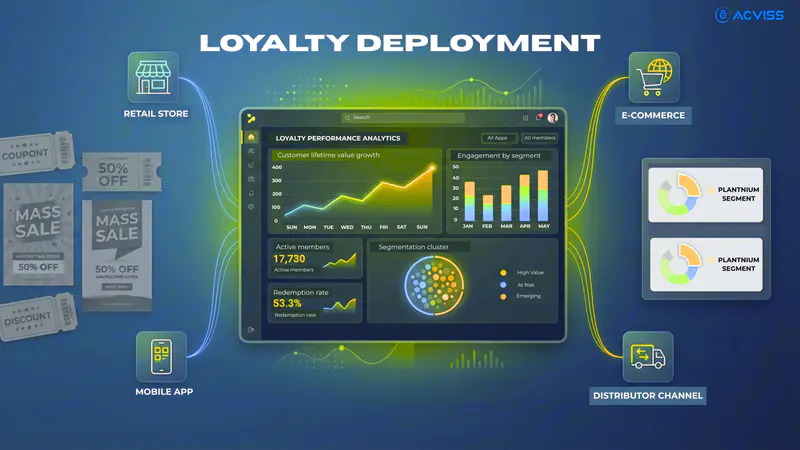
In a market where every percentage point of dealer engagement translates directly to revenue, brands can no longer afford to run loyalty programs on intuition alone. The evolution from gut-feel incentives to precision, data-driven loyalty represents one of the most significant competitive advantages available to manufacturers and distributors today.
This post unpacks the maturity journey that brands travel — from manual, ad hoc reward structures to fully instrumented, analytics-powered channel engagement — and illustrates the tangible ROI that companies unlock at every stage of the curve.
The Loyalty Maturity Curve: From Manual to Data-Driven

Most channel loyalty programs begin the same way: a sales manager with a spreadsheet, a gut feel about which dealers are worth extra attention, and a budget allocated primarily based on historical relationships rather than performance data. This is Stage 1 of the maturity curve, and while it's where almost every brand starts, it's also where millions of rupees in loyalty ROI are left on the table every quarter.
Stage 1 - Manual / Relationship-Based Loyalty
At this stage, engagement is reactive. Brands distribute rewards, cash bonuses, product samples, or branded merchandise, based largely on the loudest voice in the room or the most frequent caller. There is little to no systematic data collection. Performance benchmarks are vague, and attribution of dealer effort to actual sell-out numbers is nearly impossible.
Communication happens via phone calls, WhatsApp, or in-person visits.
Incentive structures are inconsistent across geographies and tiers.
No visibility into dealer inventory, secondary sales, or end-customer behaviour.
High risk of leakage: rewards reach the wrong people or go unclaimed.
Stage 2 - Semi-Structured / Rule-Based Loyalty
Growth-stage brands typically graduate to a semi-structured model where some rules are defined, for example, a dealer earns points for every unit purchased above a threshold, but the system still operates in silos. CRM data, sales data, and loyalty data exist in different places and are rarely reconciled in real time.
The key limitation at Stage 2 is that rules are built on assumed behaviour, not observed behaviour. Incentives are averaged rather than personalised, meaning high-performing dealers are often under-rewarded while low-potential accounts consume disproportionate budget.
Basic digital platforms for point tracking and redemption
Quarterly or monthly performance reviews with manual reconciliation
Some geographic segmentation, but limited dealer-level personalisation
Modest improvement in retention, but significant measurement gaps
Stage 3 - Data-Driven / Precision Loyalty
This is where Acviss operates. Precision loyalty means every reward, every communication, and every engagement touchpoint is informed by real-time data, from secondary sales signals and scan-based verification to dealer tier modelling and predictive churn indicators.
At Stage 3, brands can answer questions that were previously impossible: Which dealers are about to lapse? Which SKUs are moving fastest in which micro-markets? Which incentive mechanic drives the highest incremental sell-out per rupee spent?
Scan-to-earn mechanics linked to verified product movement data
Dealer segmentation is updated dynamically based on engagement signals
Predictive analytics to identify at-risk dealers before they churn
Full-funnel attribution from manufacturer to end-customer
ROI in Action: 4 Examples of Precision Loyalty Delivering Results
The business case for moving up the maturity curve is not theoretical. Across industries, from consumer durables to FMCG to pharma distribution, brands that have adopted data-driven channel engagement strategies consistently report measurable uplift across key commercial metrics.
EXAMPLE 1: Lamina Suspensions – Scan-Led Aftermarket Control
Deployed 150K+ non-cloneable codes across automotive SKUs, generating 35,136 successful scans and 25.65% MoM scan growth. Counterfeit signals became region-trackable, turning post-distribution into a measurable ecosystem.
EXAMPLE 2: Sturlite – Authentication Driving Engagement
2M+ labels deployed with instant QR verification and app-based rewards. Achieved 100% counterfeit detection success, 28% YoY earnings growth, and 600K+ redemptions without disrupting supply chain workflows.
EXAMPLE 3: Kitply – Revenue Recovery from Counterfeits
With 50% of products previously fake and ₹120 Cr annual losses, instant authentication enabled market recovery. Result: 4× market sales growth, 2× sales increase, and 30% ROI improvement.
EXAMPLE 4: K-ONN Electricals – New Brand, Early Protection
A newly launched electrical brand under the ₹300 Cr Kundan Group deployed authentication with rewards. Protected 100,000+ products, eliminated counterfeits across the supply chain, achieved 30% ROI growth, and onboarded 1,000+ users in the first year.
Read more about our implementation case studies.
Why Leading Brands Are Choosing Precision Over Broadcast
The shift toward data-led channel engagement is not just a technology trend — it reflects a fundamental rethinking of how dealer relationships create value. Broadcast loyalty (send the same offer to everyone and hope for the best) is being replaced by precision loyalty (deliver the right incentive to the right dealer at the right moment in their purchase cycle).
Leading brands choose this approach for three reasons:
1. Accountability replaces assumption
When every reward is tied to a verified action, a scan, a sale, or a registration, all these brands get clean attribution data. CFOs and CMOs can finally answer "What is our loyalty ROI?" with confidence rather than estimation.
2. Personalisation drives engagement velocity
Dealers who receive communications and incentives relevant to their specific business size, geography, and category mix are significantly more likely to act. Generic blast communications produce generic (low) response rates.
3. Competitive differentiation at the last mile
In categories where products are near-parity, the quality of the brand's channel engagement program can be the deciding factor in which product a dealer actively recommends to end customers. Precision loyalty gives brands a defensible edge at the last mile.
How Acviss Powers Precision Loyalty Deployment
Acviss brings together product authentication, scan-based verification, and a configurable loyalty engine to give brands the infrastructure they need to operate at Stage 3 of the channel engagement maturity curve.
Tamper-evident QR codes on every SKU enable verified sell-out tracking at the dealer level
Scan-to-earn mechanics eliminate manual claims and reduce processing overhead
A real-time dealer dashboard gives brand managers visibility into engagement heat maps
Integration-ready APIs connect loyalty data to existing ERP and CRM systems
Campaign configurability allows A/B testing of incentive mechanics across dealer segments
The result is a channel loyalty infrastructure that grows more intelligent over time, learning which mechanics work for which dealer segments and continuously refining how loyalty spend is allocated for maximum commercial return.
The Bottom Line
The maturity curve from manual to data-driven loyalty is not a question of "if" but "when." Brands that make the transition early build durable competitive advantages: better dealer relationships, sharper spend allocation, and measurable sell-out uplift.
Precision loyalty deployment is not a luxury for large brands. It's the operating standard that forward-thinking channel managers are setting today, and the baseline their competitors will have to match tomorrow. Ready to move up the maturity curve?
Acviss helps brands at every stage of the journey, from structuring your first scan-based incentive program to deploying full predictive dealer engagement analytics. Talk to our channel intelligence team at acviss.com