Product verification used to be a passive feature buried in packaging. A code was printed, a label was applied, and occasionally a customer might verify the product out of curiosity. For most brands, Product Authentication existed mainly to satisfy compliance expectations or to support internal Brand protection teams.
That model is quickly becoming obsolete.
Between 2025 and 2030, global supply chains will undergo a structural shift. Regulatory mandates such as Digital Product Passports, rapid advances in Artificial Intelligence and blockchain traceability, and the emergence of Ambient IoT are redefining how products are tracked and verified throughout their lifecycle. Authentication is no longer a backend compliance step. It is becoming a customer-facing experience that must be instant, intuitive and trustworthy.
The brands that succeed in this new environment will design Product Verification systems that are frictionless, messaging-based and deeply integrated with emerging technologies. Among these, WhatsApp-based authentication is emerging as one of the most powerful interfaces for real-world verification.
The Growing Importance of Frictionless Product Verification
The global counterfeit market continues to expand rapidly. Industry reports estimate that counterfeit trade is growing at a compound annual rate exceeding 13 percent, driven largely by e-commerce expansion and cross-border logistics.
At the same time, regulatory frameworks are tightening. Governments are demanding stronger Product traceability, better product safety oversight and more transparent Supply chain management.
For brands, the implication is clear. Authentication systems must work at scale, and they must work for real people.
A Product Verification process that requires app downloads, registration forms or multiple steps will fail to achieve adoption. Consumers expect instant answers delivered through familiar digital channels.
This is where WhatsApp-based authentication is transforming the verification experience.
Why WhatsApp is Becoming the Default Authentication Interface
Messaging platforms have quietly become the most widely used digital infrastructure in the world. WhatsApp alone serves more than two billion users globally, making it one of the most accessible communication tools available to brands.
From a Product Authentication perspective, WhatsApp offers a uniquely powerful advantage. It eliminates friction.
Instead of forcing consumers to install an unfamiliar application or navigate complex websites, the authentication process can happen within a messaging conversation that already feels natural.
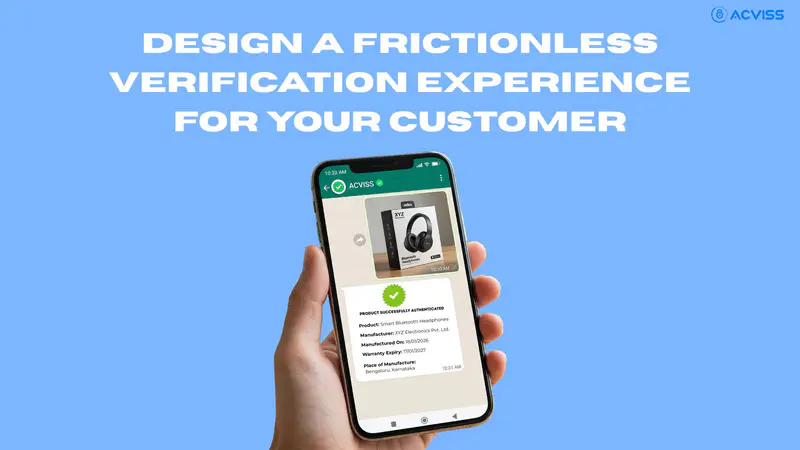
A typical WhatsApp verification journey works as follows:
The customer scans a QR code printed on the packaging.
The scan opens a WhatsApp chat with the brand’s verification system.
The consumer receives an instant response confirming Product Verification and Brand Authentication.
The interaction can also deliver additional information such as manufacturing origin, warranty eligibility or usage guidance.
This simple interaction removes the behavioural barriers that historically limited consumer participation in Product Authentication.
The Role of Messaging in Supply Chain Intelligence

WhatsApp-based verification does more than confirm authenticity. Each verification generates valuable data.
Every scan becomes a signal within the product lifecycle.
When aggregated, these signals provide insights into:
Geographic distribution patterns
Consumer engagement levels
Potential counterfeit hotspots
Diversion within Supply chain management networks
This real-time data strengthens Track and trace capabilities and enhances Product traceability across distribution channels.
For example, if a product manufactured for one market suddenly receives verification attempts in another region, the system can flag a potential diversion risk.
Such intelligence supports Brand protection strategies and helps companies intervene before counterfeit networks damage Trademark Protection or IP Protection efforts.
Regulatory Shifts Driving Verification Innovation
The push toward stronger Product Verification is not only driven by counterfeit threats. Regulatory pressure is accelerating the need for digital authentication systems.
One of the most significant developments is the introduction of Digital Product Passports under the European Union’s Ecodesign for Sustainable Products Regulation.
Digital Product Passports will effectively serve as a legal birth certificate for products. By 2026 and 2027, sectors including batteries, electronics and textiles will be required to maintain detailed digital records describing:
Product identification
Manufacturing carbon footprint
Recyclability metrics
Material origin
To support this requirement, products must carry unique identifiers that allow customers, regulators and supply chain partners to access lifecycle data.
QR codes, NFC tags and RFID identifiers will become critical components of this infrastructure.
WhatsApp-based authentication provides an intuitive interface for accessing these digital product passports, allowing consumers to verify authenticity while simultaneously viewing sustainability data.
NFC and the Multi-Purpose Tap Experience
Alongside messaging-based verification, Near Field Communication is gaining momentum as a powerful authentication technology.
The NFC Forum’s roadmap for 2026 introduces the concept of the multi-purpose tap. A single tap on a smartphone can trigger several actions simultaneously.
These actions may include:
Loyalty Program enrollment
Contactless payment
This unified interaction takes less than a tenth of a second to complete.
Retail analysts predict that NFC-based verification could increase conversion rates in physical retail by nearly 18 per cent by removing friction from both verification and payment processes.
For brands focused on Product Authentication and customer engagement, NFC represents a natural extension of scan-based verification.
Ambient IoT and Real-Time Product Monitoring

Another emerging technology shaping Product traceability is Ambient IoT.
Unlike traditional RFID systems that require dedicated readers, Ambient IoT devices harvest energy from surrounding radio waves. This enables battery-free sensors capable of transmitting environmental data such as temperature and humidity.
For industries such as pharma, where product safety depends on environmental conditions, this technology provides unprecedented visibility.
Real-time monitoring combined with Product Verification creates a powerful lifecycle intelligence framework. Brands can confirm not only that a product is genuine, but also that it has been stored and transported under appropriate conditions.
Such capabilities are particularly valuable for medical products and sensitive supply chains.
AI in Brand Protection
While consumer-facing verification ensures authenticity at the point of use, Artificial Intelligence is increasingly protecting brands behind the scenes.
Advanced image recognition systems based on Convolutional Neural Networks are now capable of detecting brand infringement with accuracy rates approaching 95 percent.
Major e-commerce platforms process millions of product images every day using these systems. Amazon alone evaluates more than two million new listings daily, reducing verification response times from several days to just a few hours.
This AI-driven surveillance helps identify counterfeit listings before they reach consumers.
Combined with consumer-side Product Authentication systems such as WhatsApp verification, AI monitoring creates a multi-layered defence against counterfeit networks.
Securing Verification with Non-Cloneable Identity
Convenience alone cannot guarantee effective authentication. The underlying security architecture must be resilient against duplication.
Counterfeit networks often copy static QR codes or serial numbers. If verification relies solely on printed identifiers, criminals can replicate those codes across thousands of fake products.
Certify by Acviss addresses this challenge through non-cloneable identity technology.
Each product receives a unique digital identity that cannot be replicated through simple copying. When a consumer verifies the product using WhatsApp or a scanning interface, the system checks the authenticity of that identity in real time.
If a duplicate appears in multiple locations, the system detects the anomaly immediately.
This protects Brand Verification, strengthens Trademark Protection and reinforces IP Protection strategies.
Connecting Verification with Customer Engagement

Authentication should not be treated as a defensive measure alone. When designed correctly, Product Verification can become a powerful engagement channel.
Consumers who verify a product through WhatsApp can be invited to:
Register for warranty services
Join loyalty programmes
Receive product usage guidance
Access sustainability information
This interaction improves customer satisfaction and creates a direct relationship between the brand and the end user.
In markets where counterfeit products are common, the ability to confirm authenticity instantly also reinforces consumer trust.
The Future of Zero-Trust Supply Chains
The evolution of Product Authentication is part of a broader shift toward zero-trust supply chains.
Under this model, authenticity is never assumed. Every product identity must be verified continuously throughout its lifecycle.
This approach relies on several interconnected technologies:
Scan-based Product Verification
Messaging-based authentication interfaces
AI-driven counterfeit detection
Non-cloneable identity technologies
Together, these technologies create a verification ecosystem capable of protecting both revenue and reputation.
Designing Verification Systems for 2026
Looking ahead, the most effective Product Authentication systems will share several characteristics.
They will be frictionless for consumers, allowing instant verification through familiar interfaces such as WhatsApp.
They will be secure at the identity level, ensuring that counterfeit actors cannot replicate authentication codes.
They will integrate seamlessly with regulatory frameworks such as Digital Product Passports and EUDR compliance requirements.
And they will generate real-time data that improves Supply chain management and Brand protection strategies.
Conclusion
The future of Product Verification lies in simplicity combined with intelligence. Messaging-based authentication, particularly through WhatsApp, is rapidly emerging as the most practical interface for consumer-driven verification.
At the same time, emerging technologies such as NFC multi-purpose tap interactions, Ambient IoT monitoring and AI-driven Brand protection systems are expanding the capabilities of authentication infrastructure.
When these technologies are combined with secure non-cloneable identity systems such as Certify, brands gain a verification ecosystem that is both frictionless and resilient.
The result is stronger Product traceability, improved product safety and deeper customer engagement.
Interested to learn more about building a frictionless Product Authentication and Brand Verification system for the next generation of supply chains? Get in touch with us.