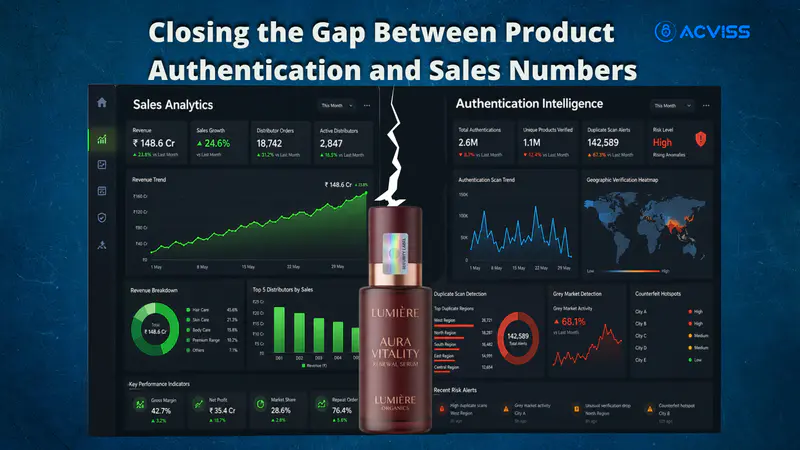
Every sales dashboard tells a story, but it is rarely the complete one. A region may report healthy sales while product authentication scans remain unusually low. Another market may show modest distributor orders, but thousands of product verifications from consumers. These mismatches are often dismissed as reporting delays or differences in customer behaviour. In reality, they can reveal much deeper problems within the supply chain.
For brands investing in product authentication, the real value lies beyond verifying whether a product is genuine. Authentication data provides an independent stream of market intelligence that can validate sales performance, expose counterfeit activity, uncover distributor misconduct, and reveal weaknesses in supply chain execution. When analysed alongside sales data, it becomes one of the most powerful investigative tools available to brand owners.
Authentication Data and Sales Data Measure Different Realities

One of the most common misconceptions is that authentication scans should closely mirror product sales. While both datasets relate to the same products, they capture entirely different events across the product lifecycle.
Sales data reflects commercial transactions. It records products that have been manufactured, shipped, invoiced, or sold through authorised channels. Authentication data, on the other hand, records interactions with individual products after they enter the market. Each scan represents a real verification event from a distributor, retailer, field investigator, or end consumer.
Because these datasets originate from different points in the supply chain, expecting them to match perfectly often leads to incorrect conclusions.
The objective is therefore not to force these datasets into alignment, but to understand why they diverge. The gap between them frequently contains the most valuable operational insights.
Why Scan and Sales Numbers Drift Apart
Some level of variation is expected. Not every customer verifies a product, while certain industries encourage routine authentication through field inspections or regulatory compliance. However, persistent or unexplained differences deserve closer investigation.
Several operational factors commonly contribute to these mismatches:
Counterfeit products circulating without corresponding sales records.
Grey market diversion into unauthorised regions.
Rogue distributors are redirecting inventory outside approved channels.
Delayed or incomplete sales reporting.
Retail stock remains unsold despite distributor invoices.
Duplicate warranty claims using copied product identities.
Regional differences in consumer verification behaviour.
Viewed individually, these factors may appear unrelated. When authentication data is analysed over time alongside sales records, distribution history, and geographic information, recurring patterns begin to emerge that would otherwise remain hidden.
The Hidden Intelligence Inside Authentication Data

Most organisations initially deploy authentication programmes to protect consumers from counterfeit products. Over time, many discover that authentication data becomes just as valuable for understanding how products actually move through the market.
Unlike invoices or shipment records, authentication events originate from the field. They reflect real interactions with physical products rather than planned commercial activity. Every verified product contributes another data point that helps brands understand where products appear, how frequently they are checked, and whether those patterns align with authorised distribution.
This independent perspective is particularly valuable because counterfeit networks rarely follow official supply chains. Fraudulent operators exploit weak distributor controls, regional price differences, excess inventory, and fragmented reporting systems. Traditional sales reports often fail to reveal these activities until financial losses or customer complaints become significant.
Authentication data provides much earlier signals. A sudden cluster of scans in a territory that received no authorised shipments, repeated verification attempts on identical product identities, or unexpected activity around discontinued stock can all indicate issues that warrant investigation before they escalate.
When Mismatches Point to Counterfeit Distribution

Counterfeit distribution networks seldom operate randomly. They target locations where demand is strong, enforcement is limited, and genuine products are difficult to monitor. As a result, authentication data often reveals abnormal activity long before conventional sales analysis detects a problem.
Consider a manufacturer whose ERP reports no shipments to a particular region during the previous quarter. Despite this, hundreds of consumers authenticate products from that market over several weeks. The products may appear genuine at first glance, yet their presence raises immediate questions.
Possible explanations include:
Unauthorised imports entering through parallel supply chains.
Distributor diversion into higher-margin markets.
Inventory leakage from warehouses or logistics partners.
Products originally intended for export are being sold domestically.
Each scenario requires a different response. Without authentication intelligence, all five possibilities could remain invisible until brand reputation or revenue is already affected.
Research into AI-enabled authentication systems shows that combining authentication events with multiple data sources significantly improves anomaly detection while reducing false positives. Rather than relying solely on packaging features, modern systems analyse behavioural patterns, product identities, locations, and verification history to distinguish isolated incidents from organised distribution activity.
Rogue Distributors Leave Digital Footprints
Distributor diversion is often more difficult to detect than outright counterfeiting because the products themselves are genuine. Instead of producing fake goods, unauthorised actors manipulate legitimate inventory by selling it outside agreed territories or customer segments.
Sales records alone may suggest everything is operating normally. Products were manufactured, shipped, and invoiced through authorised channels. Only when authentication events begin appearing in unexpected locations does the underlying problem become visible.
This creates an opportunity for investigation rather than assumption. Brands can compare authentication activity with distributor allocations, shipment destinations, warehouse records, and regional sales forecasts to determine whether inventory has followed its intended route.
Repeated mismatches across the same distributors or territories may indicate systemic channel leakage rather than isolated operational errors. Over time, these insights enable organisations to strengthen distributor governance, refine contractual controls, and focus investigations where the commercial risk is greatest.
The real advantage is not simply identifying a single incident. It is recognising patterns early enough to prevent counterfeit expansion, reduce grey market activity, and improve confidence in the integrity of the wider supply chain.
From Authentication to Supply Chain Intelligence
Authentication data becomes significantly more valuable when every product carries a unique, serialised identity. Instead of confirming whether a product is genuine, brands gain the ability to understand where each unit has travelled, when it was verified, and whether its journey aligns with the intended supply chain.
This shift transforms product authentication from a defensive measure into a source of operational intelligence. A serialised product can be linked with manufacturing records, distribution history, warranty registrations, and consumer interactions, creating a far more complete picture of market activity.
Industry research increasingly shows that organisations treating serialisation as a strategic intelligence asset outperform those using it solely for regulatory compliance. Item-level visibility supports faster investigations, targeted recalls, better inventory management through First Expired, First Out (FEFO), and improved detection of grey market diversion. It also helps reduce revenue leakage by identifying invalid returns, duplicate warranty claims, and unauthorised product movement before these issues become widespread.
Why Many Investigations Still Fall Short
Even organisations with authentication programmes often struggle to act on the data they collect. The problem is rarely the authentication technology itself. More often, valuable information remains isolated across different systems.
Authentication records may reside in one platform, sales information in an ERP, distributor data in another application, and warranty registrations somewhere else entirely. Without connecting these datasets, investigators are forced to analyse isolated events instead of understanding the complete operational picture.
An effective investigation typically follows a structured process:
Identify authentication anomalies, such as unexpected scan volumes or unusual geographic activity.
Compare those events against sales records, shipment history, and distributor allocations.
Determine whether the pattern indicates counterfeit activity, channel diversion, reporting inconsistencies, or genuine market demand.
Validate findings through field inspections, distributor audits, or marketplace monitoring.
Implement corrective actions and continue monitoring for recurring patterns.
This investigative approach replaces assumptions with evidence, allowing brands to respond more quickly and allocate resources where the commercial risk is highest.
Building an Intelligent Product Protection Strategy with Acviss Certify
Effective product protection requires more than secure packaging or authentication labels. It depends on connecting every product verification with meaningful business intelligence.
Acviss Certify combines non-cloneable product authentication with serialisation, supply chain visibility, and authentication intelligence to help brands understand not only whether a product is genuine, but also how it moves through authorised and unauthorised channels.
Each authenticated product contributes valuable operational data that can be analysed alongside sales performance, geographic distribution, warranty registrations, and consumer engagement. Instead of treating every scan as an isolated verification event, organisations can identify broader trends that indicate counterfeit activity, distributor diversion, unusual regional demand, or weaknesses within the supply chain.
When integrated into wider brand protection initiatives, authentication data also complements online brand protection, marketplace investigations, warranty verification, and supply chain monitoring. Together, these capabilities provide a more comprehensive understanding of product integrity throughout its lifecycle, enabling faster investigations and more informed business decisions.
Best Practices for Analysing Authentication Data
Organisations that extract the greatest value from authentication programmes typically adopt a broader analytical approach rather than viewing authentication as a standalone security measure.
Key practices include:
Compare authentication trends with sales performance regularly instead of relying on quarterly reviews.
Analyse authentication data at the individual product and regional levels rather than using only aggregate reports.
Investigate recurring anomalies instead of treating them as isolated incidents.
Correlate authentication events with warranty claims, distributor activity, and marketplace intelligence.
Establish clear governance for reviewing authentication intelligence across sales, operations, compliance, and brand protection teams.
Continuously refine investigation workflows as new market risks emerge.
The objective is not to eliminate every discrepancy. It is to understand which discrepancies represent genuine commercial risk and which simply reflect normal market behaviour.
Looking Beyond the Numbers
The future of product authentication lies in intelligence rather than verification alone. Artificial intelligence, computer vision, and connected supply chain platforms are enabling organisations to detect behavioural anomalies that would have been impossible to identify through manual analysis or sales reports alone.
As counterfeit networks become increasingly organised and global supply chains grow more complex, businesses will need to combine authentication, traceability, supply chain visibility, and market intelligence into a unified strategy. The organisations that continue treating authentication solely as a compliance exercise risk overlooking valuable operational insights hidden within their own data.
Conclusion
Authentication data and sales data are not competing sources of information; they answer different business questions. Sales data explains what should have happened commercially, while authentication data reveals what is actually happening in the market. The difference between the two is often where the most valuable intelligence exists.
For organisations focused on protecting revenue, strengthening distribution networks, and improving supply chain visibility, analysing these datasets together provides a far clearer understanding of market realities than either can offer independently. As product protection continues to evolve beyond authentication alone, the ability to transform verification events into actionable intelligence will increasingly distinguish proactive brands from reactive ones.
Interested in understanding what your authentication data is really telling you? Get in touch with us to explore how Acviss Certify can help you turn every product verification into actionable supply chain intelligence.