Picture the moment a customer lifts your handbag out of its dust bag. They run a thumb over the stitching, turn the hangtag, and scan the little QR code because a friend told them to always check. It scans. A page loads. They feel reassured, and they should, except the bag is a fake, bought from a reseller who looked authorised, and everything they just touched was reproduced in a workshop that had one genuine unit to copy.
When that bag frays or falls apart, the disappointment lands on your name, not the counterfeiter's. The next time that customer sees your brand at full price, they hesitate. That is the quiet cost in fashion: not just the lost sale, but a customer you paid to acquire now trusting you a little less.
Fashion carries this weight more than most categories. In the OECD and EUIPO report Mapping Global Trade in Fakes 2025, clothing, footwear, and leather goods together accounted for 62% of counterfeit goods seized in the 2021 customs data analysed. That is a global border seizure figure, and it only counts the fakes stopped at customs desks. The ones made and sold inside your home market, or listed on a domestic marketplace, never reach that desk, and those are the ones quietly taking your margin.
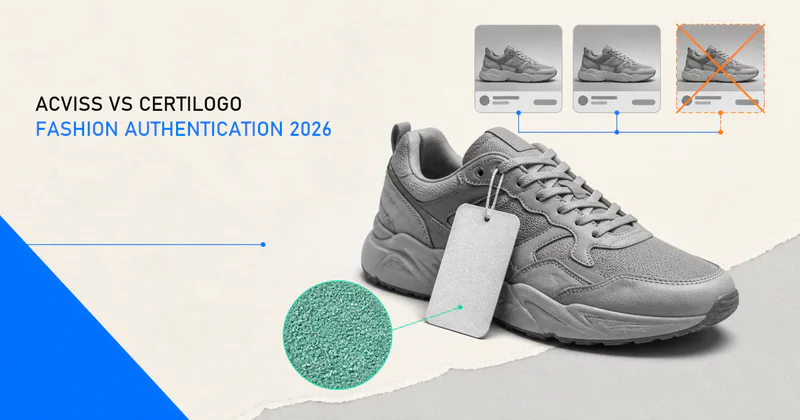
So the useful question is not whether to authenticate. It is where your counterfeit actually reaches the buyer, and what you need authentication to do once it gets there. Two names come up together for fashion and lifestyle brands, Acviss and Certilogo, and they answer from opposite ends. Certilogo authenticates a digital identity, using AI over an ordinary marker such as a QR code, NFC or RFID tag. Acviss authenticates the physical object itself, using a non-cloneable label whose security lives in the item rather than the database. Both are real approaches. They defend against different attackers, and the difference shows up the moment you look past the scan.
Why fashion is a harder problem than it looks
Most anti-counterfeiting technology assumes a printed box. Fashion rarely has one.
A t-shirt has no packaging artwork. A handbag has no folding carton on the shelf. What it has is a sewn-in care label, a hangtag, a dust bag, and a brand mark that a capable counterfeiter can photograph and reproduce in a week. The surface you have to protect is smaller, softer, and more exposed to the person copying it.
Three things follow from that:
The marker is out in the open. A QR code or NFC tag on a hangtag can be read, copied and reprinted by anyone holding one real unit. So the security has to sit somewhere other than how the marker looks.
The product outlives the sale. Fashion has a resale market, a repair market, and, in the EU, an approaching obligation to carry lifecycle data, with textiles among the first product groups lined up for the Digital Product Passport. (Check the current scope and dates with the European Commission before you build a timeline on any vendor's page, including this one.)
The fake often sells where no label reaches. A counterfeit listing on Instagram or a marketplace does not carry your hangtag at all. Authentication can't see it. Only enforcement can.
Hold those three in mind, because they're what separate the two platforms.
Meet the two approaches
Certilogo is a Milan-founded, eBay-owned platform built specifically for fashion and luxury, with more than sixteen years in digital product authentication. Its method, called Secure by Design, is deliberately marker-agnostic: instead of securing one particular tag, it layers AI anomaly detection over whatever marker a brand already uses, a QR code, an NFC or RFID tag, or an existing serial, and reasons over how each identity behaves to tell a genuine product from a cloned one in circulation. Around that, it offers a Digital Product Passport with digital twins, consumer-facing repair and resale services, and a Seal of Authentication a reseller can attach to a listing. eBay announced the acquisition in May 2023 and closed it that July, and the Milan team continues under founder Michele Casucci. The intelligence, not the marker, is the product.
Acviss is a Bengaluru-based product authentication and brand protection company that works across several industries, apparel and lifestyle among them. Its authentication is anchored in a physical, non-cloneable identity on the tag itself, wrapped together with supply-chain traceability, marketplace enforcement, loyalty and warranty on one shared data layer. Because a single scan can feed all of those at once, the data underneath has to be trustworthy, which is why Acviss holds ISO 27001 certification.
For fashion, that identity goes on a hangtag, a care label or a box seal through Axion Label, which pairs a cryptographically generated code with an AI-read fingerprint of the microscopic print variation unique to that one label. Both the code and the physical fingerprint have to pass before a unit is confirmed genuine. Around it sit the rest of the pieces: Certify for consumer verification (through an app, a web page, or WhatsApp with no download), Truviss for online enforcement, Origin for serialisation and traceability, and Bonus and Assist to turn the scan into loyalty and after-sales registration.
Where the security actually lives

This is the heart of the comparison, because both companies say "AI" and "authentication" and mean genuinely different things.
Certilogo's security lives in the decision layer. Its documentation says a copied code won't return an authentic result, that the platform recognises cloned products even when they use QR codes, and that its AI spots anomalies in how the verification service is used. In plain terms: a model watches how, where and how often an identity gets verified, and separates a genuine first scan from a cloned identity already doing the rounds. The marker is interchangeable on purpose.
Acviss's security lives in the artefact. Axion Label's fingerprint comes from microscopic print variation that happens naturally when that specific label is manufactured. It isn't designed, can't be specified, and doesn't survive reproduction. Photograph the label and reprint it, and the code copies cleanly, but the fingerprint it was registered against does not, so the reprint fails. That's the physically unclonable principle applied to a label. The claim is deliberately modest: no vendor ends counterfeiting in the world at large; what this prevents is the cloning of the label, which keeps units carrying it from being replicated and passed off as real.
The interesting test is how each one fails:
A behavioural model needs data. Where scan volume is thin, a quiet product line, a brand-new market, it has little to learn from, and the first cloned identity can look exactly like a legitimate first scan.
A physical fingerprint has no such dependency. It works on unit one, with no history. Its one requirement is that the label reaches the product intact, which is why Axion Labels are tamper-evident: lift one off a genuine product to move it onto a fake and it's damaged, and a damaged label doesn't scan.
Neither is "better" in the abstract. They protect against different failure modes, and which one matters depends on where your fakes actually come from.
A side-by-side, read by your own problem
Read that table by your own problem, not by counting rows. Certilogo's strengths cluster in one place: EU-facing resale and circularity, consumer pre-purchase verification, and layering over NFC or RFID you already run. Acviss's cluster in another: a non-cloneable physical identity that holds on unit one, online enforcement that actually files takedowns, and traceability that follows grey-market diversion through your own channels.
When Certilogo is the stronger fit
A comparison that concedes nothing is one nobody believes, so here's where a fashion brand should lean Certilogo.
If your programme is driven by EU resale and circularity, Certilogo is purpose-built for it. It offers consumer-facing repair, re-commerce and recycling, plus a Seal of Authentication that lets a reseller prove a garment before a buyer commits. And because eBay owns it, that authentication sits inside one of the largest pre-owned fashion channels in the world, a structural advantage no Indian vendor currently matches. On the passport itself the gap is narrower than it first looks: Acviss's Origin provides the serialisation, unit-level traceability and permissioned custody record a Digital Product Passport rests on. So if your real need is the reporting backbone rather than a consumer resale experience, ask both vendors to map it against your actual obligation, and confirm the phase-in scope and dates for textiles with the European Commission.
If you've already deployed NFC or RFID and don't want to replace it, Certilogo is built to layer over it. Its authentication is marker-agnostic and can add recognition to serialisation you already run. Acviss takes the opposite approach on purpose, anchoring in its own label and code because that's where the non-cloneable property comes from. If protecting an existing tagging investment matters more to you than a physical fingerprint, that's a fair reason to weigh Certilogo.
And there's an honest specialisation point. Certilogo works in fashion and luxury only and has spent sixteen years on this one category's resale behaviour and consumer expectations. Acviss is a cross-industry platform that covers apparel and lifestyle among several verticals.
When Acviss is the stronger fit
Your fakes are physical and online at the same time. A counterfeiter with a genuine hangtag can reproduce a QR code and even an NFC chip, but not the microscopic print variation registered to that one Axion Label at production. Because the security lives in the item, unit one is protected without waiting for a model to accumulate scans. But that same fake also sells where no hangtag reaches: a marketplace listing or an Instagram store for a garment that never carried your tag. Authentication can't see that; Truviss can. It monitors marketplaces, lookalike domains, social platforms, app stores and search ads, scores each listing against more than 500 data points, and files takedowns with platforms, registrars and ad networks. Certilogo's public materials describe grey-market and brand-protection dashboards rather than takedown filing. Detection without enforcement is only half the job.
Your buyer verifies on WhatsApp, not a web app. Certify works through an app, a web page, or WhatsApp — already open on the phone of the person deciding whether your hangtag is real. Certilogo's Connector is a well-built no-download web app answering the same question, but in markets where WhatsApp is the default for commerce, meeting the buyer inside it converts better than a browser redirect.
Your problem starts before retail. Grey-market diversion often begins not with a counterfeiter but with authorised stock moving outside its territory. Origin gives you GS1-compliant serialisation, unit-to-carton aggregation, ERP reconciliation, geo-tagged custody events and duplicate-scan alerts when one identity surfaces in two districts. Its blockchain doesn't prevent counterfeiting — it creates a tamper-evident record of events, which is what makes the record hold up when you confront a distributor. The label stops the fake; the ledger proves what happened.
You want the scan to earn its keep. Bonus turns an authentication into a loyalty event and first-party data, and Assist handles ownership registration and after-sales verification, so the authentication budget survives a hard look from finance.
Five questions before you sign
Is there a regulator, or not? If the EU Digital Product Passport is a live obligation on your line, that outranks everything else. Ask both vendors to map their answer to your actual requirement, and verify scope and dates with the European Commission, not a vendor page. If there's no live obligation, don't buy compliance you don't owe.
Are you defending the object or the identity? Photograph one of your own hangtags. Reprint it. Ask each vendor exactly what happens when that reprint is scanned, on unit one, in a market where you have zero scan history. The answers will differ.
Where does the fake actually sell? If it moves through marketplaces and social commerce, ask who files the takedown, who pays the legal cost, and what happens when a delisted seller returns under a new handle. Get it in the contract.
Does the verification surface fit your buyer? Web app, native app, or WhatsApp, test it on the phone your customer owns, in the store where they stand.
What happens if you leave? Get the export format for your serials, scan events and consumer records written down before you sign.
Frequently asked questions
How is the underlying authentication different?
Acviss ties authentication to a physical property of the label: Axion Label combines a generated code with an AI-read fingerprint of microscopic print variation unique to that one label, and both must validate independently. Certilogo's Secure by Design layers AI over an ordinary QR code, NFC tag, RFID tag or barcode, and reasons over how the identity is used. The deciding question is what happens on the first unit sold in a new market — where a behavioural model has no history and a physical fingerprint doesn't need one.
Is Certilogo owned by eBay?
Yes. eBay announced the acquisition in May 2023 and closed it that July, and the company continues under founder Michele Casucci. For a resale-minded brand that's a genuine plus: it places the authentication inside one of the largest pre-owned fashion marketplaces in the world.
Which is better for EU Digital Product Passport compliance in textiles?
If your driver is a consumer-facing resale and circularity experience, weigh Certilogo, which sells a named DPP product. If it's the reporting backbone, Origin provides the serialisation, traceability and custody record a passport rests on. Ask both to map it against your obligation, and confirm the current textile timeline with the European Commission.
Can either one stop counterfeit listings on Instagram and marketplaces?
Authentication can't, because that listing never carries your tag — enforcement can. Truviss monitors marketplaces, domains, social platforms, app stores and search ads and files takedowns with platforms, registrars and ad networks. If online enforcement matters to you, pin down who files, who bears the legal cost, and what happens on re-listing.
Do consumers have to download an app?
With neither. Certilogo's Connector is a no-download web app localised in ten languages. Acviss verifies through its app, a web page, or WhatsApp. In India, the Gulf and Southeast Asia, WhatsApp is usually already open, and removing even a browser redirect lifts completion; in Europe, a branded web experience may suit the luxury journey better.
Can a garment with no packaging be protected?
Yes, and it's the common case in fashion. Axion Label goes on hangtags, care labels or box seals, and because the labels are tamper-evident, a genuine one can't be lifted and reapplied to a fake without being destroyed. Uniqolabel covers holographic and sewn-in textile labels where visible security is a deliberate brand signal, while Phantom Code embeds authentication invisibly into printed artwork for boxed lines such as fragrance and cosmetics. Match the format to the product.