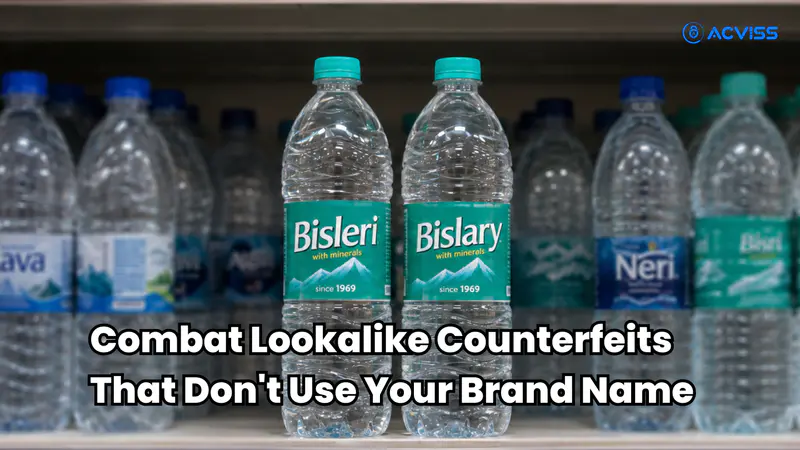
Most anti-counterfeiting programmes are designed to identify trademark infringement. The challenge is that many counterfeiters no longer need to copy your logo to steal your customers.
Across marketplaces, social commerce channels, and distribution networks, counterfeit operations are increasingly focused on visual imitation rather than direct brand replication. They mimic packaging, colour schemes, product layouts, listing styles, and purchasing experiences while avoiding the legal triggers that traditionally attract enforcement action.
For manufacturers, brand owners, and supply chain leaders, this creates a far more complicated threat landscape. A counterfeit product carrying your trademark is relatively easy to identify. A lookalike product that creates confusion without using your brand name often slips through monitoring systems, enforcement workflows, and even consumer scrutiny.
The result is the same. Lost revenue, damaged customer trust, warranty abuse, and growing pressure on brand protection teams.
The Rise of the Lookalike Economy

Counterfeiters have become remarkably sophisticated in their approach to modern commerce.
Rather than producing exact copies that immediately violate trademarks, many now focus on creating products that look familiar enough to influence purchasing decisions. They understand that consumers often buy based on recognition rather than detailed evaluation.
This behaviour is especially common in online environments where shoppers scroll quickly through hundreds of products. Colours, packaging shapes, product photography, and category positioning often influence decisions faster than brand names.
A counterfeit product may therefore avoid using a protected trademark while still borrowing visual elements associated with a category leader.
In practice, this creates a form of commercial deception that is harder to detect and often harder to prosecute.
Traditional Counterfeits vs Lookalike Counterfeits
The distinction matters because many organisations continue building brand protection programmes around direct trademark abuse while overlooking visual imitation tactics.
How Hidden-Link Selling Fuels Lookalike Counterfeits
One of the most effective techniques used by counterfeit networks today is the hidden-link model.
Instead of openly advertising counterfeit goods, sellers create generic marketplace listings that appear compliant. The visible product may be completely unrelated to the item eventually delivered.
A consumer browsing a social media group or influencer channel receives a link to a seemingly harmless listing. Once the purchase is completed, a different product is shipped.
This approach allows counterfeiters to bypass many of the detection systems used by marketplaces.
Common hidden-link tactics include:
Generic product listings that act only as payment mechanisms.
Blurred or modified product images that hide identifiable branding.
Generic titles designed to avoid trademark detection.
Social media and messaging groups used to distribute purchasing instructions.
Influencer-led promotion that directs followers towards hidden listings.
Because the marketplace listing itself often appears legitimate, conventional monitoring tools struggle to identify these operations.
Why Trademark Monitoring Alone Is No Longer Enough

Many organisations invest heavily in trademark monitoring, keyword scanning, and logo detection technologies.
These remain valuable capabilities, but they were designed for an earlier generation of counterfeit threats.
Lookalike sellers deliberately avoid direct indicators of infringement. They know that the fastest route to a takedown is using a protected trademark. Instead, they focus on visual familiarity and consumer confusion.
This creates several operational blind spots.
A listing may not contain your trademark. The images may not display your logo. The seller may never directly reference your company.
Yet the customer still believes they are purchasing something associated with your brand.
This is where online brand protection programmes must evolve beyond trademark monitoring and begin analysing broader patterns of digital abuse.
Truviss by Acviss helps organisations identify counterfeit ecosystems across marketplaces, websites, domains, mobile applications, social media channels, and online advertisements. Rather than examining isolated listings, they help uncover the wider infrastructure supporting counterfeit operations.
The Hidden Operational Costs Most Brands Underestimate
Many executives evaluate counterfeiting primarily through lost sales figures. In reality, the operational costs are often significantly higher.
Customer support teams spend time investigating complaints linked to products they never manufactured. Warranty departments process invalid claims. Quality teams investigate incidents involving counterfeit goods. Compliance teams respond to audits and inquiries triggered by unauthorised products.
The damage compounds over time.
Common Business Impacts of Lookalike Counterfeits
For regulated industries such as pharma, agrochemicals, automotive components, and healthcare products, the consequences can become even more severe due to product safety concerns.
Packaging Has Become the New Battleground
Many consumers remember visual characteristics more easily than brand names.
They remember colours. They remember packaging shapes. They remember shelf placement and design cues. Counterfeiters understand this behaviour extremely well.
A product does not necessarily need to carry a copied logo to benefit from the trust established by another brand. By mimicking visual characteristics, counterfeit operators can influence purchasing decisions while remaining outside the boundaries of straightforward trademark infringement.
This is particularly common in:
Food and beverage products
Personal care products
Nutraceuticals
Household goods
Automotive aftermarket products
Brands that rely heavily on colour recognition while neglecting distinctive visual assets often become especially vulnerable.
Building a Multi-Layered Protection Strategy
There is no single technology capable of eliminating lookalike counterfeits.
The strongest programmes combine multiple defensive layers that work together.
Organisations that rely on only one layer frequently discover that counterfeiters simply adapt their tactics.
Layered protection creates resilience.
Why Product Authentication Is Becoming Essential

Authentication is no longer limited to luxury products and pharmaceuticals.
As counterfeit techniques become more sophisticated, organisations across industries are recognising the need for reliable product verification. The challenge is that not all authentication technologies provide the same level of protection.
Many programmes still rely on:
Static QR codes
Predictable serial numbers
Generic holograms
Easily replicated labels
These approaches may discourage casual counterfeiters but often fail against organised operations.
Modern product authentication systems increasingly focus on creating identifiers that cannot be duplicated easily. Non-cloneable label technology has become particularly important because it addresses one of the most common weaknesses in traditional authentication systems: replication.
When deployed correctly, authentication does more than verify products.
It generates valuable intelligence regarding where products are being scanned, where anomalies occur, and where counterfeit infiltration may be happening.
The Connection Between Traceability and Brand Protection
Many companies continue treating track and trace initiatives as separate from anti-counterfeiting efforts. That separation often creates unnecessary blind spots.
Product traceability provides visibility into how products move through the supply chain. When products appear in unexpected locations or duplicate identifiers emerge, these anomalies frequently indicate diversion, grey market activity, or counterfeit infiltration.
Strong product traceability programmes can help identify:
Unauthorised distribution activity.
Duplicate product identities.
Missing chain-of-custody records.
Regional diversion patterns.
Inventory inconsistencies.
This visibility is becoming increasingly important as supply chain regulations continue to evolve.
Requirements linked to transparency, sustainability, and due diligence frameworks such as EUDR are encouraging organisations to strengthen their traceability capabilities. The same infrastructure supporting compliance can often strengthen brand protection outcomes.
Useful guidance on supply chain transparency and due diligence can be found through the European Commission's EUDR framework:
Why Anti-Counterfeiting Deployments Fail
Technology is rarely the first point of failure. Most large-scale anti-counterfeiting programmes struggle because of operational and governance challenges.
Some of the most common issues include:
1. Distributor Non-Compliance:
Verification procedures are viewed as additional work and gradually abandoned.
2. ERP Synchronisation Gaps
Authentication platforms and enterprise systems drift apart, creating inconsistent product records.
3. Packaging Redesign Conflicts
Marketing teams update packaging without considering authentication requirements.
4. Poor Consumer Adoption
Customers are never properly educated on product verification processes.
5. Weak Data Governance
Serialisation data becomes inconsistent across regions and business units.
Successful programmes treat authentication, online brand protection, and supply chain visibility as business processes rather than standalone technology deployments.
The Future of Fighting Lookalike Counterfeits
Artificial intelligence is making product imitation easier than ever.
Counterfeit operators can now generate packaging concepts, marketplace listings, advertising assets, and product imagery at unprecedented speed. At the same time, brands are gaining access to more advanced monitoring technologies capable of identifying patterns that traditional enforcement teams would struggle to detect.
The future of brand protection will increasingly depend on intelligence-driven ecosystems that combine online brand protection, authentication, product traceability, and real-time monitoring.
The organisations most likely to succeed will be those that stop viewing counterfeiting solely as an intellectual property problem and start treating it as a supply chain, compliance, product safety, and customer trust challenge.
Frequently Asked Questions
What is a lookalike counterfeit?
A lookalike counterfeit imitates the appearance, packaging, design language, or marketplace presentation of a product without necessarily using the original trademark.
Why are lookalike products harder to detect?
They often avoid trademark violations, making keyword monitoring, logo detection, and conventional marketplace enforcement less effective.
How does product authentication help?
Authentication enables consumers and businesses to verify whether a product is genuine while generating intelligence that supports investigations and enforcement.
What role does online brand protection play?
Online brand protection identifies counterfeit activity across marketplaces, websites, social media channels, applications, and other digital environments before significant commercial damage occurs.
Why is product traceability important?
Product traceability improves supply chain management, supports compliance requirements, strengthens product verification, and helps identify counterfeit infiltration points.
Final Thoughts
Lookalike counterfeits represent one of the most difficult brand protection challenges facing organisations today because they exploit perception rather than direct infringement.
By avoiding trademarks and focusing on visual mimicry, counterfeiters create confusion while remaining harder to identify and remove. Traditional enforcement methods alone are increasingly insufficient.
Organisations need a broader strategy that combines online brand protection, product authentication, non-cloneable label technology, track and trace infrastructure, and strong governance practices. Solutions such as Truviss can help uncover counterfeit ecosystems operating across digital channels, while authentication and traceability programmes strengthen visibility throughout the supply chain.
As regulatory expectations rise and counterfeit tactics continue evolving, brands that invest in intelligence-driven protection strategies will be better positioned to safeguard customer trust, product safety, and long-term commercial value.
Interested in learning more? Get in touch with us.