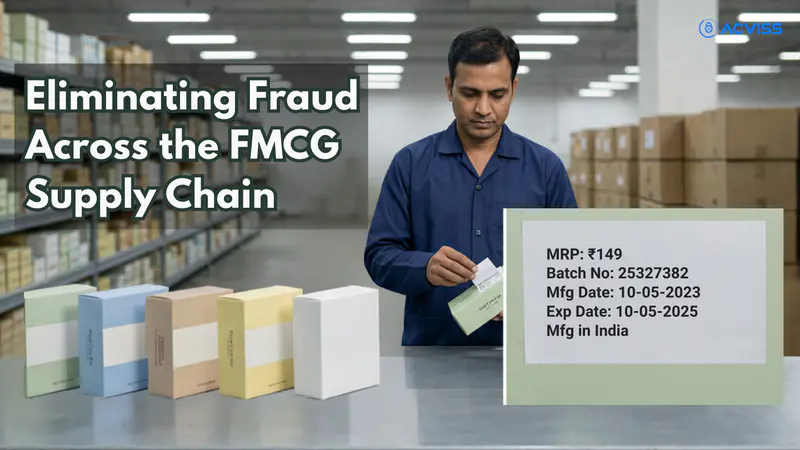
Trust in fast-moving consumer goods has always been implicit. A customer picks up a product expecting it to be genuine, safe, and exactly what it claims to be. That assumption is increasingly fragile. Behind the polished shelves of modern retail lies a growing layer of invisible risk. Repack scams, unauthorised diversion, and silent overproduction are eroding margins, damaging brand reputation, and compromising product safety.
For brands operating across fragmented supply chains, the question is no longer whether fraud exists, but how deeply it is embedded. What is needed is not just better monitoring, but a foundational shift. A trust layer that sits across the entire lifecycle of a product, from manufacturing to consumption.
Understanding the Invisible Threat Landscape
FMCG supply chains are vast, decentralised, and often opaque. This makes them highly efficient, but equally vulnerable.
Repack Scams: The Silent Substitution
Repackaging is one of the most insidious forms of fraud. Expired, diluted, or counterfeit products are reintroduced into the market in genuine-looking packaging. This is particularly dangerous in sectors such as pharma, dairy, and packaged foods, where product safety is critical.
Unlike outright counterfeiting, repack scams are difficult to detect. The packaging appears legitimate. The barcode scans correctly. Yet the contents have been compromised.
The consequences extend beyond financial loss:
Increased product safety risks
Erosion of customer satisfaction
Long-term damage to trademark protection and brand equity
Diversion: When Products Go Off-Route
Unauthorised product diversion occurs when products meant for one geography or channel are redirected into another. This is often driven by price arbitrage.
For example, a product intended for a lower-cost rural market may find its way into an urban retail environment at a higher price point. While the product itself may be genuine, its presence in the wrong channel disrupts pricing strategies, damages partner relationships, and creates compliance risks.
Diversion also complicates supply chain management, making it difficult to maintain accurate inventory visibility.
Overproduction: The Hidden Leak
Overproduction is rarely discussed openly, yet it is a significant contributor to grey market leakage. When excess units are manufactured beyond authorised quantities, they often enter unofficial channels.
These products are indistinguishable from legitimate inventory, making detection nearly impossible without granular product traceability.
The Regulatory Push Towards Transparency

The global regulatory environment is rapidly evolving, forcing brands to rethink how they manage traceability and product verification.
A New Compliance Reality
Frameworks such as the Food Safety Modernisation Act Rule 204 and the upcoming Digital Product Passport in the European Union are redefining expectations.
Businesses must track Critical Tracking Events across the entire supply chain
Data must be accessible within 24 hours for audits
Products must carry digital records that include origin, composition, and movement
By 2027, it is estimated that nearly 78 per cent of the global economy will operate under some form of digital product traceability requirement.
This shift is not just regulatory. It is structural.
Why Traditional Systems Are Failing
For decades, brands have relied on static identifiers such as barcodes and batch codes. These systems were designed for efficiency, not security.
The Problem with Static Identification
Static codes can be copied, reused, and manipulated with ease. Once replicated, they offer no mechanism to distinguish between genuine and fraudulent units.
This creates a dangerous blind spot:
A counterfeit product can pass basic product authentication checks
Diverted goods appear legitimate within existing systems
Overproduced units blend seamlessly into authorised inventory
In effect, the system confirms identity, but not authenticity.
Building the Trust Layer
The concept of a trust layer introduces a dynamic, intelligence-driven approach to brand protection. It moves beyond tracking batches to verifying individual units.
From Traceability to Verifiability
Modern supply chains require more than track and trace. They require the ability to:
Assign a unique identity to every unit
Monitor its journey in real time
Validate its authenticity at any point
This is where technologies such as dynamic QR codes, NFC, IoT sensors, and blockchain-based ledgers come into play.
Key Capabilities of a Trust Layer
Unit-level product authentication rather than batch-level tracking
Real-time product verification across geographies
Tamper detection and audit trails
Integration with supply chain management systems
Customer engagement through direct verification interfaces
The result is a system that does not just record movement but actively enforces trust.
The Role of Dynamic Identification Technologies

Dynamic QR Codes and Non-Cloneable Identity
Unlike traditional barcodes, dynamic QR codes assign a unique identity to each product unit. These identifiers can track scan frequency, location, and anomalies.
For high-risk categories, non-cloneable labels provide an additional layer of protection. These labels are physically impossible to replicate, ensuring that each product carries a secure identity.
NFC and Hardware-Level Security
Near Field Communication adds a hardware-based authentication layer. It is particularly effective in preventing repack scams, as the embedded chip cannot be duplicated without specialised infrastructure.
IoT and Environmental Integrity
IoT sensors ensure that products maintain integrity throughout their lifecycle. In cold chain environments, for example, temperature deviations can be detected and logged automatically.
This is critical for pharma and perishable FMCG categories where product safety is directly linked to environmental conditions.
Economic Impact: Beyond Compliance
The adoption of a trust layer is often viewed through the lens of compliance. In reality, its financial implications are far broader.
Cost of Inaction
Global counterfeit trade accounts for approximately 3.3 per cent of total trade
Product recalls can exceed 10 million dollars in direct losses
Inventory inaccuracies can lead to significant revenue leakage
Measurable Gains
Up to 40 per cent reduction in counterfeit exposure
Inventory accuracy improvements from 65 per cent to 99 per cent using advanced tracking
Reduction in logistics costs by up to 25 per cent through optimised packaging and digital documentation
These are not incremental improvements. They represent a structural shift in how FMCG businesses operate.
Implementing the Trust Layer in Practice

Adopting a trust layer requires a strategic approach. It is not merely a technology upgrade, but an organisational transformation.
Key Considerations
Integration with Existing Systems
Legacy ERP and SCADA systems must be aligned with new traceability platforms. This requires careful planning and cross-functional collaboration.
Data Security
Handling sensitive production and supply chain data demands robust encryption standards such as AES-256, along with strict access controls.
Cost vs Long-Term Value
While initial deployment costs can be significant, the long-term benefits in terms of brand protection, operational efficiency, and customer satisfaction far outweigh the investment.
Where Solutions Fit In
While the broader framework defines the trust layer, its execution depends on specific capabilities working together.
Unit-Level Authentication and Verification
Solutions built around non-cloneable identity enable precise product authentication and brand verification at the unit level. This is essential in eliminating repack scams and detecting counterfeit entries.
Track and Trace Across the Supply Chain
End-to-end product traceability ensures visibility across manufacturing, distribution, and retail. It enables brands to identify product diversion patterns and take corrective action.
Origin Validation and Transparency
Origin-based systems establish a verifiable chain of custody. This is increasingly relevant for regulatory compliance, sustainability reporting, and initiatives such as EUDR.
Together, these elements form a cohesive anti-counterfeiting solution that strengthens IP protection and trademark protection while enhancing customer engagement.
The Consumer Dimension of Trust
Trust is not only enforced internally. It must also be visible externally.
Modern consumers are more informed and cautious. They expect the ability to verify products before use.
Turning Verification into Engagement
When customers can scan and verify a product:
It reinforces confidence in product safety
It creates a direct communication channel with the brand
It enhances customer satisfaction and loyalty
This transforms product authentication from a backend function into a front-facing experience.
Challenges That Cannot Be Ignored
Despite its advantages, building a trust layer comes with challenges.
Complexity
Implementing unit-level traceability across global operations requires coordination across multiple stakeholders.
Cost Barriers
Small and mid-sized businesses may find initial costs prohibitive, although scalable solutions are gradually addressing this gap.
Data Management
The volume of data generated by track and trace systems can be overwhelming without a proper analytics infrastructure.
Yet, these challenges are transitional. The direction of the industry is clear.
A Structural Shift, Not a Trend
The FMCG sector is moving towards a future where transparency is mandatory, not optional. Regulatory frameworks, technological advancements, and consumer expectations are converging to create a new baseline.
Brands that continue to rely on legacy systems will find themselves increasingly exposed to fraud, inefficiencies, and compliance risks.
Those that invest in a trust layer will gain a competitive advantage, not just in protecting revenue, but in building long-term credibility.
From Visibility to Trust
Supply chains were once designed for speed and scale. Today, they must also be designed for integrity.
Preventing repack scams, diversion, and overproduction requires more than reactive measures. It requires a proactive, intelligent system that embeds trust into every product.
The trust layer is that system.
It connects product authentication, track and trace, and supply chain management into a unified framework that protects brands, ensures product safety, and strengthens customer relationships.
For FMCG brands navigating an increasingly complex landscape, the question is no longer whether to adopt such systems, but how quickly they can do so.
Interested in learning more? Get in touch with us.