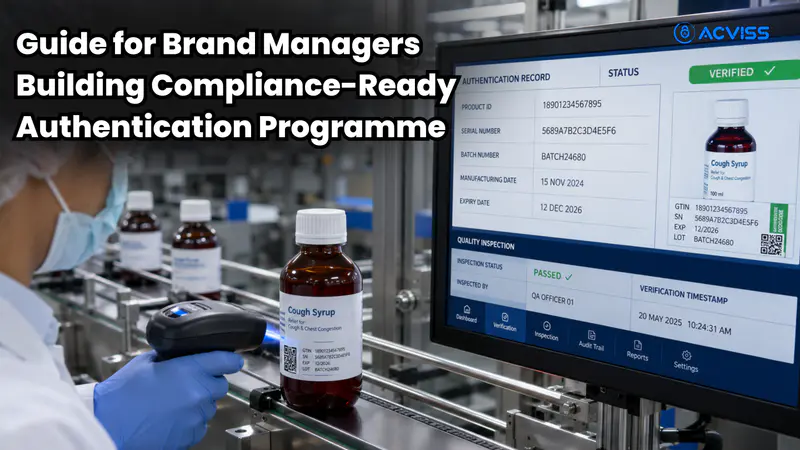
Regulators are increasingly treating product authentication as part of broader supply chain transparency and consumer protection frameworks rather than a standalone anti-counterfeiting measure. For brand managers operating in pharmaceuticals, food, agrochemicals, medical devices, and other regulated sectors, authentication is no longer simply a security initiative. It is becoming a compliance requirement with direct implications for audits, recalls, investigations, and regulatory reporting.
Many organisations respond to these requirements by adding a QR code to packaging and assuming the job is done. In practice, compliance-ready authentication demands far more. Regulators may require specific data elements, traceability capabilities, audit records, accessibility considerations, and verification mechanisms that can withstand scrutiny during inspections or investigations. The challenge is not deploying a code. The challenge is building a system that consistently supports regulatory obligations, operational workflows, and consumer trust at scale.
This guide explains how to build a compliance-ready authentication programme, helping brand managers move beyond basic implementation and establish a framework that supports both regulatory expectations and business objectives.
What Does "Compliance-Ready" Actually Mean?
A compliance-ready authentication programme can demonstrate control, traceability, and accountability throughout the product lifecycle.
This distinction matters because many authentication deployments focus primarily on consumer engagement. They provide a scan experience but fail to capture the underlying records required for audits, investigations, recalls, or regulatory verification.
A compliance-ready system should answer questions such as:
Where was this product manufactured?
Which batch did it originate from?
When was it distributed?
Who verified it?
Has the product been scanned before?
Can the organisation prove authenticity using historical records?
Are the required regulatory data fields available and accessible?
The gap between marketing-focused authentication and compliance-focused authentication is substantial.
For regulated brands, compliance readiness requires authentication, traceability, data governance, and auditability working together.
Step 1: Map Your Regulatory Obligations by Product Category

The first mistake many organisations make is selecting technology before understanding regulatory requirements.
Authentication requirements vary significantly across industries.
For example, under the Ministry of Health & Family Welfare notification G.S.R. 823(E), India's top pharmaceutical brands must implement Barcodes or QR Codes containing specific product information to facilitate authentication and traceability. Required fields include batch number, manufacturing details, expiry date, manufacturer information, and product identifiers.
Food businesses face different expectations.
The Food Safety and Standards Authority of India (FSSAI) has encouraged Food Business Operators to use QR codes that improve accessibility for visually impaired consumers. These codes may include nutritional information, allergen declarations, ingredients, manufacturing details, and customer support information.
Before selecting any authentication technology, create a compliance inventory covering:
Regulatory Requirements Checklist
Organisations that skip this exercise often discover expensive compliance gaps after deployment.
Step 2: Define What Needs to Be Authenticated

Not every product requires unit-level authentication.
This is where compliance objectives and operational realities must be aligned.
Authentication can be implemented at multiple levels:
Unit-Level Authentication
Each product receives a unique identity.
Examples include:
Pharmaceutical blister packs
Prescription medicine bottles
High-value electronics
Premium cosmetics
Unit-level authentication provides the highest level of visibility but also increases implementation complexity, printing requirements, and data management obligations.
Batch-Level Authentication
Authentication is linked to a production batch rather than individual units.
This approach is often used when:
Product volumes are extremely high
Regulatory requirements permit batch tracking
Cost efficiency is a priority
However, investigations become less precise because individual products cannot be distinguished from one another.
Shipment-Level Authentication
Authentication occurs at the carton, case, or pallet level.
This model supports logistics visibility but provides limited consumer verification capabilities.
The appropriate level depends on:
Regulatory obligations
Product risk profile
Counterfeit exposure
Supply chain complexity
Investigation requirements
One of the most common deployment failures occurs when organisations implement batch-level controls while regulators, customers, or distributors expect unit-level traceability.
Step 3: Choose the Authentication Mechanism

The technology decision should follow compliance requirements, not precede them.
Each authentication mechanism carries different operational and regulatory implications.
Authentication Technology Comparison
For pharmaceutical applications, GS1 DataMatrix remains the preferred standard globally because it supports structured product identification and serialisation requirements.
QR codes using GS1 Digital Link standards are increasingly attractive because they bridge both B2B and B2C use cases, allowing a single code to support supply chain operations and consumer interactions.
The critical lesson is that no technology alone guarantees compliance.
A copied QR code attached to a counterfeit product remains a valid QR code. Compliance depends on verification logic, data integrity, and auditability rather than the code itself.
Step 4: Build the Consumer-Facing Verification Layer

Many authentication projects underestimate the importance of the verification experience.
Consumers, retailers, pharmacists, and inspectors should receive clear and consistent authentication responses.
An effective verification layer should provide:
Product authenticity status
Product description
Manufacturer information
Batch details
Manufacturing date
Expiry date
Recall notifications if applicable
Customer support access
For food products, the verification interface may also include:
Nutritional information
Ingredients
Allergen declarations
Accessibility features
Poorly designed verification portals often create compliance risks.
If information is incomplete, inconsistent, or outdated, consumers may lose trust while regulators may question the reliability of the system.
The verification layer should therefore be treated as a regulated information interface rather than a marketing microsite.
Step 5: Establish Data Governance and Audit Trails

Authentication programmes succeed or fail based on data quality.
The visible code represents only a small part of the overall compliance architecture.
The real value lies in the records generated behind the scenes.
Every authentication event should create a structured record including:
Product identifier
Batch information
Scan timestamp
User location
Verification outcome
Device information
Distribution status
These records support:
Regulatory audits
Product recalls
Counterfeit investigations
Supply chain monitoring
Warranty validation
Compliance reporting
Without reliable audit trails, authentication programmes become difficult to defend during investigations.
This is particularly important in industries where regulators may request evidence months or years after a product enters the market.
Solutions such as Origin can strengthen this layer by providing traceability records across the supply chain, creating continuity between authentication events and product movement data.
Step 6: Distributor and Retail Onboarding
Authentication systems rarely fail because of technology.
They often fail because supply chain participants do not use them consistently.
Distributors and retailers play a critical role in maintaining authentication integrity.
Common onboarding challenges include:
1. Operational Resistance
Distribution teams may perceive scanning procedures as additional work.
Unless workflows are simple and clearly beneficial, adoption rates tend to decline over time.
2. Inconsistent Processes
Different regions often implement different verification procedures.
This creates data gaps and weakens compliance controls.
3. Training Deficiencies
Employees may not understand:
What to scan
When to scan
Why scanning matters
How to report anomalies
A successful onboarding programme should include:
The strongest authentication programmes treat onboarding as an ongoing process rather than a one-time training exercise.
Step 7: Monitor Continuously and Manage Regulatory Change

Compliance is not static.
Regulations evolve, product portfolios change, and counterfeiters adapt.
An authentication programme that meets today's requirements may become inadequate within a few years.
Ongoing monitoring should include:
Regulatory Monitoring
Track updates from:
Ministry of Health & Family Welfare
FSSAI
CDSCO
Industry standards organisations
Authentication Analytics
Monitor:
Verification volumes
Geographic scan patterns
Duplicate scan events
Unusual authentication activity
Product-specific anomalies
Governance Reviews
Review:
Data quality
Process adherence
Distributor participation
Audit readiness
Incident response procedures
Authentication should be managed as a continuous compliance function rather than a completed project.
Common Mistakes That Undermine Compliance Readiness
Many programmes encounter predictable problems.
The most frequent include:
Ignoring regulatory requirements during system design
Failing to establish audit trails
Underestimating distributor adoption challenges
Using proprietary identification structures without interoperability planning
Neglecting governance ownership
Failing to update programmes as regulations evolve
Each of these issues can create vulnerabilities that only become visible during recalls, inspections, or counterfeit investigations.
How Certify Supports a Compliance-Ready Authentication Programme
Building a compliance-ready authentication framework requires multiple layers working together.
Certify is structured to support this process through secure product authentication, unique product identities, verification workflows, consumer engagement capabilities, and audit-ready authentication records.
The platform enables brands to implement authentication programmes that extend beyond simple QR code deployment, supporting product verification, compliance reporting, warranty validation, and investigation workflows.
When combined with Origin's supply chain traceability capabilities, organisations can connect authentication events with product movement records, creating greater visibility across manufacturing, distribution, and retail operations.
This integrated approach is particularly valuable for regulated industries where authentication, traceability, and compliance reporting increasingly overlap.
The Future of Authentication Is Compliance-Centred
The conversation around authentication is changing.
What was once viewed primarily as a brand protection initiative is increasingly becoming part of broader compliance, transparency, and supply chain governance strategies. Regulators are demanding greater visibility, consumers expect easier access to product information, and organisations need stronger evidence when responding to investigations, recalls, or counterfeit incidents.
The brands that gain the most value from authentication programmes will not be those that deploy the most sophisticated technology. They will be the organisations that build structured, auditable, and scalable systems capable of supporting regulatory requirements while strengthening trust across the supply chain.
For brand managers in pharmaceuticals, food, agrochemicals, and other regulated sectors, the objective is no longer simply proving authenticity. It is proving authenticity in a way that stands up to scrutiny, supports operational decision-making, and remains resilient as regulations evolve.
Interested in building a compliance-ready authentication programme for your products? Get in touch with the Acviss team to explore how Certify and Origin can support your compliance, traceability, and brand protection objectives.