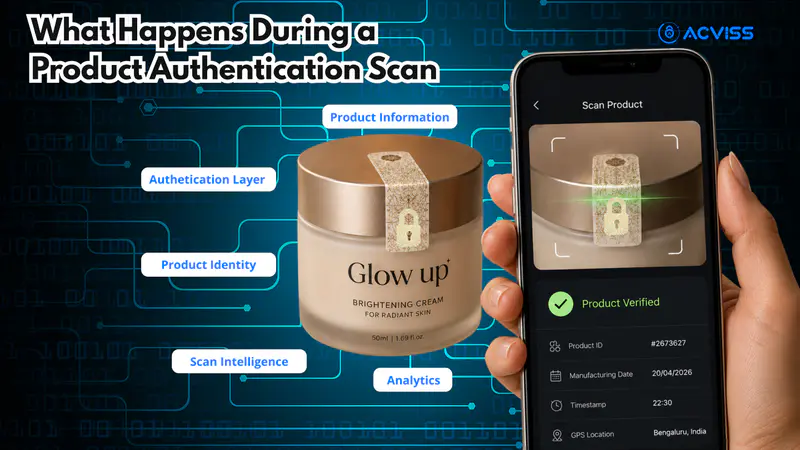
A product authentication scan takes only a couple of seconds. Behind that brief interaction, however, dozens of validation checks, intelligence models, and risk assessments are working simultaneously to determine whether a product can be trusted.
For many organisations, the scan is often misunderstood as nothing more than opening a webpage through a QR code. In reality, an enterprise-grade authentication platform analyses product identity, supply chain history, scan behaviour, duplication patterns, and contextual risk before returning a verification result. More importantly, every scan creates valuable operational intelligence that helps brands strengthen product security, improve supply chain visibility, investigate suspicious activity, and make better business decisions.
Why a Two-Second Scan Represents Years of Engineering
Consumers experience a simple process. They point their smartphone camera at a product label, wait a moment, and receive a confirmation indicating whether the product is genuine.
From a brand owner's perspective, that same interaction is significantly more complex.
A modern product authentication scan is designed to answer multiple questions simultaneously:
Is this a legitimate product identity?
Has this unique code been copied?
Is the product being scanned where it is expected to be?
Does the scan behaviour match genuine consumer activity?
Has the same identity appeared elsewhere before?
Should this scan trigger an investigation?
Answering these questions requires far more than checking whether a code exists in a database. Enterprise authentication platforms combine unique product identities, AI-driven verification, behavioural analytics, duplicate detection, and supply chain intelligence to evaluate every scan in real time.
Recent advances in AI-enabled authentication have further accelerated this process. Industry research shows that intelligent authentication systems improve verification accuracy by 15–26% while reducing authentication time from nearly 47 minutes of manual investigation to under three seconds in automated environments. These improvements have transformed authentication from a reactive investigation tool into an operational capability that supports day-to-day manufacturing, distribution, and brand protection.
What Actually Happens During a Product Authentication Scan?

Although every platform uses different technologies, the authentication workflow generally follows a structured sequence of validation steps. Each stage contributes to determining whether a product can be trusted while simultaneously generating valuable business intelligence.
Step 1: The Scan Request Reaches the Authentication Platform
The process begins when a consumer, distributor, field auditor, retailer, or service engineer scans the authentication label using a mobile application, web browser, or integrated enterprise application.
The scan captures considerably more information than the visible code printed on the packaging.
Typical data collected includes:
Rather than treating every scan as an isolated event, enterprise authentication systems enrich it with contextual information. This provides the foundation for downstream intelligence and helps distinguish legitimate consumer interactions from suspicious behaviour.
Step 2: The Unique Product Identity Is Validated
Once the scan request reaches the authentication engine, the first task is verifying the product's unique identity.
This stage is frequently mistaken for a simple database lookup. In practice, it involves validating whether the identity exists, whether it was legitimately generated, and whether it belongs to the correct product.
Unlike conventional marketing QR codes that simply redirect users to a website, authentication labels assign a unique digital identity to every individual product. This allows brands to distinguish one unit from another instead of treating an entire product line as identical.
A robust authentication platform typically verifies:
Whether the identity exists in the manufacturer's database
Whether the code has been activated
Whether the product belongs to the correct SKU
Whether the manufacturing batch is valid
Whether the product has already been sold or retired
Whether the identity has been modified or tampered with
If any inconsistency is detected at this stage, the authentication workflow can immediately classify the scan as suspicious before proceeding to deeper analysis.
Why Ordinary QR Codes Cannot Provide Authentication

One of the biggest misconceptions in product security is that every QR code provides authentication.
It does not.
A standard QR code is simply a method of storing information. It can contain a website address, serial number, promotional content, or contact information, but the code itself has no inherent security. Anyone with basic software can copy, print, and reproduce it without altering its appearance.
This is why counterfeiters often duplicate genuine QR codes directly from authentic products. From the consumer's perspective, the copied code appears legitimate because it opens the expected webpage.
The difference lies not in the QR code itself, but in the intelligence behind it.
This distinction becomes particularly important in industries where counterfeit products can compromise safety, compliance, or warranty obligations. Pharmaceuticals, automotive components, electronics, agrochemicals, and premium consumer goods all require authentication systems capable of identifying cloned identities rather than merely displaying product information.
Step 3: Duplicate Detection Begins Immediately
Once the product identity has been validated, the authentication platform evaluates whether the same identity has been scanned previously.
This is where counterfeit detection becomes significantly more sophisticated.
Legitimate products naturally generate multiple scans throughout their lifecycle. A manufacturer may verify the product during packaging, a distributor may confirm receipt, a retailer may perform inventory checks, and finally, a consumer may authenticate the purchase.
Viewed independently, none of these scans is unusual.
The authentication engine, therefore, analyses the broader scan history instead of counting scan frequency alone.
Questions typically evaluated include:
Has this product been scanned before?
Where did previous scans occur?
How much time elapsed between scans?
Does the sequence follow the expected supply chain?
Are multiple consumers scanning the same identity?
Are geographically distant scans occurring within unrealistic timeframes?
For example, imagine a product authenticated by a customer in Bengaluru. Ten minutes later, the same identity is scanned in Delhi.
The issue is not simply that the code has been scanned twice. The concern is that the movement is operationally impossible, suggesting that the identity has been copied and reproduced elsewhere.
Similarly, if hundreds of products suddenly begin reporting identical authentication histories, investigators can identify emerging counterfeit clusters before customer complaints begin to surface.
Duplicate detection, therefore, serves a much broader purpose than identifying copied labels. It provides an early warning system for counterfeit distribution, grey market diversion, parallel imports, and unauthorised channel activity.
Rather than waiting for market complaints, brands gain visibility into suspicious behaviour while products are still moving through the supply chain, allowing investigations to begin before the problem escalates.
Step 4: Every Scan Is Assigned a Risk Score
After validating the product identity and analysing its scan history, the authentication platform begins evaluating the level of risk associated with that particular event.
Contrary to popular belief, authentication is rarely a simple "genuine" or "fake" decision. Many scans fall into a grey area that requires additional context before they can be classified confidently.
For example, a product may be genuine but sold through an unauthorised distributor. Another may have been diverted into a different country before reaching consumers. A third may involve a cloned code that has only recently begun appearing in the market.
Instead of relying on a single indicator, modern authentication platforms combine multiple signals to generate a dynamic risk score.
Typical evaluation criteria include:
Previous authentication history
Frequency of scans
Geographic anomalies
Time between consecutive scans
Distribution channel
Product lifecycle stage
Device behaviour
Historical fraud patterns
Rather than treating every anomaly as counterfeit, the platform prioritises investigations based on the likelihood of fraud. This enables brand protection teams to focus their resources on incidents that present the highest commercial or operational risk.
For organisations managing millions of products across multiple markets, intelligent risk scoring is far more practical than manually reviewing every suspicious scan.
Step 5: AI Looks Beyond the Visible Code
A secure authentication system should not rely solely on the information encoded inside a QR code. Sophisticated counterfeiters can often duplicate visible identifiers with surprising accuracy.
This is where artificial intelligence adds another layer of protection.
Modern authentication platforms analyse characteristics that are difficult to reproduce consistently, even when a counterfeiter has copied the visible code. Depending on the technology deployed, AI models may evaluate microscopic print variations, embedded security patterns, scan behaviour, image quality, or contextual information gathered during the verification process.
Research comparing AI-enabled authentication systems with conventional verification methods has shown measurable improvements in both speed and accuracy. Computer vision models can identify subtle differences in printed patterns that are invisible to the human eye, allowing authentication decisions to be made within seconds rather than through lengthy manual inspections.
The objective is not simply to recognise a QR code. It is to determine whether the physical label, the digital identity, and the surrounding context all support the conclusion that the product is genuine.
Beyond Verification: Every Authentication Scan Creates Business Intelligence
The most valuable outcome of a product authentication scan is often not the authentication result itself.
Every scan generates a new layer of operational intelligence that can help brands understand how products move through the market, where irregularities occur, and how consumers interact with their products.
Over time, this information becomes increasingly valuable for multiple business functions.
Intelligence Generated From Every Scan
Rather than functioning as a standalone authentication tool, enterprise platforms transform verification events into actionable operational data.
For QA teams, this data can reveal packaging inconsistencies or production anomalies.
For supply chain managers, it offers greater visibility into product movement across distributors, warehouses, and retail channels.
For brand protection teams, it helps identify emerging counterfeit hotspots before they become widespread.
For marketing teams, verified consumer scans provide valuable engagement insights that can support loyalty programmes, warranty activation, and post-purchase communication.
The authentication scan, therefore, becomes a source of continuous business intelligence rather than a one-time verification event.
Product Authentication Is Strongest When Combined With Supply Chain Visibility

Authentication confirms whether a product appears genuine at a specific point in time.
Supply chain visibility explains how that product reached that point.
These capabilities complement one another.
Without authentication, organisations may know where products were shipped, but cannot verify whether the product being scanned is authentic.
Without traceability, they may confirm authenticity but have a limited understanding of where the product entered the supply chain or where irregularities began.
When integrated, they provide a far more complete operational picture.
A typical product journey may include:
Manufacturing and packaging
Warehouse dispatch
Distributor receipt
Secondary distribution
Retail placement
Consumer authentication
Warranty registration
After-sales service
Capturing verified events throughout this journey enables brands to identify bottlenecks, investigate unauthorised movement, and establish accountability across multiple supply chain partners.
This level of visibility is becoming increasingly important as global supply chains become more complex and regulatory expectations around product traceability continue to evolve.
How Acviss Certify Strengthens Enterprise Product Authentication
Enterprise authentication requires more than generating unique codes. It demands a platform capable of verifying products, detecting suspicious behaviour, and converting authentication events into meaningful business intelligence.
Acviss Certify is designed around this broader objective.
Instead of treating authentication as a simple QR verification exercise, Certify combines secure digital identities, intelligent validation, analytics, and supply chain insights to help brands protect products throughout their lifecycle.
A typical authentication workflow within Certify includes:
Generation of a unique digital identity for every product unit
Secure authentication through mobile applications or web-based verification
Duplicate scan detection
Risk-based authentication logic
Consumer verification experience
Centralised analytics dashboard
Investigation support for suspicious activity
Because every authentication event contributes additional data, brands gain continuous visibility into how products move across distributors, retailers, and end consumers.
This operational intelligence supports functions well beyond counterfeit detection, including warranty verification, customer engagement, product recalls, and distribution monitoring.
Axion: Adding Security Beyond Conventional QR Codes
One of the limitations of ordinary QR codes is that they are designed primarily for information storage rather than security.
Axion addresses this limitation by incorporating advanced non-cloneable security features into the authentication label itself.
Instead of relying solely on the visible QR code, Axion combines secure printing techniques with intelligent verification technologies that make duplication significantly more difficult.
This additional layer of protection helps brands defend against one of the most common counterfeit tactics: reproducing genuine QR codes on fake products.
When combined with Certify, Axion enables organisations to verify not only the digital identity of a product but also the integrity of the physical authentication label.
The result is a stronger defence against cloning, greater confidence during verification, and richer intelligence for brand protection teams investigating suspicious activity.
Choosing an Authentication Platform: Questions Every Brand Should Ask
Selecting an authentication platform is a long-term operational decision rather than a packaging decision.
While security features are important, organisations should also evaluate how effectively the platform supports investigations, analytics, supply chain visibility, and future scalability.
Key evaluation questions include:
Does every product receive a unique digital identity?
Can the platform detect duplicate and abnormal scans?
How are risk scores generated?
Does the platform provide actionable analytics?
Can authentication integrate with ERP and supply chain systems?
Does it support warranty verification and consumer engagement?
Can investigators easily analyse suspicious activity?
Is the authentication technology resistant to cloning?
Can the platform scale across multiple countries and product lines?
Brands that evaluate authentication purely on label cost often overlook the significantly greater costs associated with counterfeit products, warranty abuse, unauthorised distribution, product recalls, and lost consumer trust.
Final Thoughts
A product authentication scan may last only two seconds, but the intelligence behind it extends far beyond that brief interaction.
Each scan validates a product, analyses behavioural patterns, evaluates risk, updates supply chain intelligence, and contributes to a growing body of operational data that helps brands make faster, better-informed decisions.
As counterfeiting techniques become more sophisticated, authentication can no longer be viewed as a standalone packaging feature. It is increasingly becoming part of a broader product integrity strategy that combines secure labels, intelligent verification, supply chain visibility, investigation workflows, consumer engagement, and actionable analytics.
Organisations that recognise this shift will be better equipped to protect their products, strengthen customer trust, and respond proactively to emerging risks rather than reacting after damage has already occurred.
Interested in understanding how intelligent product authentication can strengthen your brand protection strategy? Get in touch with the Acviss team to explore how Certify and Axion can help secure your products across the entire supply chain.