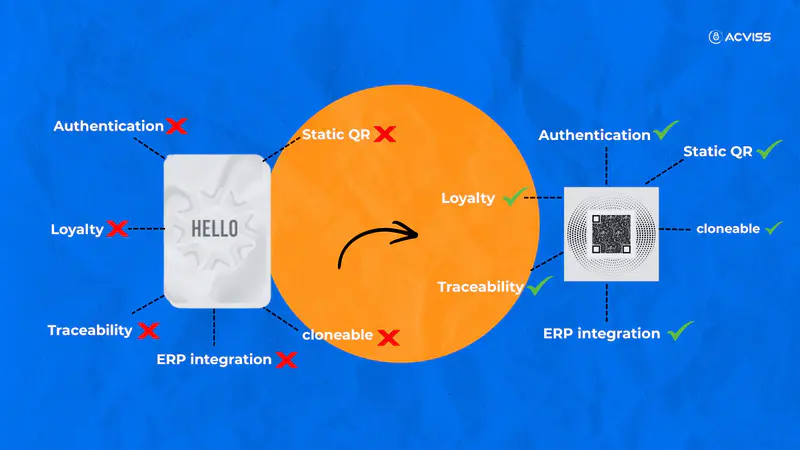
Why Many Brands Are Rethinking Holograms
For decades, holograms have been the default choice for product security. They are visible, familiar, and easy to explain to distributors and customers. However, the threat landscape has changed.
Today’s counterfeiters are technologically capable, well-funded, and fast-moving. What once acted as a strong deterrent has become a visual formality.
Manufacturers across FMCG, pharmaceuticals, agro inputs, electronics, automotive parts, and lifestyle goods are now asking a critical question.
When is it time to move beyond holograms?
This blog explains the upgrade path, not as a sudden replacement, but as a strategic evolution toward non-cloneable security.
What Holograms Were Designed to Solve
Holograms were originally introduced to solve three problems:
Provide a visible security feature that is hard to replicate
Help inspectors and distributors visually identify genuine products
Act as a deterrent against casual counterfeiters
For a long time, this worked.
Replication required specialised equipment, and most counterfeit operations stayed away.
That is no longer the case.
Why Holograms Are No Longer Enough
Modern counterfeiters can replicate holograms at scale.
Advances in printing, scanning, and material access have reduced the cost and complexity of duplication.
Common issues manufacturers face today include:
Holograms that look identical on genuine and fake products
No way to verify authenticity digitally
Zero traceability once the product leaves the factory
Distributors are unable to distinguish originals from high-quality copies
Consumers are relying on guesswork instead of verification
In short, holograms are static. Static security fails in dynamic markets.
Understanding the Difference: Hologram vs Secure QR
When manufacturers evaluate holograms vs. secure QR codes, the real difference lies in how security behaves in the field.
A hologram is a passive indicator.
A secure QR code is an active verification mechanism.
Key differences include:
A hologram can be copied visually, while a secure QR can be validated digitally
A hologram does not change after application, while a QR scan generates live data
A hologram cannot detect duplication, while secure systems flag repeated or suspicious scans
A hologram provides no analytics, while QR-based systems generate intelligence
This does not mean QR alone is enough.
The real upgrade happens when QR codes are paired with non-clonable labels.
What Makes a Label Truly Non-Cloneable

Not all QR-based solutions are secure.
Standard QR codes can be copied, shared, or redirected.
Non-cloneable labels solve this problem by embedding physical uniqueness into each label.
Characteristics of non-cloneable labels include:
Physically random patterns that cannot be reproduced
One-to-one mapping between the physical label and its digital identity
Authentication that validates the physical structure, not just the printed code
Automatic detection of copied or reused identities
This means even if a counterfeiter copies the visual appearance, the system detects it immediately.
When Manufacturers Should Upgrade From Holograms

The decision to upgrade should be based on risk, scale, and business impact.
You should seriously evaluate an upgrade if:
Your products are being counterfeited despite hologram usage
Distributors report look-alike or duplicate labels in the market
You sell high-value or safety-critical products
You operate across multiple regions or channels
You sell on e-commerce marketplaces
You need data on where and how counterfeits appear
If security is still purely visual, the upgrade is overdue.
The Upgrade Path Does Not Have to Be Disruptive
A common misconception is that moving away from holograms requires a complete packaging overhaul.
In reality, many manufacturers adopt a phased approach:
Introduce non-cloneable labels alongside existing holograms
Enable QR-based authentication for distributors and field teams
Gradually educate consumers on scanning and verification
Use scan data to identify risk regions and channels
Phase out holograms once digital verification becomes standard
This reduces risk, minimises operational disruption, and allows teams to adapt smoothly.
Why Uniqolabel Is Designed for This Transition
Uniqolabel is built specifically for manufacturers moving beyond static security.
It combines:
Non-cloneable physical labels that cannot be copied
Secure QR-based authentication for real-time verification
Duplicate and anomaly detection
Integration with traceability and analytics platforms
Compatibility with existing packaging and workflows
Instead of relying on appearance, Uniqolabel shifts security to verification.
This changes the role of security from a passive deterrent to an active control system.
Business Benefits Beyond Counterfeit Prevention
Upgrading security delivers benefits beyond stopping fakes.
Manufacturers gain:
Visibility into product movement and scan locations
Early warning signals for diversion and parallel trade
Cleaner distributor and retailer accountability
Higher consumer trust at the point of purchase
Data-driven decisions instead of assumptions
Security becomes a source of intelligence, not just protection.
A Practical Evaluation Checklist
When comparing anti-counterfeit tech vendors, ask:
Is the label physically non-cloneable
Can the system detect copied identities in real time
Does authentication work in low-connectivity environments
Can the solution scale to millions of units
Does it integrate with ERP or traceability platforms
Who owns the data generated by scans
If the answer is unclear, the solution is not future-ready.
The New Standard in Product Security
Holograms had their time.
They solved yesterday’s problems.
Today’s environment requires security that can respond, adapt, and provide proof.
Non-cloneable labels and secure QR-based authentication represent the new standard.
Manufacturers who upgrade early protect not only their products but also their brand equity and channel relationships.
And for brands that are buying holograms,
If your security strategy still depends on holograms alone, it is time to reassess.
Uniqolabel helps manufacturers transition from static visual security to non-cloneable, digitally verifiable protection that scales across markets and channels.
Explore how Uniqolabel can upgrade your anti-counterfeit strategy without disrupting your operations.