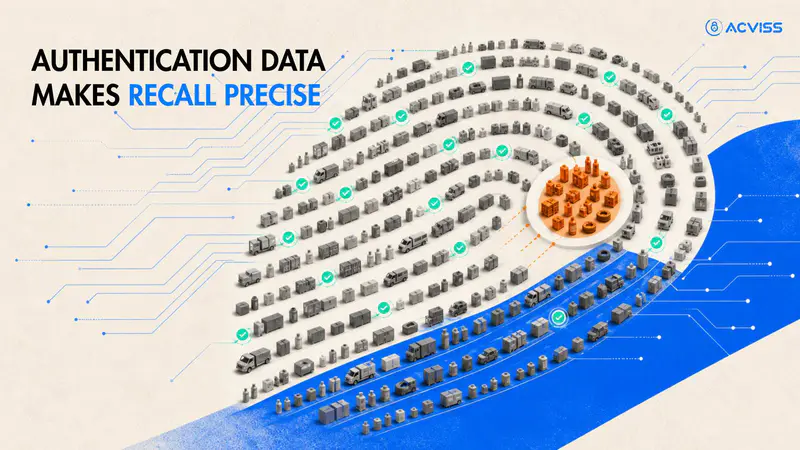
A product recall is rarely just a quality issue. It is a test of how well a business understands its own supply chain. The organisations that recover fastest are not necessarily those with the best manufacturing processes, but those that can quickly identify where affected products are, who received them, and how to isolate them without disrupting unaffected inventory.
Many businesses still rely on batch records, distributor reports, spreadsheets, and manual investigations when a recall occurs. That approach often results in broader recalls than necessary, higher financial losses, prolonged regulatory scrutiny, and avoidable damage to customer trust. Authentication data changes this equation by providing product-level intelligence that enables targeted, evidence-based recall decisions rather than blanket market withdrawals.
Why Traditional Product Recalls Often Become Larger Than Necessary
Most recalls begin with a simple question:
Which products are actually affected?
Surprisingly, many organisations cannot answer this immediately. Production data may identify a manufacturing batch, but it rarely provides complete visibility into where every affected product travelled after leaving the factory.
Without reliable downstream visibility, businesses tend to adopt the safest regulatory approach: recalling every product that might be affected.
Although understandable, this creates significant operational consequences:
Perfectly safe inventory is removed from the market.
Distribution partners experience unnecessary disruption.
Retail shelves remain empty longer than required.
Investigation costs increase dramatically.
Customer confidence declines even when the actual defect affects only a small percentage of products.
In regulated industries such as pharmaceuticals, food and beverage, automotive components, and agrochemicals, these consequences extend beyond commercial losses. Delayed or inaccurate recalls can attract regulatory action while exposing consumers to unnecessary risks.
The real challenge is therefore not initiating a recall. It is executing one with precision.
Authentication Data Turns Product Verification into Supply Chain Intelligence
Product authentication is often viewed purely as an anti-counterfeiting measure. In reality, it generates a continuous stream of operational data that becomes invaluable when investigating quality incidents or executing recalls.
Every authenticated product interaction contributes information that helps businesses understand how products move beyond manufacturing.
Authentication data can include:
Instead of asking "Which batch should we recall?", organisations can begin asking much more precise questions:
Which serialised products originated from the affected production run?
Which distributors still hold inventory?
Which retailers have already sold affected units?
Which consumers have verified or registered those products?
Which regions remain unaffected?
This shift transforms recalls from broad logistical exercises into targeted operational interventions.
Why Batch-Level Traceability Alone Is No Longer Enough

Many manufacturers already maintain batch records and therefore assume they are prepared for recalls.
Batch traceability is undoubtedly essential, but it has limitations.
A production batch often contains thousands or even hundreds of thousands of individual products distributed across multiple warehouses, distributors, retailers, export markets, and online channels.
Once products leave the factory, visibility frequently becomes fragmented.
Typical gaps include:
Secondary distribution between wholesalers.
Marketplace resellers.
Cross-border product movement.
Consumer-to-consumer resale.
Mixed warehouse inventory.
Returns entering different supply chains.
When a defect is discovered, businesses may know when products were manufactured but struggle to determine where individual units currently exist.
This is where product authentication complements traceability.
Instead of relying solely on production records, businesses gain access to product-level verification data generated throughout the product lifecycle.
The result is considerably better recall readiness without requiring complete redesign of existing ERP or warehouse systems.
The Operational Difference Between Traditional and Data-Driven Recall Execution
Recall strategies vary significantly depending on the quality of available product intelligence.
The difference is not merely technological.
It changes how quickly businesses make decisions, how accurately they communicate with partners, and how effectively they reduce commercial disruption.
Industry research has shown that digital recall ecosystems can replace lengthy manual communication processes with same-day notifications across downstream partners, significantly reducing the time required to remove affected products from circulation.
Authentication Enables More Than Verification
Authentication is often associated with answering one question:
Is this product genuine?
Modern authentication systems answer several additional questions that become critical during investigations:
Where was this product first verified?
Has the product appeared in multiple locations simultaneously?
Does its movement align with authorised distribution routes?
Is the product already with a consumer?
Has the warranty already been activated?
Are multiple products exhibiting similar verification patterns?
Collectively, these insights create operational intelligence rather than simple verification records.
When quality incidents occur, investigation teams no longer depend exclusively on manufacturing logs. They can combine authentication events with supply chain movement, consumer engagement, warranty information, and distribution data to understand the true scope of the problem.
Building Recall Readiness Through Product Authentication

Authentication should not be viewed as a technology deployed only after counterfeit incidents become frequent.
It should be considered part of a broader product integrity framework that improves visibility throughout the supply chain.
An effective recall-ready authentication strategy typically includes:
1. Unique Product Identity
Each product should carry a unique, non-replicable identity rather than a generic batch identifier. This allows individual products to be tracked throughout their lifecycle instead of treating every item within a batch as identical.
2. Continuous Verification
Authentication events should occur across multiple supply chain stages, including manufacturing, distribution, retail, field service, and consumer verification.
Each interaction strengthens visibility and reduces investigation uncertainty.
3. Supply Chain Event Capture
Authentication becomes significantly more valuable when combined with operational events such as dispatch, warehouse transfers, exports, returns, installations, warranty activation, and service history.
Together, these records create a richer chain of evidence during investigations.
4. Consumer Connectivity
Verified customer interactions provide organisations with an important communication channel during recalls.
Rather than relying solely on distributors or retailers, businesses can directly notify affected consumers with product-specific guidance where regulations permit.
Certify Creates Supply Chain Intelligence Beyond Authentication
Authentication labels are often treated as static security features attached to packaging. Their real value, however, lies in the intelligence generated every time they are scanned.
Acviss Certify combines secure product authentication with unique non-cloneable label technology, enabling every protected product to carry its own digital identity. Unlike conventional QR codes that can be copied and redistributed, non-cloneable labels are designed to resist duplication, making product verification significantly more reliable in real-world environments.
More importantly, every authentication event contributes to a growing layer of supply chain intelligence.
Instead of collecting isolated verification records, organisations gain visibility into how products move through distributors, retailers, service networks, and end customers. This information becomes particularly valuable during recalls, compliance investigations, and quality incidents where speed and accuracy determine both commercial and regulatory outcomes.
With Certify, businesses can support operational decisions by connecting authentication with intelligence such as:
Individual product identity and manufacturing information.
Batch and serial-level verification records.
Geographic scan distribution and movement trends.
Distributor and retail verification activity.
Consumer authentication history.
Warranty activation and ownership records.
Suspicious verification patterns that may indicate diversion or counterfeiting.
Rather than functioning as an isolated authentication solution, Certify helps create a connected intelligence layer that supports quality assurance, supply chain operations, investigation teams, and customer engagement simultaneously.
That intelligence becomes increasingly valuable as products continue moving through increasingly fragmented global supply chains.
Product Authentication Also Helps Prevent Warranty Fraud During Recall Events

Warranty fraud often increases during large-scale recalls. Fraudsters attempt to exploit uncertainty by submitting claims for counterfeit, unauthorised, or unrelated products, hoping manufacturers will prioritise speed over verification.
Without robust authentication, support teams are forced to manually validate purchase records, invoices, serial numbers, or distributor information. This slows recall execution while increasing operational costs.
Authentication-backed warranty verification creates an additional layer of protection by confirming whether a product:
Was genuinely manufactured by the brand.
Belongs to the affected production batch.
Has already been registered or serviced.
Has previously been reported or verified.
Originated from an authorised distribution channel.
This enables businesses to compensate legitimate customers more efficiently while reducing fraudulent warranty claims that often accompany high-profile recalls.
Implementation Challenges That Businesses Commonly Overlook
Deploying authentication and traceability technology does not automatically improve recall readiness. Many projects struggle because organisations focus on the technology while overlooking the operational processes required to support it.
Some of the most common implementation challenges include:
1. Inconsistent Data Capture
Authentication is only as valuable as the data collected throughout the supply chain. If distributors, retailers, field teams, or service centres do not consistently scan products, visibility quickly becomes fragmented.
2. Weak Governance
Different departments often maintain separate records for manufacturing, quality assurance, logistics, warranty, and customer support. Without integrated governance, valuable authentication data remains isolated rather than contributing to recall decisions.
3. Infrastructure Variability
Authentication systems must operate reliably across different environments. Research has shown that temperature, humidity, and poor connectivity can reduce authentication performance if systems are not designed with adaptive calibration and edge capabilities. Businesses operating across multiple regions should account for these practical deployment conditions rather than assuming laboratory performance will translate directly into the field.
4. Focusing Only on Compliance
Many organisations deploy traceability systems primarily to satisfy regulatory requirements. While compliance is essential, recall readiness requires broader operational visibility, including downstream product movement, consumer verification, and investigation workflows.
Successful deployments treat authentication as a continuous operational capability rather than a one-time compliance initiative.
A Practical Framework for Recall-Ready Product Integrity
Organisations looking to strengthen recall preparedness should evaluate their product integrity programme across five key dimensions.
Businesses that score well across all five areas are typically better positioned to execute targeted recalls, reduce unnecessary product withdrawals, and shorten investigation timelines.
Looking Ahead: Recall Readiness Will Depend on Connected Product Intelligence
Global supply chains are becoming more fragmented, regulations are becoming stricter, and products are increasingly moving through online marketplaces, third-party logistics providers, and complex distribution networks. In this environment, relying solely on production records or manual investigations is becoming increasingly difficult.
Industry research reflects this shift. AI-enabled authentication systems have demonstrated measurable improvements in verification accuracy while reducing authentication times from several minutes to just a few seconds. Likewise, combining multiple data sources such as visual authentication, RFID, and immutable digital records has been shown to improve detection accuracy and significantly reduce false positives. Standards such as GS1 Digital Link and increasing regulatory emphasis on end-to-end traceability further reinforce the need for connected product intelligence rather than isolated security measures.
For businesses, the objective is no longer simply detecting counterfeit products. It is creating a trusted flow of information that supports quality management, recall execution, warranty verification, compliance, supply chain visibility, and consumer confidence from the factory floor to the end user.
Authentication data sits at the centre of that capability. When integrated with traceability, supply chain intelligence, and product lifecycle information, it enables organisations to replace broad, reactive recalls with faster, evidence-based decisions that protect both customers and business continuity.
The Bottom Line
The effectiveness of a product recall is no longer measured by how quickly products are withdrawn, but by how accurately organisations can identify, isolate, and communicate about affected products without disrupting the wider supply chain.
Businesses that combine product authentication, non-cloneable label technology, traceability, supply chain intelligence, warranty verification, and brand protection are far better equipped to respond to quality incidents with confidence. Instead of relying on assumptions and manual investigations, they can make evidence-based decisions that protect consumers, reduce operational losses, and preserve brand trust.
Interested in strengthening your product recall readiness with intelligent authentication and traceability? Get in touch with the Acviss team to explore how Certify can help build a more resilient and data-driven product integrity strategy.
Frequently Asked Questions
How does authentication data improve product recall readiness?
Authentication data provides visibility into individual products, their manufacturing details, verification history, distribution movement, and consumer interactions. This allows businesses to identify affected products more precisely and execute targeted recalls instead of withdrawing entire product ranges.
Is batch traceability enough for modern recalls?
Batch traceability remains important, but it rarely provides complete downstream visibility. Combining batch information with product-level authentication and supply chain intelligence helps organisations understand where affected products are, who owns them, and how to remove them with minimal disruption.
Can authentication systems help prevent warranty fraud?
Yes. Authentication verifies whether a product is genuine before warranty claims are processed. During recall events, this helps manufacturers distinguish legitimate claims from counterfeit or unauthorised products, reducing financial losses and improving customer service efficiency.
What role does supply chain intelligence play in recall management?
Supply chain intelligence connects authentication data with manufacturing, logistics, distribution, retail, and consumer interactions. This provides investigation teams with the operational visibility needed to isolate affected inventory, monitor recall progress, and identify potential diversion or counterfeit activity.