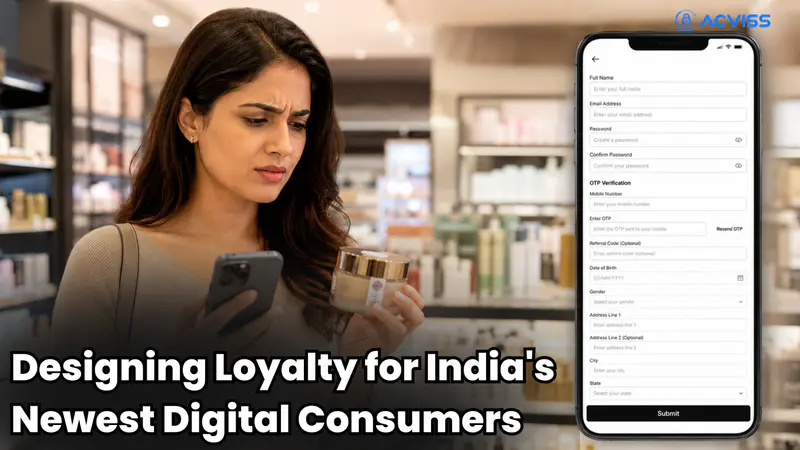
A woman in a small town buys a cooking oil brand she has been using for years. There is a QR code on the pack; it promises rewards. She opens the camera and scans it. The app asks for her email address. Then a password. Then an OTP. All in English. She closes the app.
This is not just a story, but a very common reality.
The target audience and the intent are right, but the delivery planning and execution have to be different.
This is happening at scale, every single day. And it points to one of the most significant design failures in modern brand loyalty programs.
Here is what brands need to understand about India's newest digital consumers, and how to actually reach them.
India's Newest Internet Users Are Already Your Customers
As per the April-June 2025 reports, India has approximately 1,002.85 million internet subscribers.
The internet users in India are rapidly increasing, especially since 2016, with the entry of Jio in September 2016, free data, affordable smartphones, and 4G connectivity reaching districts that had never seen reliable mobile internet. The cost of 1 GB of mobile data fell from ₹269 in 2014 to ₹9 by 2024.
Rural India now contributes 53% of the country's total internet users. Tier 2 and Tier 3 cities account for over 70% of new smartphone sales. Broadband subscribers grew from 25 crore in 2014–15 to over 103 crore by 2024–25, which is a 400% increase in a decade.
Knowing these dynamics is very important for a brand, and here is the part most brand loyalty teams are missing: these consumers are buying. They are purchasing packaged goods, personal care products, beverages, and household staples. They are your customers.
The behaviour profile of this cohort looks different from India's urban, digitally-fluent consumer. They are largely YouTube-first and WhatsApp-first, not app-store-first. They discovered the internet through video and messaging, not through e-commerce platforms or productivity tools. Many do not have email addresses. Many have never downloaded a brand app. Their digital comfort zone is narrow but deep: they are highly active within it.
Designing loyalty for this audience does not require a proper understanding of user behaviour and a design reset.
Why Standard Loyalty Programmes Fail at the First Screen

Here is a set of assumptions that fail for first-generation smartphone users:
The user has an email address.
The user can navigate a multi-step registration flow.
The user understands what "terms and conditions" means.
The user will wait for an OTP, enter it correctly, and move on.
Many brands do not consider them while building a loyalty program.
Here is what a standard programme signup actually demands.
→ First, download the app → Then, register by email or phone → Then, verify via OTP (which requires switching between apps, reading a code, and re-entering it within a countdown timer) → Then, complete a profile → Then, agree to data collection terms in English → Then, finally, arrive at the actual loyalty mechanic.
That is six to eight decision points before the consumer has received a single rupee of value. Each step is a potential exit. Research across developing markets shows that 42% of consumers are interested but do not participate in loyalty programmes simply because they do not know how to use them.
The Language Wall Nobody Talks About
As of 2025, only around 19% of India's population speaks English. Over 500 million people speak Hindi. The country has 22 official languages and hundreds of regional dialects. Most Indians, particularly first-generation smartphone users, prefer their native language; they also actively distrust content they cannot fully read.
Yet most of the loyalty program’s onboarding flow, error messages, reward description, terms and redemption instructions are in English. The UI defaults assume the user can parse phrases like "verify your identity," "redeem points," and "subscription preferences."
There is a useful concept in Indian product design circles called the "English tax." It describes what happens when an interface uses English language and branding in ways that make the product intimidating and inaccessible to non-English speakers. For a first-generation smartphone user, it signals: this product was not made for you.
A 2018 survey found 3/4 respondents believed the lack of English language proficiency was actively preventing new users from engaging with digital products. That finding holds just as strongly for loyalty programmes as it does for e-commerce or fintech.
The solution to this is designing the entire experience to be language-native. Using familiar idioms, local script, vernacular phrasing, and icons that communicate without words wherever possible. Brands that have cracked vernacular engagement in marketing, through regional YouTube ads, local influencers, Hindi WhatsApp campaigns, often revert to English the moment the consumer enters a loyalty flow. That gap is where engagement dies.
Read on: How to Design Loyalty Programmes That Actually Reach Rural India
The Trust Problem: Why Data Collection Feels Like a Threat

Urban, digitally-experienced consumers have a kind of learned tolerance for data collection. They have clicked "accept" on enough terms and conditions to develop a mental shortcut: this is what you do to use apps.
Newly digitised consumers have not built that tolerance. For them, a form asking for name, phone number, address, and date of birth is not routine.
This is a reasonable response from a consumer who has not spent years normalising digital data exchange. And it is one of the least-discussed reasons why loyalty programme registration rates are structurally low in the markets that matter most for growth.
The design principle that addresses this is simple: earn trust before asking for data. Do not start with a form. Start with value.
A consumer who scans a pack and immediately receives a confirmed reward like a cashback credit, a free product, or a discount has a reason to trust the brand before handing over personal information. Registration, if required, should come after the first value exchange.
Brands that have understood this have redesigned their entry flows accordingly. The goal is to get the consumer to their first reward in as few steps as possible, with data collection deferred to moments when they have already experienced benefit.
What the Right Entry Point Actually Looks Like
The design challenge is not complex in theory: reduce the first interaction to a single gesture. In practice, there are several tested entry-point approaches that work for low-digital-literacy consumers.
1. Scan-first, reward-first flows: The consumer scans the QR code on pack. They immediately see a confirmation of a reward. The reward is theirs. Registration is optional, or deferred to the point of redemption. This approach works because it separates the discovery moment from the friction moment.
2. Missed call authentication: India has a deep cultural familiarity with the missed call as a communication tool. In the context of loyalty, a consumer makes a missed call to a number printed on a pack. The system registers the number automatically and confirms enrollment via an outbound SMS. It works on any phone, on any network, even with poor internet connectivity.
3. WhatsApp-based engagement: With over 500 million users in India, WhatsApp is the most familiar digital interface for a majority of smartphone users. A loyalty programme delivered via WhatsApp Business, where the consumer sends a code, receives a reward confirmation, and interacts in a conversational way, eliminates the app download barrier entirely. It can be multilingual from the start. And because it lives in an app the consumer already uses daily, the cognitive load is near zero.
4. USSD and SMS as fallbacks: For consumers in genuinely low-connectivity areas, USSD-based flows (the same mechanism used for mobile recharges) and SMS confirmation systems provide a non-internet path to programme participation.
The right entry point is a design choice calibrated to where your consumer actually is on the digital literacy spectrum.
How Brands Have Done This Right
Here’s the playbook that has not been widely discussed:
1. FMCG channel loyalty: Several FMCG majors have built retailer and consumer loyalty programmes that operate entirely through WhatsApp. A retailer scans a batch code, sends it to a WhatsApp number, and receives a points confirmation in their preferred language. No app download, no email, no English interface. The engagement rates in Tier 3 markets for these programmes far exceed those of app-based equivalents in the same regions.
2. Telecom onboarding precedent: Jio's own onboarding approach in 2016 is instructive. They made voice calls free, data essentially free, and reduced the new-user experience to a single physical action: getting a SIM. There were no multi-step digital verification barriers at the point of first engagement. The design principle was: get the consumer their first unit of value with zero friction, then build the relationship.
3. Trade-to-consumer flows in agriculture inputs: Some agrochemical and seeds brands have used missed call mechanics and IVR (Interactive Voice Response) to onboard farmers into loyalty programmes. A farmer gives a missed call after buying a certified product; they receive a reward SMS in their regional language. These programmes have documented completion rates well above industry averages for the same demographic.
The common pattern across all successful examples: the design started from the consumer's actual capability, not from the brand's ideal workflow. They asked: what can this consumer do in 30 seconds without help? And built the entry point around that answer.
The First-Mover Advantage You Cannot Afford to Miss

India's newly digitised consumers are at the most impressionable stage of their brand journey. They are forming their loyalties right now. Their preferences are not yet entrenched. The brands that reach them, reward them, and build a relationship before their purchasing patterns solidify will hold a structural advantage that compounds over time.
Brands are advertising to these consumers via television, local radio, vernacular YouTube, but almost none are building the engagement infrastructure to convert that awareness into loyalty data, repeat purchase behaviour, and first-party consumer relationships.
That gap is closing. And when competitors do invest in this design, the brands that built early will have the consumer relationships, the first-party data, and the loyalty depth that late movers cannot replicate quickly.
The argument is simple: the cost of designing for this consumer now is low. The cost of trying to displace established loyalty relationships later is high.
Start with one product line. One SKU. One entry-point mechanic. Measure completion rates, first-time rewards claimed, and return scan rates. The data will tell the story. And the story, for every brand that has taken this seriously, has been the same: the consumer was ready. The programme just wasn't.
How Acviss Helps Brands Connect with Verified Consumers
Acviss Certify
Non-cloneable QR codes on product packaging that authenticate and engage in the same scan
Supports simplified scan-first consumer flows, reward at the moment of verification
Real-time analytics to track engagement by region, product line, and consumer profile
Acviss Bonus
Loyalty campaign layer for verified, authenticated consumers
Designed to layer onto Certify scan flows, enabling brands to build engagement without a separate app or registration barrier
Together, these tools allow brands to authenticate the product, verify the consumer, and reward in a single scan, the exact entry-point design that works for India's newest digital consumers.
Explore how Acviss helps brands build loyalty from the moment of scan. Visit acviss.com
FAQs
What makes loyalty programmes fail for rural consumers in India?
The most common failure points are English-only interfaces, multi-step registration flows, OTP dependency, and the requirement for an email address. Each of these assumes a level of digital fluency that first-generation smartphone users have not yet developed, causing drop-off before the consumer receives any value.
What is a scan-first loyalty flow and why does it work?
A scan-first flow lets a consumer scan a QR code and immediately receive a confirmed reward, before any registration is required. By delivering value before asking for data, it earns trust and keeps the first interaction to a single, frictionless gesture. Registration is deferred to the point of redemption, when the consumer already has a reason to stay.
How does WhatsApp-based loyalty engagement work for FMCG brands?
Through WhatsApp Business API, brands can accept a product code sent by the consumer, confirm rewards in real time, and manage the full loyalty interaction conversationally, in any regional language. Because WhatsApp is already the most-used app for India's newer internet users, it eliminates the app download barrier entirely.
Why is language a bigger barrier than technology in loyalty programme adoption?
Most consumers in India are not English-first. When a loyalty interface defaults to English for instructions, error messages, reward descriptions, and terms, it signals that the product was not designed for them. Language exclusion causes drop-off before any technical friction is encountered.
What is the "English tax" in digital product design?
The English tax refers to the implicit penalty placed on non-English speakers when digital interfaces default to English, making products harder to use, understand, and trust for consumers who are more comfortable in vernacular languages. For brand loyalty programmes, this tax directly reduces participation rates in Tier 2, Tier 3, and rural markets.
How can brands build trust with first-time digital consumers before asking for data?
Deliver value first. A consumer who receives a reward instantly upon first scan has a concrete reason to trust the brand before handing over personal information. Data collection should come after the first positive experience, not as the condition for accessing it. This sequence shift alone significantly improves registration completion rates.