Most counterfeit discussions focus on luxury fashion, pharmaceuticals, electronics, or high-margin FMCG products. Cooperative brands are rarely part of the conversation despite operating some of the largest and most operationally complex supply chains in India.
That gap matters because brands such as Amul do not function like conventional companies. Millions of producers contribute to a shared identity that consumers trust implicitly. The brand belongs to everyone inside the network, which also means responsibility, operational control, and vulnerability are distributed across thousands of moving parts.
For cooperative organisations, counterfeiting is not simply about fake products appearing outside the system. The harder problem is proving authenticity consistently inside a fragmented ecosystem where procurement, production, packaging, logistics, and distribution may all operate under separate layers of governance.
Why Amul Is Not a Normal FMCG Brand
Most FMCG brands are built around centralised ownership. Manufacturing is tightly controlled, packaging standards are standardised nationally, and supply chain governance flows downward from a corporate structure with clear operational authority.
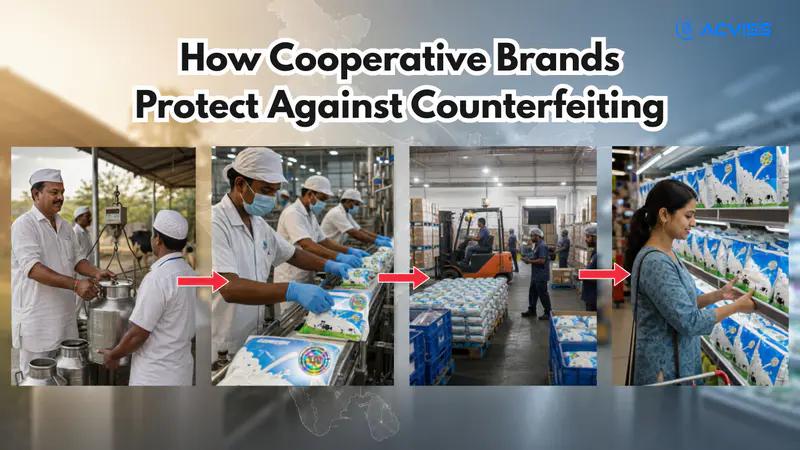
Amul operates differently. The brand is managed by the Gujarat Cooperative Milk Marketing Federation, but the underlying ecosystem includes millions of dairy farmers connected through village societies, district unions, chilling centres, processing plants, transport systems, regional distributors, and retail networks spread across India.
Milk may originate in one village, move through multiple aggregation points, enter different processing facilities, and finally appear on a retail shelf hundreds of kilometres away under the same collective mark.
That structure is precisely what made Amul one of India’s most successful cooperative models. It allowed decentralised milk procurement on an enormous scale while preserving collective ownership and farmer participation. But operationally, it also creates a very different brand protection challenge compared to a conventional packaged goods company.
A centralised manufacturer usually knows:
where a product was produced,
which line produced it,
which packaging batch was used,
which warehouse dispatched it,
and which distributors handled it.
Inside cooperative ecosystems, those workflows are often distributed across separate operational entities with different levels of technological maturity.
That distinction changes everything about product authentication and counterfeit prevention.
The Counterfeit Problem Inside Cooperative Ecosystems Looks Different

Counterfeiting within cooperative ecosystems is rarely straightforward.
A fake luxury handbag is obviously outside the legitimate manufacturing system. Cooperative counterfeiting is often harder to classify because unauthorised products can enter partially legitimate supply chains and still appear authentic to consumers.
This is particularly common in categories involving:
Dairy,
Edible oils,
Fertilisers,
Grains,
Seeds,
Handloom products.
The counterfeit risk is not limited to illegal factories replicating branded packaging. It also includes:
non-member sourcing entering authorised procurement systems,
local repackaging using cooperative branding,
unauthorised distributors selling diverted inventory,
counterfeit packaging supplied into regional ecosystems,
and expired stock re-entering secondary markets.
The operational challenge becomes identifying whether the product genuinely belongs within the authorised cooperative network at all.
That is a much more difficult problem than detecting visually fake packaging.
When Thousands of Producers Share One Brand
The cooperative model distributes both value creation and operational risk.
Every participating producer becomes part of the brand’s trust architecture. If one node fails operationally, the reputational impact affects the entire collective identity.
This creates vulnerabilities that most conventional anti-counterfeiting discussions completely overlook.
A regional packaging vendor using inconsistent coding standards may weaken traceability for an entire product line. A distributor bypassing verification workflows can create blind spots that counterfeiters exploit later. A procurement centre accepting unauthorised products during supply shortages may unintentionally compromise authentication integrity downstream.
These failures are often operational rather than criminal in intent.
That is what makes cooperative brand protection uniquely complicated.
In many industries, counterfeit prevention focuses heavily on keeping external bad actors out. Cooperative ecosystems also have to manage internal inconsistency, fragmented governance, and varying operational discipline across geographically distributed networks.
Even packaging itself becomes difficult to standardise fully.
Regional cooperatives frequently work with multiple print vendors, different substrate suppliers, varying coding equipment, and separate packaging procurement arrangements. Over time, visual inconsistencies emerge naturally across legitimate packaging.
Counterfeiters exploit exactly that kind of ambiguity. Consumers eventually stop knowing what “real” packaging should consistently look like.
Why GI Tags and Trademark Protection Are Not Enough

India has made significant progress in strengthening trademark and Geographical Indication protections across agricultural and cooperative-linked industries. Products associated with regional identity, farming traditions, and collective production systems increasingly benefit from stronger legal recognition.
But legal ownership and operational authenticity are not the same thing.
A GI tag can establish that only authorised producers from a specific region may use a protected identity. It does not independently guarantee:
item-level traceability,
packaging authenticity,
distributor legitimacy,
cold-chain integrity,
or real-time product verification.
A product may visually imitate a GI-linked cooperative brand convincingly even when the sourcing itself is unauthorised.
That distinction becomes critical in fragmented markets where enforcement capacity remains limited relative to supply chain scale.
Many organisations overestimate how much protection legal registration alone provides. Trademark protection helps establish rights. It does not automatically create operational visibility.
The Real Problem Is Traceability Fragmentation
Most cooperative supply chains are not built on a unified digital architecture.
The producer, procurement centre, processor, packaging vendor, warehouse operator, transporter, and distributor often use separate systems that do not synchronise cleanly with one another. Some units may operate sophisticated ERP infrastructure while others still rely on spreadsheets or partially digitised workflows.
This fragmentation creates serious traceability blind spots.
A batch may be visible during procurement but lose visibility temporarily during transport or repackaging stages. Serialisation systems deployed centrally may not integrate properly with regional dispatch operations. Verification records may exist in different formats across federations, unions, and logistics partners.
Once these inconsistencies accumulate, authentication reliability starts weakening.
This is one reason many cooperative traceability deployments perform well during pilot programmes but struggle after scale.
Pilot environments operate under controlled conditions. National cooperative ecosystems do not.
Rural internet instability, multilingual operator environments, scanner inconsistencies, damaged labels, moisture exposure, packaging abrasion, and operator workarounds all affect how authentication systems behave in practice.
The technology itself may function correctly. The surrounding operational ecosystem often introduces friction that designers have underestimated.
Why Traditional QR Codes Are No Longer Enough
Many organisations still approach authentication as a packaging exercise rather than a supply chain governance system.
A QR code is added to the packaging. Consumers are encouraged to scan products. The deployment is considered complete.
That model has limitations, especially in cooperative ecosystems.
Once counterfeiters understand packaging structures, static QR formats become relatively easy to duplicate visually. Duplicate scans may go undetected if monitoring systems lack strong anomaly detection capability. In fragmented retail environments, consumers may not scan consistently enough for cloned codes to become immediately visible operationally.
This is why non-cloneable label technology is becoming increasingly important for cooperative brand protection.
Instead of relying solely on visible printed identifiers, advanced authentication systems now combine:
secure UID architectures,
cryptographic verification logic,
dynamic scan intelligence,
and duplication detection workflows.
The objective is not merely verifying that a label exists. The objective is to establish whether:
The product genuinely originated from an authorised cooperative member network,
The package has been substituted.
The code has been replicated elsewhere,
The product moved through unexpected supply chain pathways.
Acviss’s Certify anti-counterfeiting is becoming increasingly relevant in these environments because they combine product authentication, brand protection, consumer verification, and non-cloneable label technology within operationally scalable frameworks.
For cooperative ecosystems, this matters because authentication can no longer depend solely on visual trust.
It needs to become verifiable trust.
Marketplace Monitoring Has Become a Major Cooperative Blind Spot

Cooperative brands were historically built around physical retail ecosystems. Digital commerce changed the threat landscape entirely.
Today, counterfeit and unauthorised products increasingly move through:
marketplace sellers,
informal B2B trading groups,
regional online distributors,
social commerce channels,
and secondary inventory networks.
According to Europol Intellectual Property Crime Reports, fragmented digital commerce ecosystems have significantly accelerated counterfeit distribution globally.
Cooperative brands face a particularly difficult challenge here because their products are associated with mass accessibility and broad distribution. Consumers may not immediately question authenticity when products appear through unofficial online sellers at slightly discounted prices.
This has pushed modern cooperative brand protection into areas that many federations were never originally structured to manage.
Brand protection teams increasingly need capabilities involving:
marketplace monitoring,
counterfeit listing removal,
seller intelligence analysis,
domain monitoring,
image similarity detection,
and digital infringement enforcement.
The anti-counterfeit perimeter is no longer confined to factories and distributors.
It now extends into digital ecosystems where counterfeiters can scale extremely quickly with very little infrastructure.
Why Cooperative Authentication Deployments Fail After Scale
The industry talks extensively about successful pilots. The real operational story usually emerges later.
Many cooperative authentication systems weaken after expansion because operational discipline gradually erodes under real-world conditions.
Member onboarding standards drift. Regional packaging procurement becomes inconsistent again under cost pressure. Distributors bypass scanning steps to improve dispatch speed. Retailers stop participating in verification workflows consistently. Duplicate scan alerts remain unresolved because escalation ownership was never clearly defined.
Environmental realities also create problems rarely discussed during deployment planning.
Cold-chain moisture damages labels faster than expected. Printing inconsistencies emerge across regional facilities. Legacy packaging lines struggle to accommodate serialisation changes without affecting throughput. Verification systems designed for urban connectivity conditions perform inconsistently in rural procurement environments.
Strong deployments usually share one characteristic. They treat authentication as an operational governance system rather than a packaging technology project.
That distinction separates sustainable deployments from short-lived pilots.
The Future of Cooperative Brand Protection in India
The next phase of cooperative brand protection in India will not be defined by standalone technologies alone. It will be defined by how effectively cooperative ecosystems integrate authentication, traceability, marketplace monitoring, and supply chain governance into a unified operational framework.
That shift is already beginning.
Cooperatives are gradually recognising that authentication systems can provide more than counterfeit prevention. They can strengthen:
recall management,
distributor accountability,
product verification,
customer engagement,
loyalty programmes,
and compliance readiness.
Global regulatory expectations around traceability and sourcing transparency are also increasing steadily. Frameworks linked to food safety, sustainability reporting, export compliance, and due diligence are pushing organisations towards stronger verification infrastructure across agricultural and food ecosystems. For cooperative brands, the long-term challenge is not simply protecting trademarks.
It is protecting collective trust at an industrial scale while operating across fragmented, decentralised, and deeply human supply chains. That requires more than labels. It requires operational visibility that survives beyond the pilot stage.
Interested in learning more? Get in touch with us.