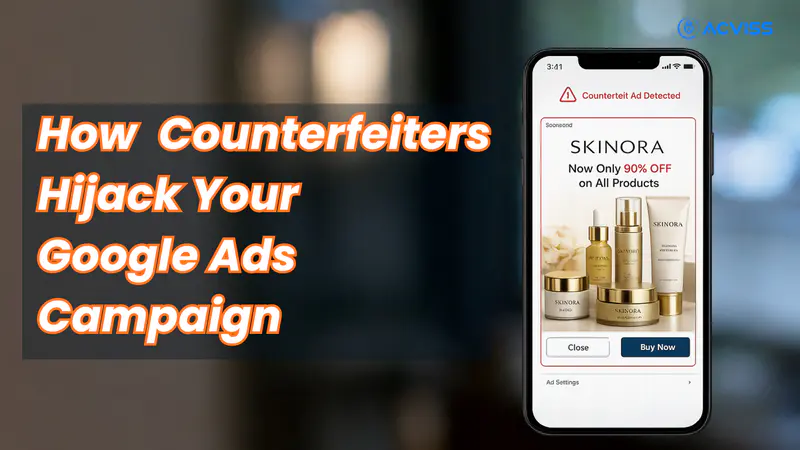
A consumer who already knows your brand, has seen your ad, heard about you from a friend, or bought from you before. If they open Google and type your brand name, they are going to click the very first result at the top of the page.
What if that result is not yours?
Many counterfeits pay Google to be there. The consumer lands on a convincing fake storefront, buys a product, and when it arrives substandard, or does not arrive at all, they do not blame the anonymous scammer. They blame you.
According to a 2025 State of Brand Protection report, 71.6% of buyers unknowingly purchase fake products, up from 50% in 2023. And 87% of consumers begin their product search online. Your brand is one of the top real estate is google search, and it is sold to the highest bidder.
Most brand teams are aware of fake listings on Amazon and counterfeit accounts on Instagram. Paid search brand abuse, where counterfeiters and grey market sellers bid on your own brand keywords in Google Ads, is an entirely different threat. It is specific, high-damage, and almost entirely absent from most brand protection programmes.
This blog breaks down how it works, who is doing it, and what you need to do about it.
How Paid Search Brand Abuse Actually Works
Google Ads runs on an open keyword auction. This means almost anyone can bid on any keyword they want, including your brand name, your product names, and variations of both. While Google does verify the identity of account holders today, it still does not check whether someone has the actual right to sell your specific products before they bid.
A bad actor starts by setting up a fraudulent storefront. This is often a convincing clone of your real website that uses your stolen logos and product imagery. Next, they open a Google Ads account and bid aggressively on your brand name. They usually combine it with high-intent search terms like "buy [Brand Name]," "[Brand Name] official site," or "[Brand Name] clearance sale."
Because counterfeiters do not have to pay for research, development, or quality control, their profit margins are massive. This gives them enough cash to outbid your marketing team's cost-per-click limits. Even though Google's system favours the real brand owner with cheaper clicks, the fraudsters simply throw more money at the auction to force their fake ad to the top of the search results. This pushes your legitimate website down, and unsuspecting consumers click the wrong link.
Industry data shows that global digital ad fraud hit an estimated 84 billion dollars in 2023, and brand keyword abuse is one of its fastest-growing forms. According to research by BrandVerity, trademark abuse intercepts up to 30% of brand traffic in certain industries. That is traffic and revenue that already belonged to you.
The Three Types of Bad Actors Buying Your Brand Name

Not every rogue ad is selling a counterfeit. Effective paid search brand protection requires understanding the three distinct actors using this method, because the damage each causes is different, and so is the response.
The grey market importer is the most misunderstood of the three. Their products are real. But in categories like pharmaceuticals, food, cosmetics, and electronics, a genuine product sold outside its intended distribution channel can carry different formulations, labelling, compliance certifications, or storage histories. The consumer assumes they bought the real thing. The product may technically be real, but regulatory exposure for your brand is not.
Why This Is Harder to Catch Than a Fake Marketplace Listing

A counterfeit listing on an e-commerce marketplace is visible 24 hours a day, seven days a week, to anyone who looks. A paid search ad is not.
Bad actors in this space are sophisticated. They use three techniques specifically designed to evade detection by brand protection teams.
Dayparting: Fraudulent ads are scheduled to run only during hours when your legal and marketing teams are offline, like late at night, on weekends, and on public holidays.
Geo-targeting: An ad might only appear to users searching from specific cities or postal codes. If a counterfeiter targets consumers in Mumbai or Hyderabad but your brand team is searching from a Bengaluru office, the ad is invisible to you.
Device targeting and cloaking: Some bad actors run mobile-only ad campaigns that never appear on desktop browsers, or use cloaking to show Google's crawler one page and show the consumer a completely different storefront.
The result is that manual monitoring, where you type your brand into Google occasionally dies not give you a full picture of what is happening. The gaps are invisible until an automated monitoring system flags them.
What Happens to Your Customer After the Click
The consumer clicked the top result on Google. To them, that carries an implicit trust signal. What happens next depends on which type of bad actor bought that ad slot.
If it is a counterfeiter, they land on a mirror site that looks credible. They purchase. The product arrives damaged, wrong, or not at all. The customer contacts your official support team or leaves a one-star review naming your brand. You have lost the sale, the customer's lifetime value, and your review score.
If it is an unauthorised reseller, they receive a genuine product but with no official warranty, no customer service, and potentially a different specification than what your authorised channel sells. When something goes wrong, they come to you. You have no record of the purchase.
If it is a grey market importer, the stakes can be higher still. In pharmaceuticals, a product sourced from a different regulatory market may carry different dosage instructions or inactive ingredients. In food and FMCG, storage and cold chain conditions may have been compromised. The consumer believes they bought from a trusted brand. The liability, if something goes wrong, points back to you.
In all three cases, the consumer's negative experience is attributed to your brand. That is the real cost of paid search brand abuse: the damage accumulates silently in customer trust and brand equity, long before it shows up in revenue numbers.
How to Monitor Your Brand's Paid Search Landscape
Catching Google ads counterfeit requires moving beyond manual spot-checks. Here is a practical starting framework.
Incognito searches across devices and locations: Search your brand name in private/incognito mode, on both desktop and mobile, and if possible from different geographic locations using a VPN. What appears differs significantly by device and region.
Watch your branded CPC trends: A rising cost-per-click on your own brand keywords is often the first signal that new bidders have entered the auction and are inflating competition.
Use Google's Ad Transparency Centre: This tool allows you to see ads running across Google's network. Although it is limited to an extent, it is useful.
Document everything; When you find an infringing ad, take screenshots with date and time stamps, capture the display URL and final destination URL, and note the geography and device. This documentation is your evidence package for both Google complaints and legal action.
Set up brand alerts: Configure Google Alerts for your brand name combined with terms like "buy," "official," "discount," "reseller," and "clearance." These catch new domains and pages exploiting your brand name in content even when they are not actively running paid ads.
For brands operating at scale or in high-risk verticals like pharma, FMCG, or luxury goods, manual monitoring at any cadence is insufficient. Automated, continuous monitoring across geographies, devices, and dayparts is the only way to catch the full picture.
Google's Trademark Policy and Its Structural Limits

Google does have a trademark policy, and it is important to understand exactly what it does and does not cover.
Google restricts the use of your trademark in ad copy text. If an unauthorised advertiser uses your brand name in their headline or ad description without permission, you can file a trademark complaint and Google may restrict that advertiser from using your trademark in their copy.
What Google does not restrict is bidding on your brand name as a keyword. Google's own policy states: "We don't investigate or restrict trademarks as keywords." Any advertiser, authorised or otherwise, can bid on your brand name and trigger their ad when a consumer searches for you. The ad may not contain your name in the text — but it will still appear on your branded search results page.
This is the structural gap that most brand teams do not understand until it is too late.
The complaint process itself is reactive by design. Google reviews complaints and may restrict a specific advertiser's ad copy — but a new ad from a different domain can appear the next day, and the process starts again. The enforcement burden falls entirely on the brand owner, not on the platform.
Legal escalation is an option in serious cases. In April 2024, Dr. Martens filed a trademark infringement lawsuit in the UK High Court, accusing Temu of bidding on branded keywords including "Dr Martens" and "Airwair" in Google Ads to promote lookalike products. The case illustrated both the scale of the problem and the limitations of relying on platform policy alone. Litigation is slow and expensive. Platform policy is porous. Neither is a substitute for continuous monitoring.
How Acviss Truviss Helps
Truviss : Online Brand Protection Tool
It's the best AI-powered online brand monitoring solution. Detects and acts on digital threats across paid search, marketplaces, social platforms, and beyond. It gives brand teams the visibility and evidence they need to shut down abuse before it reaches the consumer.
AI and ML-powered scanning across digital channels to detect fake ads, unauthorised brand use in paid search, counterfeit listings, and IP infringements in real time
Identifies the fraudulent domains and mirror storefronts that bad actors are driving paid search traffic to neutralise the operation at its root, not just its symptom
Generates timestamped evidence documentation, including ad screenshots, URLs, and violation records, ready for platform complaints and legal action
Provides continuous monitoring across geographies, devices, and time zones covering the day parted and geo-targeted campaigns that manual checks will never surface
Sits within a wider 360-degree online brand protection programme: paid search, marketplaces, social platforms, and the grey web, monitored together
The key difference between reactive and proactive brand protection is detection speed. Truviss finds the infringing ad before the customer does.
Value Outcomes
Fewer infringing ads reaching high-intent consumers
Faster enforcement with platform-ready evidence
Cleaner attribution data in your paid search campaigns
Reduced CPC inflation caused by unauthorised bidders in your brand keyword auctions
Strengthen your online brand protection programme with Truviss → Book a Demo
What Ongoing Paid Search Monitoring Looks Like in Practice
Paid search brand protection is an ongoing discipline and belongs within your brand protection programme as a permanent function.
A practical ongoing cadence looks something like this.
Weekly: Run branded SERP checks across your key markets, on both mobile and desktop, using incognito mode. Flag any sponsored results that are not yours.
Monthly: Review your branded keyword CPC trends in Google Ads. Unusual spikes in cost-per-click often signal new unauthorised bidders entering your auction. Brief your paid search team and legal team together as this is not only a performance marketing issue.
Quarterly: Compile your enforcement actions, document patterns by geography and bad actor type, and assess whether gaps in your monitoring coverage need to be addressed with automated tooling.
Your brand name is your most valuable digital asset. The search query "[Your Brand] buy online" represents a consumer who is ready to spend. Whether that purchase happens on your terms, or someone else's, depends entirely on who is watching your search landscape right now.
Frequently Asked Questions
What is brand keyword hijacking?
Brand keyword hijacking is when an unauthorised third party like a counterfeiter, grey market importer, or rogue reseller, bids on your registered brand name in Google Ads, making their ad appear when consumers search specifically for your brand.
Can a counterfeiter legally bid on my brand name in Google Ads?
Yes. Google explicitly does not restrict trademark use as a keyword. If an advertiser includes your brand name in their headline or description without authorisation, you can file a complaint. But the keyword bid itself is not restricted.
What is the difference between a competitor bidding on my brand and a counterfeiter doing it?
A competitor bidding on your brand name is a legitimate, if unwelcome, marketing tactic. A counterfeiter or grey market seller doing the same is brand abuse. They are using your brand's equity to sell products that damage consumer trust, erode your pricing, or in serious cases harm consumers.
How do I know if someone is running Google Ads using my brand name?
Search your brand name in incognito mode, on mobile and desktop, from different locations if possible. Check Google's Ad Transparency Centre. Monitor your branded keyword CPCs for unusual increases. Automated monitoring tools for brand keyword hijacking, provide continuous visibility that manual checks cannot.
What can I actually do if a counterfeiter is bidding on my brand keywords?
File a trademark complaint with Google if they are using your trademark in ad copy text. Ensure you have a registered trademark in the relevant country. Document the ad with screenshots and timestamps. Identify the destination domain and pursue a takedown of the underlying website. For persistent or high-scale abuse, legal escalation is an option.
How is paid search brand abuse different from marketplace counterfeiting?
A fake listing on a marketplace is visible continuously and can be found by anyone searching the platform. A paid search ad can be dayparted, geo-targeted, and device-specific, invisible to manual spot checks and to platform crawlers. Paid search abuse also reaches consumers at a higher-intent moment: they have already decided they want your brand and are actively searching for it. The trust signal of appearing at the top of Google is itself weaponised against your brand.