Illicit tobacco rarely dominates discussions around counterfeiting, yet few illicit markets operate at its scale. According to the World Health Organisation, illicit cigarettes account for roughly 11% of global cigarette consumption, representing hundreds of billions of cigarettes moving through unauthorised channels every year. The numbers are staggering, but volume alone does not explain why illicit tobacco remains one of the most persistent challenges in global trade.
Unlike counterfeit luxury goods or fake pharmaceuticals, illicit tobacco sits at the intersection of public health policy, organised crime, taxation, international trade, and brand protection. Criminal networks, smugglers, rogue manufacturers, distributors, and even legitimate supply chain participants can all become part of the same ecosystem. For tobacco manufacturers, the consequences extend far beyond lost sales. Illicit trade erodes supply chain visibility, weakens regulatory compliance efforts, undermines brand integrity, and creates blind spots that can persist for years before they are detected.
The Scale of the Illicit Tobacco Economy
Few illicit product categories generate the revenues, distribution reach, and operational sophistication associated with tobacco. While public attention often focuses on counterfeit handbags, electronics, or pharmaceuticals, tobacco remains one of the largest illicit consumer product markets in the world.
The WHO estimates that more than 650 billion illicit cigarettes are consumed annually. Governments collectively lose tens of billions of dollars in tax revenues each year as products bypass legitimate taxation systems. The broader economic impact is even larger when healthcare costs, enforcement expenditure, lost productivity, and criminal activity are considered.
What makes the illicit tobacco economy particularly resilient is its ability to adapt to changing market conditions. Criminal networks respond quickly to tax increases, regulatory changes, enforcement crackdowns, and supply disruptions. Routes shift, manufacturing locations change, and distribution channels evolve, often faster than enforcement agencies can react.
Asia occupies a particularly important position within this ecosystem. The region contains some of the world's largest tobacco-consuming populations, major manufacturing centres, extensive maritime trade routes, and numerous cross-border trading corridors. Large differences in taxation between neighbouring countries create arbitrage opportunities, making certain routes highly attractive to illicit operators.
For tobacco companies operating across Asia-Pacific markets, the challenge is rarely limited to a single country. Products may be manufactured in one jurisdiction, diverted through another, repackaged in a third, and ultimately sold thousands of kilometres away from their intended destination.
Not All Illicit Tobacco Is Counterfeit

One of the most common misconceptions surrounding illicit tobacco is the assumption that every illicit cigarette is counterfeit. In reality, the illicit tobacco market consists of multiple categories, each requiring a different enforcement and brand protection strategy.
Understanding these distinctions is critical because a solution that works against counterfeit products may be ineffective against diversion or unauthorised manufacturing.
Counterfeit Cigarettes
Counterfeit cigarettes are what most people imagine when discussing illicit tobacco. These products illegally replicate legitimate brands, trademarks, packaging designs, and visual identifiers.
Modern counterfeit operations are often surprisingly sophisticated. Packaging quality has improved dramatically over the past decade, making visual inspection alone increasingly unreliable. In many investigations, counterfeit products have successfully entered distribution channels and remained undetected until laboratory testing or detailed forensic analysis was conducted.
For tobacco manufacturers, counterfeit products represent a direct attack on intellectual property, trademark rights, and brand equity.
Contraband Genuine Products
This category creates a far more complex problem.
The products themselves are genuine. They were manufactured by authorised facilities and originally entered legitimate supply chains. The issue arises when those products are diverted into markets where they were never intended to be sold.
A pack produced for one country may appear in another market without appropriate duties, taxes, or regulatory approvals. From a consumer perspective, the product may appear entirely authentic because it is.
This is where traditional anti-counterfeiting measures often struggle. Authentication alone cannot identify supply chain diversion if the product itself is legitimate.
Illicitly Manufactured Tobacco
A third category consists of products manufactured entirely outside regulatory systems.
These operations may not imitate recognised brands at all. Instead, they produce tobacco products through unlicensed facilities that avoid taxation, quality controls, reporting obligations, and regulatory oversight.
Enforcement agencies across Europe and Asia have increasingly uncovered highly sophisticated illicit factories capable of producing millions of cigarettes every week. Many operate with commercial-grade manufacturing equipment that rivals legitimate production facilities.
Why Tobacco Creates a Different Brand Protection Problem
Most industries benefit from an important source of intelligence when counterfeit products enter the market: consumer complaints.
A customer who purchases a fake luxury item may complain about quality issues. Pharmaceutical companies receive reports when products fail to perform as expected. Electronics manufacturers often discover counterfeit infiltration through warranty claims and customer support interactions.
Tobacco operates differently.
Consumers purchasing illicit cigarettes frequently understand that they are buying products outside authorised channels. In many cases, lower prices are the primary motivation behind the purchase decision. As a result, complaints are significantly less common than in other industries.
This creates a visibility problem that many tobacco companies underestimate.
The absence of consumer reports does not indicate the absence of illicit activity. It simply removes one of the most valuable sources of intelligence available to brand protection teams.
As a result, tobacco manufacturers often discover illicit activity through customs seizures, enforcement investigations, marketplace monitoring programmes, distributor audits, or irregularities within supply chain data rather than direct customer feedback.
This delayed visibility frequently allows illicit networks to establish significant market penetration before intervention occurs.
Following the Route: How Illicit Tobacco Moves Across Borders

The image of a smuggler carrying cigarettes across a border captures only a small part of the modern illicit tobacco economy.
Today's operations increasingly resemble professional supply chains.
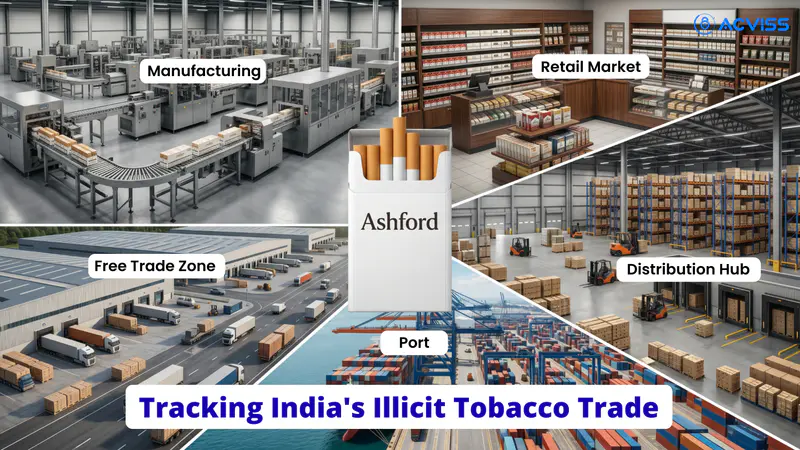
Products move through manufacturing facilities, logistics providers, warehouses, distributors, freight forwarders, maritime routes, and retail channels. The primary difference is that portions of the network operate outside regulatory oversight.
A typical illicit tobacco journey may involve:
Manufacturing in a high-risk production location
Temporary storage within a free trade zone
Multiple transhipment events through regional ports
Documentation changes designed to obscure origin
Retail sale through informal or grey-market channels
Every transfer introduces another layer of complexity for investigators attempting to reconstruct product movements.
By the time authorities seize illicit products, determining where diversion occurred often becomes a forensic exercise involving customs records, shipping documentation, warehouse audits, and increasingly, digital traceability systems.
Why Free Trade Zones Continue to Attract Illicit Tobacco Networks
Free trade zones were established to facilitate international commerce, reduce customs friction, and encourage economic activity. Most operate entirely within legal frameworks and serve important commercial purposes.
However, certain free trade zones have also attracted illicit operators seeking opportunities to obscure the origins and movements of products.
According to the WHO Protocol to Eliminate Illicit Trade in Tobacco Products and various enforcement investigations, free trade zones have been used for activities including repackaging, relabelling, transhipment, and documentation manipulation.
The challenge is not necessarily the free trade zone itself. The challenge lies in visibility.
When products move through multiple jurisdictions, documentation systems, and intermediaries, establishing a clear chain of custody becomes increasingly difficult. Every missing event creates another opportunity for diversion.
This is one of the primary reasons why modern regulatory frameworks increasingly focus on traceability rather than relying exclusively on enforcement actions.
The Regulatory Shift Towards Track and Trace
For many years, tobacco enforcement relied heavily on seizures and investigations. Authorities would identify illicit products after they had already entered circulation and attempt to trace them backwards through fragmented supply chains.
The approach had obvious limitations. Once products disappeared into complex distribution networks, visibility was largely lost.
Track and trace systems emerged as an attempt to solve this problem by creating digital records throughout the product lifecycle.
Rather than asking where a seized product came from after the fact, regulators increasingly expect manufacturers to maintain records that can answer the question immediately.
The WHO Framework Convention on Tobacco Control's Protocol to Eliminate Illicit Trade in Tobacco Products established one of the most influential frameworks for this approach.
The protocol promotes the use of systems capable of recording:
Manufacturing location
Production date and time
Product identifiers
Shipment information
Supply chain transactions
Distribution events
The objective is not merely compliance; it is accountability throughout the supply chain.
What Tobacco Traceability Looks Like in Practice

Many organisations assume compliance begins and ends with printing a serial number on a pack. The reality is considerably more complicated.
Effective illicit tobacco track and trace programmes depend on multiple interconnected systems operating consistently across manufacturing, logistics, distribution, and regulatory environments.
A typical implementation includes:
Packaging line integration
Aggregation relationships between packs, cartons, and cases
Event capture systems
Centralised data repositories
Regulatory reporting mechanisms
Verification and audit capabilities
Each component introduces operational challenges.
Packaging lines may require modifications to support high-speed code generation and verification. Existing ERP systems often need extensive integration work. Distributors must be onboarded into new reporting processes. Data governance frameworks must be established to ensure information remains accurate and auditable.
Many projects discover that technology deployment is only a small part of the overall effort.
The more difficult challenge is achieving operational consistency across every participant in the supply chain.
Why Tobacco Track and Trace Programmes Fail
Regulatory compliance does not automatically produce supply chain visibility. Many organisations learn this lesson after substantial investments. Several recurring issues appear across large-scale implementations:
Incomplete Supply Chain Participation
A traceability system is only as strong as the participants contributing data.
When distributors, wholesalers, logistics providers, or regional partners fail to record events consistently, visibility gaps emerge quickly.
Weak Data Governance
Serialisation generates enormous volumes of information.
Without clear ownership, audit processes, and validation procedures, data quality deteriorates rapidly.
Integration Problems
Manufacturing systems, warehouse platforms, regulatory repositories, and enterprise software frequently operate independently.
Synchronising these environments often proves far more challenging than anticipated during procurement.
Authentication Without Traceability
Many organisations focus heavily on product verification while overlooking movement visibility.
Authenticating a product may confirm legitimacy, but it does not necessarily reveal where diversion occurred.
The strongest programmes combine authentication, traceability, monitoring, and enforcement intelligence within a unified framework.
India's Illicit Tobacco Challenge
India presents one of the most complex illicit tobacco environments globally.
The market combines domestic production, informal distribution channels, cross-border movement, varying tax structures, and a diverse mix of tobacco products.
This complexity creates challenges for both regulators and manufacturers.
Unlike markets where illicit activity is primarily driven by cross-border smuggling, India faces a combination of domestic and international factors. Products may originate from unregulated local manufacturing operations, enter through cross-border channels, or be diverted from legitimate distribution networks.
For brand protection teams, identifying the source of the problem is often as important as identifying the product itself.
A counterfeit product, a diverted genuine product, and an illicitly manufactured product may require entirely different investigative and enforcement responses.
Where Authentication Technology Fits Into Tobacco Brand Protection

Track and trace systems answer questions about movement. Authentication systems answer questions about legitimacy. Both are essential, but they solve different problems.
Modern tobacco brand protection programmes increasingly combine serialisation with product authentication technologies capable of verifying whether a product identifier is genuine, duplicated, manipulated, or potentially cloned.
Solutions such as Acviss Certify utilise non-cloneable label technology to strengthen authentication workflows and support product verification initiatives. When integrated with broader brand protection programmes, authentication can complement traceability data by providing additional intelligence on where, when, and how products are being verified.
The most mature programmes increasingly combine:
Serialisation and traceability
Product authentication
Marketplace monitoring
Enforcement intelligence
Supply chain analytics
Customer engagement and loyalty mechanisms where applicable
Viewed independently, each capability provides only a partial picture. Combined, they create significantly stronger visibility across increasingly complex distribution networks.
The Future of Tobacco Brand Protection
The future battle against illicit tobacco is unlikely to be won through enforcement alone.
What is emerging instead is a data-driven model built around traceability, verification, intelligence sharing, and supply chain transparency.
Regulators are demanding greater accountability. Manufacturers are investing more heavily in digital traceability. Enforcement agencies are increasingly using analytics to identify anomalies before products reach consumers.
At the same time, illicit operators continue to evolve. Counterfeiters are becoming more sophisticated, diversion schemes more complex, and supply chains more fragmented.
The organisations that will be best positioned to respond are those that stop viewing compliance as a regulatory obligation and start treating visibility as a strategic asset. In an industry where products can cross multiple borders, change hands dozens of times, and disappear into informal markets within days, the ability to establish product identity, verify authenticity, and trace movement has become a fundamental requirement for protecting revenue, reputation, and regulatory standing.
