Loyalty programmes have become one of the most powerful tools for customer engagement across FMCG, pharma, agrochemicals, retail, and consumer goods industries. Brands invest heavily in scan-and-earn campaigns, cashback schemes, retailer rewards, and consumer engagement initiatives because these initiatives drive repeat purchases, improve customer satisfaction, strengthen distribution relationships, and generate valuable market intelligence. However, as these programmes scale across millions of products and transactions, they also create a rapidly expanding attack surface for fraud.
What many organisations fail to realise is that loyalty fraud is no longer limited to isolated misuse by opportunistic users seeking extra rewards. It has evolved into a structured operational problem involving fake scan submissions, account farming, synthetic identities, automated bot attacks, redemption abuse, and coordinated point manipulation networks.
Without secure Product Authentication and Brand Verification systems integrated into the loyalty architecture, brands are unknowingly leaking budgets, corrupting customer engagement data, weakening Brand protection efforts, and compromising the very trust these programmes were designed to build.
Loyalty Programme Fraud Is Growing Faster Than Most Brands Realise
Globally, loyalty programmes collectively manage billions of dollars in rewards, incentives, cashback payouts, and retailer engagement benefits every year. Across industries, fraud losses are estimated to range between 3% and 10% of total programme value, depending on the scale of operations, reward mechanisms, and security maturity.
The risk becomes significantly higher in industries where high-volume scan-based loyalty systems are tied directly to physical products. FMCG brands, pharma manufacturers, agrochemical companies, nutraceutical firms, and packaged food manufacturers now process millions of QR scans every month through customer engagement campaigns. These ecosystems were originally designed to improve consumer interaction and gather market intelligence, but many were not built with enterprise-grade fraud prevention in mind.
As a result, loyalty systems increasingly attract organised abuse.
Fraudsters no longer operate manually. They use automation, cloned packaging, shared code databases, VPN masking, emulator farms, fake identities, and scripted attacks capable of generating large-scale fake participation within days of a campaign launch. In many cases, brands only discover the issue after abnormal reward payouts, suspicious geographic activity, or unexpected redemption spikes begin affecting campaign economics.
The challenge is not merely financial leakage. Loyalty fraud directly affects:
Customer satisfaction
Product verification accuracy
Product traceability intelligence
Brand protection operations
Anti-counterfeiting solutions
Trademark Protection initiatives
Long-term customer trust
For sectors such as pharma and agrochemicals, where product safety and Product Authentication are deeply connected, the consequences extend beyond marketing budgets into regulatory and operational risk.
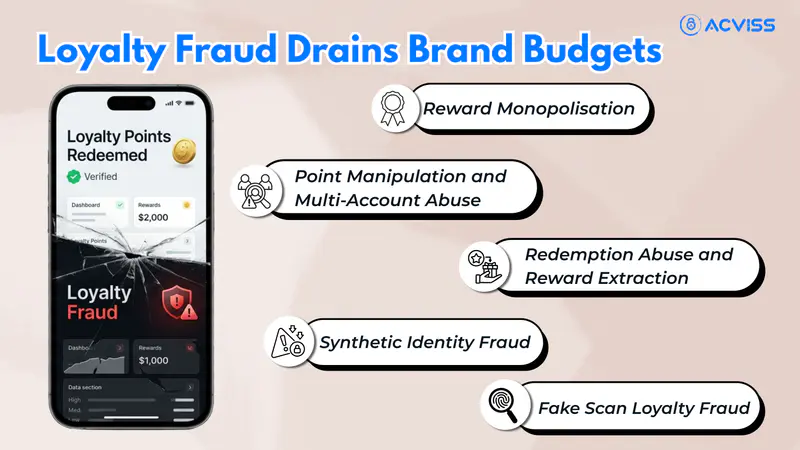
The Five Most Common Types of Loyalty Fraud

Modern loyalty fraud follows several predictable operational patterns. Understanding these fraud mechanisms is essential because many brands continue addressing symptoms rather than the structural vulnerabilities enabling abuse.
1. Reward Monopolisation
Reward monopolisation occurs when a loyalty programme’s incentive structure is unintentionally optimised for a handful of hyper-active actors rather than the broader consumer base. Instead of breaking system security, fraudsters manipulate the distribution mechanics to siphon rewards away from the intended audience.
Common methods include:
Intercepting packaging QR codes before products reach end consumers
Bulk scanning by supply chain insiders, wholesalers, or retail clerks
Consolidating rewards from multiple unique purchases into a single cluster of accounts
Using automated scanning tools or script extensions to claim high-value tiers rapidly
Colluding with distribution networks to sweep codes from unsold inventory
Over time, this activity renders the entire marketing initiative irrelevant. The target demographic receives zero benefits, causing them to lose faith in the brand, while the brand's budget is entirely drained by a microscopic group of insiders.
It completely corrupts business intelligence; dashboards will display skyrocketing engagement metrics when, in reality, the data is artificially concentrated within a tiny, unrepresentative pool of users.
2. Fake Scan Loyalty Fraud
Fake scan loyalty fraud typically begins when fraudsters gain access to valid code structures or discover weaknesses in QR generation systems.
Once that happens, they can:
Reuse existing codes repeatedly
Share codes across messaging groups
Generate fake scan attempts using automated scripts
Clone visible QR labels
Extract codes before products reach end consumers
Manipulate sequential code systems
Many loyalty programmes still rely on standard printable QR codes without secure product verification infrastructure behind them. A QR code alone does not confirm authenticity. It only confirms that a code exists. If the code architecture is predictable or easily duplicated, the system becomes vulnerable almost immediately.
This is especially dangerous in industries with high-volume, low-cost products, where campaigns generate millions of scans within short timeframes. Even a small percentage of fraudulent submissions can translate into major financial losses.
More importantly, fake scans distort business intelligence. Brands begin believing certain regions, retailers, or campaigns are performing exceptionally well when the underlying engagement data is partially artificial.
Without Product Authentication linked directly to loyalty validation, distinguishing between genuine and manipulated activity becomes increasingly difficult.
3. Point Manipulation and Multi-Account Abuse
Another growing issue is point manipulation through account sharing and identity duplication.
This type of fraud often occurs inside channel loyalty ecosystems involving retailers, distributors, field sales teams, and trade partners. Fraudsters create multiple accounts or coordinate reward collection networks to maximise incentive extraction.
Common methods include:
Multiple registrations using temporary mobile numbers
Shared retailer accounts
Referral abuse
Device rotation
Fake purchase submissions
Bulk code accumulation
Cross-account reward transfers
Over time, these activities corrupt loyalty data at scale.
Brands may incorrectly interpret manipulated participation as genuine customer engagement, causing them to make poor strategic decisions around market expansion, campaign optimisation, or distributor performance. In some cases, incentive structures themselves become distorted because a small group of users captures a disproportionate share of programme rewards.
This weakens the overall effectiveness of customer engagement initiatives while simultaneously increasing operational costs.
4. Redemption Abuse and Reward Extraction
Many loyalty programmes focus heavily on securing scan activity while underestimating the risks associated with reward redemption systems.
Redemption abuse occurs when fraudsters exploit payout infrastructure rather than verification infrastructure. Once points are accumulated through fake or manipulated activity, they are converted into cash-equivalent rewards using loopholes in the settlement process.
These attacks commonly involve:
Fraudulent cashback claims
Voucher extraction
Linked mule accounts
Stolen loyalty balances
Bulk reward withdrawals
Repeated UPI settlement attempts
Coordinated redemption networks
The introduction of digital payments, instant cashback systems, and direct bank transfers has improved user convenience significantly, but it has also increased the sophistication required for fraud prevention.
Without proper behavioural monitoring, device intelligence, and financial verification controls, redemption abuse can continue unnoticed for extended periods. By the time brands identify suspicious activity, substantial budget leakage may already have occurred.
5. Synthetic Identity Fraud
Synthetic identity fraud represents one of the most sophisticated forms of loyalty manipulation because it is designed specifically to imitate legitimate consumer behaviour.
Rather than creating obviously fake accounts, fraudsters build semi-realistic digital identities using combinations of:
Temporary mobile numbers
Disposable email addresses
Emulator devices
VPN-based location masking
AI-generated behaviour patterns
Fake KYC information
These identities are intentionally designed to appear authentic over time. They scan gradually, redeem conservatively, and avoid behaviour patterns that trigger basic fraud detection rules.
For brands running large-scale acquisition campaigns, synthetic identities are particularly dangerous because they inflate participation metrics while silently draining reward budgets. They also weaken the accuracy of customer intelligence, making loyalty analytics far less reliable for future planning.
Why High-Volume Scan Programmes Are Especially Vulnerable
The scale of modern loyalty ecosystems creates a unique security challenge. A programme processing a few thousand scans every month can often detect anomalies manually. A national programme processing millions of scans across multiple states, distributors, retailers, and customer segments cannot.
As scale increases, weaknesses inside loyalty infrastructure become amplified.
Many brands continue prioritising campaign growth and customer acquisition while treating fraud prevention as a secondary operational issue. Unfortunately, loyalty fraud scales faster than most prevention systems once vulnerabilities become publicly exploited.
Several structural weaknesses appear repeatedly across vulnerable programmes.
1. Static or Predictable Code Systems
Sequential or easily generated codes make brute-force attacks significantly easier.
2. Weak Product Authentication
If scans validate only the QR code rather than the product itself, cloned packaging can enter the ecosystem undetected.
3. Fragmented Infrastructure
Loyalty systems often operate separately from track and trace, Product traceability, and brand protection infrastructure, limiting visibility into suspicious behaviour.
4. Delayed Fraud Analysis
Many programmes investigate fraud reactively rather than monitoring suspicious behaviour in real time.
5. Limited Device Intelligence
Without device fingerprinting and behavioural analytics, detecting synthetic identities and automated abuse becomes difficult.
These vulnerabilities are particularly concerning in the pharma, agrochemicals, and food industries, where product verification is directly connected to product safety and supply chain integrity.
Why Authentication-Linked Loyalty Is Becoming Essential

The most effective loyalty fraud prevention strategies now combine customer engagement with secure product authentication infrastructure.
This shift is fundamentally changing how modern loyalty ecosystems are designed.
Traditional QR systems verify only that a code has been scanned. Authentication-linked systems verify that the product itself is genuine, traceable, and untampered before loyalty benefits are activated.
That distinction changes everything. A secure authentication-linked loyalty architecture enables brands to validate:
Product originality
Code uniqueness
Geographic consistency
Packaging legitimacy
Scan sequence integrity
Distribution flow patterns
When loyalty is connected directly to brand authentication and product verification systems, fraud becomes dramatically harder to execute at scale.
Non-cloneable security technologies play a particularly important role here because they eliminate one of the biggest weaknesses in conventional loyalty ecosystems: code duplication.
A cloned QR code can be copied infinitely. A non-cloneable identity cannot. This creates a far more resilient foundation for customer engagement while simultaneously strengthening:
Brand protection
Product traceability
Supply chain management
Trademark Protection
IP Protection
Product safety monitoring
Instead of treating loyalty and authentication as separate operational functions, brands are increasingly integrating them into unified digital trust ecosystems.
How Brands Detect Fraud Inside Loyalty Data
Modern loyalty fraud prevention relies heavily on behavioural intelligence and anomaly detection rather than simple rule-based monitoring.
Sophisticated systems continuously analyse scan activity, redemption behaviour, device signatures, and geographic patterns to identify suspicious activity before financial damage escalates.
Several indicators consistently help identify organised fraud.
1. Geographic Clustering
One of the strongest indicators involves geographically impossible scan behaviour.
For example, if the same product batch appears simultaneously across distant locations within unrealistic timeframes, the system can flag potential duplication or parallel abuse networks.
This becomes especially useful for identifying counterfeit circulation and grey-market leakage.
2. Scan Velocity Signals
Human scanning behaviour follows predictable patterns.
Automated systems do not.
Excessively rapid scan submissions often indicate scripted attacks, emulator farms, or brute-force attempts targeting loyalty infrastructure.
3. Device Fingerprinting
Advanced systems analysis:
Device signatures
IP addresses
VPN usage
Emulator behaviour
Account-device mapping
Multi-account relationships
This helps detect organised abuse clusters that would otherwise appear legitimate.
4. Redemption Pattern Analysis
Fraudulent users often redeem rewards differently from genuine consumers.
Indicators may include:
Immediate reward liquidation
Repeated withdrawal behaviour
Shared payment identifiers
High-frequency voucher claims
Low post-redemption engagement
By combining loyalty intelligence with Product Authentication and Track and trace systems, brands gain significantly stronger fraud visibility.
The Operational Cost of Loyalty Fraud Extends Beyond Budget Loss

Financial leakage is only one part of the problem. The broader business impact is often far more damaging because loyalty fraud weakens strategic decision-making across multiple departments.
Corrupted customer engagement data leads to inaccurate campaign optimisation. Fraudulent participation can distort regional demand analysis, distributor performance metrics, and consumer behaviour insights.
At the same time, operational teams face growing costs related to:
Manual investigations
Customer support disputes
Reward reconciliation
Compliance reviews
Fraud response operations
Backend verification workloads
Legitimate consumers also suffer.
When fraud increases, brands often introduce restrictive controls, delayed settlements, or additional verification steps that reduce convenience for genuine users. Over time, this negatively affects customer satisfaction and brand trust.
For industries where Product Authentication and product safety are central to brand identity, repeated loyalty abuse can eventually damage consumer confidence itself.
Building a Fraud-Resistant Loyalty Ecosystem
Fraud-resistant loyalty systems are not created through a single software layer or isolated security tool. They require an integrated infrastructure combining authentication, analytics, verification, behavioural intelligence, and secure reward management.
The strongest systems typically include:
1. Authentication-Linked Reward Activation
Rewards should activate only after successful Product Verification.
2. Non-Cloneable Security Technologies
Unique product identities significantly reduce duplication risks.
3. Real-Time Fraud Analytics
Suspicious activity must be detected continuously rather than retrospectively.
4. Device and Identity Intelligence
Behavioural analysis should monitor devices, accounts, IP behaviour, and redemption consistency.
5. Integrated Track and Trace Infrastructure
Loyalty systems should connect directly with Supply chain management and Product traceability ecosystems.
6. Secure Financial Settlement Systems
UPI, cashback, and reward disbursement infrastructure should include abuse detection and verification controls.
Regulatory Compliance Frameworks
Strong data governance aligned with DPDP requirements and digital transaction regulations is increasingly critical.
Conclusion
Loyalty fraud has evolved into a major operational and financial threat for brands running large-scale customer engagement programmes. What appears on the surface as a simple reward ecosystem is now deeply connected to Product Authentication, Brand protection, Product Verification, Track and trace visibility, and supply chain intelligence.
As fraud networks become more sophisticated, brands can no longer rely on traditional QR systems or standalone loyalty platforms that validate only participation without validating authenticity. The future of secure customer engagement lies in authentication-linked loyalty ecosystems capable of verifying both the user and the product in real time.
Brands that integrate non-cloneable authentication technologies with loyalty infrastructure gain far more than fraud prevention. They build stronger customer trust, improve product safety visibility, strengthen Anti-counterfeiting solutions, and create more reliable engagement intelligence across the supply chain.
Interested in building fraud-resistant loyalty programmes with secure Product Authentication and Brand protection capabilities? Get in touch with us to explore how authentication-linked loyalty infrastructure can help secure your campaigns, improve customer satisfaction, and protect your brand reputation at scale.