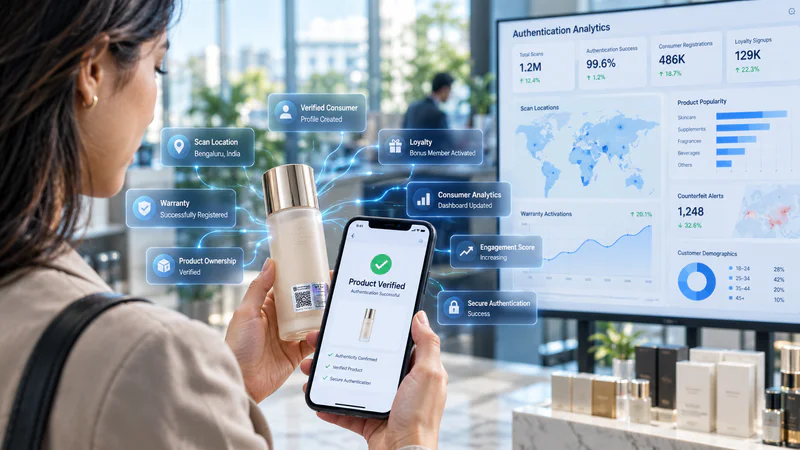
The era of relying on anonymous digital signals is steadily giving way to something far more valuable: direct, consent-based relationships with customers. Rising privacy expectations, tighter regulations, and the declining effectiveness of third-party tracking have forced brands to rethink how they understand consumer behaviour. Increasingly, the most reliable customer insights are being generated after a product leaves the shelf, when consumers authenticate a purchase, activate a warranty, or participate in a loyalty programme.
For manufacturers and consumer brands, this shift represents more than a marketing opportunity. Every authentication event can become a trusted source of first-party consumer data, revealing who purchased the product, where it was sold, how it moves through the market, and how customers engage long after the initial transaction. When authentication is integrated with loyalty, supply chain visibility, and brand protection, brands gain a continuous intelligence layer that improves decision-making across marketing, operations, and customer experience.
Why First-Party Consumer Data Has Become a Competitive Advantage
For years, digital marketing relied heavily on third-party cookies to understand customer behaviour across websites. Although Google has revised its plans around cookie deprecation, the broader industry direction remains unchanged. Organisations are investing heavily in first-party data strategies as regulators tighten privacy requirements and consumers demand greater transparency over how their information is collected and used.
This shift is also changing the economics of customer acquisition. Paid advertising costs continue to rise while anonymous audience targeting becomes less reliable. Brands that own their customer relationships are better positioned to personalise experiences, measure campaign performance, and retain customers without depending on external platforms.
The difference lies not simply in who owns the data, but in its quality and relevance. Information collected directly through product interactions reflects genuine customer engagement rather than inferred online behaviour.
Authentication Is No Longer Just About Detecting Counterfeits
Product authentication has traditionally been viewed as a security measure designed to help consumers distinguish genuine products from counterfeit ones. While protecting brand integrity remains essential, modern authentication systems have evolved into valuable sources of consumer intelligence.
Every successful authentication creates a direct interaction between the consumer and the brand. Instead of remaining anonymous after purchase, customers voluntarily engage through a secure verification process, creating opportunities to build trusted, long-term relationships.
With appropriate consent, brands can understand:
Which markets generate the highest engagement
Repeat interactions with the same product
Consumer demographics and preferences
Product popularity across regions
Warranty activation rates
Campaign participation
Customer retention trends
Unlike traditional web analytics, these insights originate from actual product ownership rather than browsing activity. That distinction makes the resulting data significantly more reliable for business decision-making.
The Cookie-Less Future Is Accelerating the Shift Towards Product-Led Data

The conversation around third-party cookies often focuses on advertising technology, but the larger transformation extends well beyond browsers. Consumers increasingly expect brands to explain what data they collect, why they collect it, and what value customers receive in return.
Research consistently reflects this changing mindset. While many consumers express concerns about personal data usage, they are also willing to share information when there is a transparent exchange of value, whether through personalised offers, faster service, exclusive rewards, or improved product experiences.
This creates an important opportunity for product authentication. Instead of requesting customer information before establishing trust, authentication begins by delivering immediate value. The customer first confirms that the product is genuine, reducing concerns around authenticity, safety, or warranty eligibility. Only then does the brand invite further engagement through optional consent-based experiences.
The interaction becomes a mutually beneficial exchange rather than a one-sided request for personal information.
Lessons from China's Membership-First Retail Model
China's "New Retail" ecosystem offers a useful example of how customer identification can become part of the buying journey rather than an afterthought. Retailers such as Hema, Starbucks, Luckin Coffee, Carrefour, and Walmart redesigned the customer experience so that membership provides immediate convenience instead of simply promising future rewards.
Rather than treating loyalty programmes as optional, these businesses created experiences where customers willingly identified themselves in exchange for faster checkout, personalised recommendations, digital payments, or exclusive offers.
The result was not simply larger loyalty databases. It was richer first-party consumer intelligence that connected purchasing behaviour, product preferences, and engagement across multiple channels.
For manufacturers, the same principle applies beyond retail stores. Product authentication provides a natural touchpoint for establishing a direct relationship with consumers, even when products are sold through distributors, wholesalers, retailers, or online marketplaces.
What Product Authentication Data Actually Reveals

Many organisations assume authentication only confirms whether a product is genuine. In practice, every verification event can contribute valuable commercial intelligence when analysed alongside supply chain and customer engagement data.
Authentication platforms can reveal insights such as:
Geographic hotspots where products are actively consumed rather than merely distributed.
Differences between shipment locations and actual customer usage help identify grey market diversion.
High-performing retail regions where marketing investment delivers stronger engagement.
Repeat scans that indicate customer loyalty, product sharing, or secondary market activity.
Patterns that may signal counterfeit distribution or suspicious product movement.
Consumer engagement with campaigns, educational content, and post-purchase experiences.
Warranty registrations that provide stronger visibility into genuine product ownership.
Viewed individually, each data point offers limited value. Combined over thousands or millions of product interactions, however, they create a powerful intelligence layer that supports marketing, supply chain planning, customer retention, and brand protection simultaneously.
Rather than relying solely on surveys or digital advertising metrics, brands can make decisions based on real interactions between consumers and authenticated products.
Turning Authentication into Consumer Intelligence: Bringing Bonus, Certify and Supply Chain Visibility Together
Authentication delivers the first interaction, but its real business value emerges when it becomes part of a connected ecosystem. Brands that treat authentication as a standalone security feature often miss the opportunity to build lasting customer relationships and actionable business intelligence.
An integrated approach connects product authentication, loyalty, supply chain visibility and brand protection into a single workflow. Instead of collecting isolated data points, brands create a continuous stream of insights throughout the product lifecycle.
A typical journey looks like this:
A customer purchases the product and verifies its authenticity using Certify.
The authentication process confirms the product is genuine while collecting consent-based interaction data.
The customer is invited to join the Bonus loyalty programme to activate rewards, exclusive content or promotional offers.
Warranty registration and post-purchase engagement enrich the customer's profile over time.
Combined with supply chain information, every interaction contributes to a richer understanding of product movement, customer behaviour and market performance.
This unified approach delivers benefits that extend far beyond marketing.
Rather than maintaining separate systems for authentication, customer engagement and product intelligence, brands can build a single source of truth that supports multiple business functions.
Why High-Quality Data Matters More Than More Data
Many organisations already possess large volumes of customer information through websites, CRM platforms and marketing campaigns. The challenge is not the quantity of data but its usefulness.
Authentication-generated first-party data offers several advantages because it is directly linked to a genuine product interaction. It is typically more accurate, more current and more relevant than inferred behavioural data collected across unrelated digital channels.
This creates opportunities to:
Build highly accurate customer segments.
Personalise campaigns based on verified product ownership.
Measure engagement after purchase rather than only before conversion.
Improve product launch planning using regional demand patterns.
Identify underserved markets with strong consumer engagement.
Support customer service with verified warranty and purchase information.
As privacy expectations continue to evolve, trusted and consent-based interactions will become increasingly valuable assets for enterprise brands.
Where First-Party Data Strategies Commonly Fail

Technology alone does not guarantee meaningful consumer intelligence. Many authentication and loyalty initiatives underperform because organisations focus on collecting data without planning how it will be activated across the business.
Some of the most common implementation challenges include:
Authentication journeys that offer little incentive for consumers to scan products.
Loyalty programmes that operate independently from authentication systems.
Marketing teams collect customer information that supply chain and brand protection teams cannot access.
Poor consent management that reduces customer trust and regulatory compliance.
QR codes or authentication labels are placed where consumers rarely notice them.
Dashboards reporting scan volumes without translating them into commercial insights.
These issues often result in fragmented datasets that cannot support better decision-making.
Successful deployments treat authentication as part of a broader operational strategy rather than a standalone technology project.
A Framework for Building Privacy-Friendly Consumer Intelligence
Brands seeking to strengthen their first-party data capabilities should evaluate whether their authentication strategy supports the following principles:
✔ Deliver value before requesting data
Consumers are more willing to share information when authentication immediately provides reassurance, warranty eligibility or exclusive benefits.
✔ Collect explicit, consent-based information
Transparency builds trust while supporting compliance with evolving privacy regulations.
✔ Connect authentication with loyalty
Integrating programmes such as Bonus transforms one-time verification into an ongoing customer relationship.
✔ Link consumer data with supply chain intelligence
Combining scan behaviour with distribution information provides better visibility into market demand, product diversion and regional performance.
✔ Enable cross-functional decision-making
Marketing, operations, customer service and brand protection teams should work from the same trusted data rather than maintaining isolated systems.
The Future Belongs to Brands That Own the Customer Relationship
The next phase of digital marketing will not be defined by better advertising technology alone. It will be shaped by brands that create meaningful, permission-based interactions through the products they sell.
Product authentication is uniquely positioned to enable this transition because it connects the physical product with the digital customer journey. Every authenticated product becomes an opportunity to establish trust, gather actionable insights and strengthen long-term customer engagement.
When authentication is combined with loyalty programmes such as Bonus, secure verification through Certify, supply chain visibility and brand protection, brands gain more than customer data. They develop an intelligence ecosystem that supports better marketing, stronger operational visibility and faster responses to emerging risks.
For organisations navigating a privacy-first landscape, the question is no longer whether first-party data matters. The real challenge is identifying the most reliable, scalable and trustworthy way to generate it.
Interested in learning how authentication, loyalty, brand protection and supply chain intelligence can work together to build meaningful first-party consumer data? Get in touch with Acviss to explore what's possible.
Frequently Asked Questions
How does product authentication help brands collect first-party consumer data?
Every authentication event creates a direct interaction between the consumer and the brand. With appropriate consent, brands can collect valuable insights such as product ownership, purchase geography, engagement behaviour, warranty registrations and loyalty participation.
Is authentication data more reliable than third-party cookies?
Yes. Authentication data is generated through verified product interactions rather than inferred browsing behaviour. This makes it more accurate for customer engagement, campaign measurement and operational decision-making.
How do loyalty programmes improve authentication strategies?
Loyalty programmes encourage ongoing engagement after the initial product verification. They help brands build richer customer profiles while offering consumers rewards, exclusive content and personalised experiences that encourage repeat interactions.
Can authentication data support supply chain decisions?
Absolutely. When combined with distribution and shipment data, authentication scans can reveal product movement, regional demand, grey market diversion and potential supply chain inefficiencies, enabling more informed operational decisions.