Every discussion around product authentication eventually arrives at the same question: How many consumers scanned the product? Brands often judge the success of an authentication programme by scan volumes, QR code engagement, or app downloads. While these metrics provide useful customer insights, they represent only a small part of how authentication systems deliver business value.
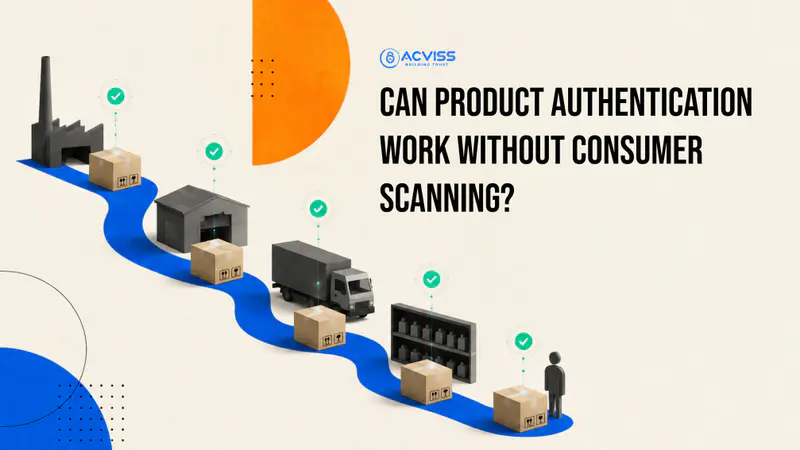
In practice, some of the most effective authentication programmes create their greatest impact long before a product reaches the consumer. Manufacturers, warehouses, distributors, retailers, investigators, and service teams generate authentication events throughout the product journey. When these internal verification points are connected, product authentication evolves from a customer-facing feature into an operational intelligence system that strengthens product integrity across the supply chain.
Why Consumer Scanning Became the Default Success Metric
Consumer verification has become synonymous with product authentication largely because smartphones made QR codes widely accessible. Brands quickly recognised an opportunity to combine authenticity verification with loyalty programmes, warranty registration, promotions, and post-purchase engagement. As a result, authentication became closely associated with customer interaction rather than operational control.
This shift delivered measurable marketing benefits, but it also created an incomplete view of what authentication should accomplish. A product that receives thousands of consumer scans may still have travelled through multiple distributors without verification. Conversely, a product that is never scanned by a consumer may have been authenticated at every operational checkpoint before reaching the shelf.
For manufacturers and brand owners, this distinction matters. Consumer scanning represents the final opportunity to validate a product, whereas operational verification helps identify issues before products reach the market. Detecting anomalies earlier reduces investigation costs, limits counterfeit distribution, and improves accountability across the supply chain.
The assumption that consumers must actively participate for authentication to create value therefore overlooks the broader role of authentication as an operational control mechanism.
Authentication Starts Long Before the Consumer
Every product passes through multiple stakeholders before reaching its end user. Each transfer creates an opportunity to verify authenticity, validate movement, and collect valuable operational data. When authentication is integrated into internal workflows, every scan contributes to product integrity rather than simply confirming authenticity at the point of purchase.
This approach aligns closely with broader developments in Automatic Identification and Data Capture (AIDC), where automated verification replaces manual record-keeping. Modern supply chains increasingly rely on machine-readable identities because structured, real-time data forms the foundation for automation, AI-driven decision-making, and operational visibility.
The value of these verification events extends beyond confirming authenticity. Each authenticated interaction creates a timestamp, location record, product identity, and movement history that can later support investigations, compliance audits, inventory reconciliation, or warranty validation.
Instead of viewing authentication as a single consumer event, leading manufacturers increasingly treat it as a continuous chain of verification that follows the product throughout its lifecycle.
Internal Authentication Often Delivers Greater Business Value
Many counterfeit prevention strategies focus heavily on the final customer. However, counterfeit products frequently enter legitimate supply chains long before consumers have an opportunity to identify them. Waiting until the point of purchase often means counterfeit goods have already passed through manufacturing partners, logistics providers, distributors, and retailers.
Internal authentication helps organisations detect these issues much earlier by embedding verification into routine operational activities rather than relying on consumer participation.
Some of the most valuable operational use cases include:
Verifying product identity before warehouse dispatch.
Confirming distributor receipt against shipment records.
Detecting duplicate product identities across different locations.
Supporting warranty validation using verified product histories.
Reconciling inventory discrepancies between supply chain partners.
Establishing a chain of custody for regulated industries.
These verification events become increasingly valuable when combined with structured operational data. Rather than producing isolated scan records, authentication begins to reveal patterns that help identify unusual product movement, repeated verification failures, or inconsistencies between physical inventory and recorded transactions.
This operational intelligence is particularly important in industries where product integrity directly affects safety, compliance, or public trust.
For example, pharmaceutical manufacturers require confidence that medicines have remained within authorised distribution channels before reaching hospitals and pharmacies. Automotive suppliers need assurance that genuine spare parts move through approved dealer networks rather than unauthorised resellers. Food and beverage manufacturers often need traceability records to support recalls, regulatory compliance, and consumer safety investigations.
In each of these industries, internal authentication provides value regardless of whether consumers ever scan the finished product.
The Biggest Mistake: Treating Authentication as a Marketing Feature
One of the most common deployment mistakes is implementing authentication solely as a consumer engagement initiative. Brands invest in QR codes, promotional campaigns, and mobile experiences while overlooking the operational workflows required to generate meaningful business intelligence.
Without structured verification processes, authentication becomes reactive rather than preventative. Counterfeit incidents are discovered only after products reach customers, investigations begin with limited evidence, and operational teams lack the visibility needed to identify where product integrity was compromised.
Authentication programmes also struggle when verification responsibilities are poorly defined. Manufacturing teams may not authenticate outbound shipments, distributors may skip receiving verification during busy periods, and retailers may have no mechanism for validating stock before it reaches consumers. Each missing checkpoint creates a gap that counterfeit products or diverted inventory can exploit.
Another overlooked challenge is data quality. Authentication systems are only as reliable as the product information supporting them. Duplicate product records, inconsistent serialisation, or incomplete master data reduce the quality of insights generated across the supply chain. As warehouses adopt automation and AI-assisted operations, structured product identity becomes increasingly important because downstream analytics depend on accurate upstream data collection.
Successful authentication programmes, therefore, extend beyond product labels or QR codes. They combine secure product identities with clearly defined verification workflows, governance processes, and operational accountability across every stage of the supply chain.
When authentication becomes embedded within manufacturing, logistics, distribution, and retail operations, consumer scanning changes from being the primary source of value to simply the final layer of a much broader product integrity strategy.
What Makes Authentication Reliable When Nobody Scans?
Authentication only delivers operational value when it can withstand real-world conditions. A solution that depends entirely on consumer participation, manual processes, or a single visible identifier leaves significant gaps throughout the supply chain.
ISO 12931, the international standard for performance criteria in product authentication, recognises that authentication should resist both external attacks, where counterfeiters attempt to copy genuine products, and internal attacks, where misuse can originate from authorised suppliers, contractors, or manufacturing partners. This makes the choice of authentication technology just as important as the verification process itself.
When evaluating an authentication solution, organisations should look beyond scan counts and consider whether it can:
Generate unique, secure product identities.
Resist duplication and cloning attempts.
Support verification across manufacturing, logistics, distribution, and retail.
Capture structured data for investigations and analytics.
Integrate with existing ERP, WMS, or quality management systems.
Scale across millions of products without disrupting production.
The objective is not simply to prove that a product is genuine. It is to create trusted product identities that remain reliable throughout the entire supply chain.
Building Product Integrity with Layered Authentication
Modern product protection rarely depends on a single security feature. Instead, organisations increasingly deploy multiple authentication layers that work together to protect products, improve operational visibility, and generate actionable intelligence.
At the core of this approach are non-cloneable labels, which are designed so that every product carries a unique identity that cannot be accurately reproduced. Unlike conventional QR codes that can often be copied and reprinted, non-cloneable label technology significantly increases the effort required to create convincing counterfeits, making duplication commercially unattractive.
For products where visible identifiers may not be desirable, Phantom Code adds another layer of protection by embedding an invisible authentication element directly into the packaging artwork. Since no obvious security feature is exposed, counterfeiters have little indication that authentication exists, while authorised users can still verify product authenticity without changing the packaging design.
Visible authentication continues to play an important role, particularly when combined with intelligence. Axion Code extends traditional QR-based verification by treating every authentication event as a source of operational data. Beyond confirming authenticity, it can help identify duplicate verification attempts, unusual location patterns, repeated scans across different regions, and other behavioural anomalies that may indicate cloning, diversion, or counterfeit activity.
These technologies become significantly more valuable when managed through a central authentication platform such as Acviss Certify. Rather than functioning as isolated security features, they operate within a connected ecosystem that supports product authentication, supply chain verification, investigation workflows, warranty validation, and enterprise reporting from a single source of truth.
Authentication therefore evolves from a product-level security measure into an intelligence layer that supports brand protection across the product lifecycle.
Authentication Data Becomes Supply Chain Intelligence
Every successful verification generates more than an authentication result. It also creates operational data that helps organisations understand how products move through authorised channels and where potential risks emerge.
The progression typically follows a simple but powerful workflow.
Viewed individually, these events may appear routine. Analysed collectively, they reveal trends that are difficult to detect through manual reporting alone.
Brands can identify counterfeit hotspots before customer complaints increase. Supply chain teams can investigate unexpected product movements between distributors. Warranty teams can distinguish genuine products from fraudulent claims. Compliance teams gain auditable verification records that support regulatory requirements and internal governance.
The result is greater visibility across the supply chain, allowing authentication to support operational decision-making rather than functioning solely as a customer-facing security feature.
A Practical Framework for Evaluating Authentication Programmes
Many authentication initiatives fail because organisations evaluate technologies instead of outcomes. Selecting the right platform requires assessing how well it supports day-to-day operations across multiple business functions.
A practical evaluation should include the following questions.
Organisations that answer these questions early are far more likely to build authentication programmes that scale with business growth instead of becoming isolated technology deployments.
Looking Beyond Consumer Scans
Consumer verification will continue to play an important role in product authentication, particularly for high-value goods and direct customer engagement. However, it should no longer be viewed as the primary measure of success.
The greatest value often comes from authenticating products before they reach the customer. Verification during manufacturing, warehousing, distribution, and retail creates trusted product histories, improves operational accountability, strengthens investigations, and generates intelligence that supports long-term brand protection.
As supply chains become increasingly automated and data-driven, authentication will become less about individual scans and more about building trusted product identities that can support every operational decision surrounding a product.
Brands that adopt this broader perspective will be better positioned to reduce counterfeit risk, improve supply chain visibility, strengthen customer trust, and respond more effectively when product integrity is challenged.
Interested in strengthening product authentication beyond consumer scanning? Discover how Acviss Certify, powered by non-cloneable label technology, can help build trusted product identities and actionable supply chain intelligence across your entire product journey. Get in touch with our team to learn more.