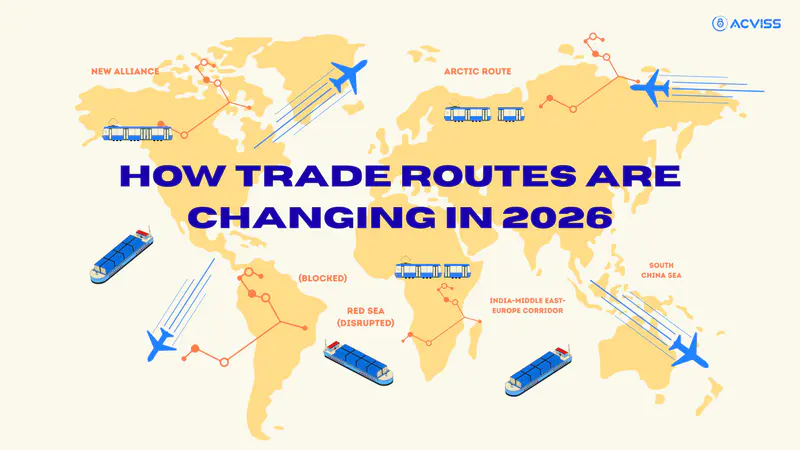
Global trade in 2026 is no longer organised around a single principle of efficiency. For nearly three decades, manufacturing and logistics decisions were driven primarily by cost optimisation and lean inventory. Companies built long supply chains across continents because it was cheaper and faster.
That model is now being rewritten.
A combination of geopolitical tensions, tariff programmes, supply disruptions and technological transformation is forcing companies to rethink how products are manufactured, moved and protected. The global supply chain system is shifting from a “just-in-time” philosophy to a “just-in-case” approach that prioritises resilience, visibility and security.
For manufacturers and supply chain leaders, these changes are not theoretical. They affect everything from sourcing decisions and logistics planning to product traceability, Brand protection and demand forecasting.
Understanding the forces reshaping trade routes in 2026 is therefore essential for strategic decision-making.
From Just-in-Time to Just-in-Case
For decades, the dominant supply chain model was based on lean operations. Inventory was minimised, production was concentrated in low-cost manufacturing hubs, and goods were transported globally through highly optimised logistics networks.
Recent global shocks have exposed the vulnerabilities of this approach.
The COVID-19 pandemic disrupted production across Asia and revealed how fragile highly centralised supply chains could be. The US-China trade war introduced tariffs that changed the economics of global sourcing. The Russia-Ukraine war disrupted commodity exports and altered shipping patterns across Europe and the Black Sea.
These disruptions came with enormous financial consequences. Research suggests that major supply chain disruptions can cost companies approximately $184 million per incident, and in severe cases, a single disruption can reduce as much as half of a firm’s annual EBITDA.
In response, companies are shifting toward a resilience-focused model.
Instead of minimising redundancy, organisations are building buffers. They are increasing inventory levels, diversifying suppliers and designing supply chains capable of absorbing geopolitical shocks.
Resilience is becoming a measurable component of lifecycle profitability.
Geo-Economic Fragmentation Is Redrawing Trade Routes
Trade policy has become a strategic geopolitical instrument rather than a purely economic one.
Governments are increasingly using tariffs, export controls and industrial policy to influence supply chains. This geo-economic fragmentation is reshaping manufacturing networks worldwide.
The United States has expanded tariffs in key sectors linked to strategic technologies. Tariffs on Chinese electric vehicles have risen to 100 per cent, while batteries, semiconductors and solar technologies face tariffs of up to 25 per cent.
These policies are designed to encourage domestic manufacturing and reduce reliance on strategic imports.
At the same time, sanctions linked to geopolitical conflicts are altering shipping routes and commodity flows. The Russia-Ukraine war disrupted Black Sea trade corridors, forcing companies to find alternative routes for agricultural and industrial exports.
Shipping routes through the Red Sea have also faced instability due to attacks on commercial vessels, leading to costly diversions around the Cape of Good Hope. This has added up to two weeks of transit time between Asia and Europe and increased logistics costs significantly.
As a result, supply chains are becoming more regional and politically aligned.
The China Plus One Strategy

One of the most significant developments in global manufacturing strategy is the emergence of the China Plus One approach.
For many years, China served as the primary manufacturing hub for global production. While companies are not fully abandoning China, they are increasingly diversifying production to reduce risk.
The China Plus One strategy maintains core operations in China while establishing secondary manufacturing capacity in alternative regions.
Key emerging hubs include:
Vietnam for electronics and consumer goods assembly
India for pharmaceuticals and electronics manufacturing
Mexico for automotive and industrial production serving North America
However, the reality is more complex than simple relocation.
China continues to dominate upstream manufacturing. Many of the countries gaining final assembly capacity still rely heavily on Chinese inputs such as components, machinery and raw materials.
This phenomenon is sometimes referred to as the upstream paradox.
Even as the United States reduced direct imports from China from 21.6 per cent to 16.3 per cent, China simultaneously became the largest supplier of intermediate goods to countries like Vietnam and Mexico.
In effect, manufacturing is not decoupling from China. It is being reorganised around it.
New Sourcing Models Are Emerging
Manufacturers are adopting a range of sourcing strategies depending on geopolitical risk, tariff exposure and logistics efficiency.
Reshoring involves bringing production back to domestic markets to improve control and security. This approach has gained momentum in sectors such as semiconductors and medical technologies.
Nearshoring moves production closer to end markets. Mexico has become a major nearshoring destination for companies serving the United States. Goods can be transported across the US-Mexico border in under 48 hours, compared to 25 to 30 days for ocean freight from Asia.
Friend-shoring aligns supply chains with politically aligned countries such as Japan, South Korea and Canada.
These strategies create distributed manufacturing networks that improve resilience but increase operational complexity.
Maintaining Product traceability across these expanded networks becomes significantly more difficult without advanced Track and trace technologies.
Artificial Intelligence Is Transforming Supply Chain Strategy

Alongside geopolitical change, artificial intelligence is rapidly becoming a core capability in supply chain management.
Industry leaders rate the usefulness of AI in supply chain operations at an average of 8 out of 10, reflecting its growing role in planning, forecasting and operational coordination.
Several AI applications are reshaping logistics and manufacturing.
Predictive intelligence enables companies to forecast demand shifts in real time, helping manufacturers adjust production and inventory levels before disruptions occur.
Agentic AI systems automate routine communication and coordinate complex planning tasks across suppliers, logistics partners and distributors.
Digital twins allow companies to simulate supply chain scenarios, enabling faster decision-making during disruptions.
In warehouse operations, computer vision systems and AI-enabled cameras improve goods processing speed, optimise storage space and monitor safety risks.
However, the effectiveness of AI depends heavily on data quality. Many companies face what analysts describe as “partner data chaos”, where inconsistent information across suppliers and logistics providers limits the effectiveness of AI models.
Strong Product traceability infrastructure is therefore essential for AI-driven supply chains.
The Semiconductor Industry Shows the Stakes
Few industries illustrate the tension between efficiency and resilience more clearly than semiconductors.
Taiwan currently produces more than 50 per cent of the world’s semiconductor chips, including the most advanced manufacturing nodes.
This geographic concentration represents a significant strategic risk for global electronics manufacturing.
To address this vulnerability, governments and companies are investing heavily in semiconductor reshoring initiatives. Diversifying chip production across multiple regions could reduce disruption risk by 55 to 70 per cent.
However, these resilience gains come with a cost premium. Building redundant semiconductor manufacturing capacity in new regions increases production costs by approximately 15 to 25 per cent.
Manufacturers must therefore balance efficiency against security.
Expanding Supply Chains Increase Counterfeit Risks

As manufacturing networks spread across more countries and distribution channels multiply, the risk of counterfeit infiltration also increases.
Global trade authorities estimate that counterfeit goods represent more than $500 billion annually, accounting for over 3 percent of global trade.
Industries such as pharma, automotive components and consumer electronics are particularly vulnerable.
Counterfeit medicines pose serious product safety risks, while fake industrial components can compromise equipment performance.
To mitigate these threats, companies are increasingly implementing Product Authentication and Product Verification systems across their supply chains.
Why Product Traceability Is Becoming Critical
In an environment of geopolitical fragmentation and distributed manufacturing, product traceability is becoming a strategic necessity.
Product traceability solutions allow manufacturers to track the movement of goods across production sites, warehouses and international borders.
This visibility helps detect:
counterfeit infiltration attempts
unexpected regional demand patterns
distribution inefficiencies
Traceability also supports compliance with emerging regulatory frameworks such as EUDR, which require companies to demonstrate transparency across supply chains.
Beyond regulatory compliance, traceability strengthens customer engagement by giving consumers confidence in product authenticity.
The Role of Origin and Non-Cloneable Technology

One of the fundamental challenges in global supply chains is ensuring that product identities cannot be easily replicated.
Traditional barcode systems are vulnerable to duplication. Counterfeiters can replicate labels and infiltrate legitimate distribution channels.
Origin addresses this challenge by assigning secure digital identities to products using non-cloneable technology.
Each product unit carries a unique identity that cannot be replicated, enabling reliable Product Authentication and Product Verification at every stage of the supply chain.
When integrated into Track and trace systems, Origin enables item-level Product traceability across manufacturing, distribution and retail channels.
This provides companies with:
improved Trademark Protection and IP Protection
enhanced customer satisfaction through verified authenticity
real-time visibility into product movement across global trade networks
In an era where supply chains span multiple regions and intermediaries, such verification capabilities are becoming essential.
Strategic Implications for Manufacturers
Manufacturers operating in 2026 must rethink how they design supply chains.
Production decisions now involve evaluating:
geopolitical risk
tariff exposure
logistics reliability
product authentication infrastructure
regulatory compliance requirements
The era when supply chain strategy was based solely on labour cost advantage is ending.
Companies must now balance efficiency with resilience and transparency.
Those that invest in advanced Product traceability technologies and robust Track and trace infrastructure will be better equipped to navigate shifting trade routes and protect their brands.
Conclusion
The transformation of global trade routes in 2026 is being driven by powerful forces: geopolitical fragmentation, tariff programmes, regional manufacturing strategies and the rapid adoption of artificial intelligence.
Supply chains are becoming more distributed, more digital and more security-focused.
For manufacturers and supply chain leaders, the challenge is not simply adapting to these changes but building systems capable of thriving within them.
Companies that combine resilient supply chain design with secure Product Authentication, Product Verification and advanced Track and trace technologies will be best positioned to protect revenue, ensure product safety and maintain Brand protection in an increasingly uncertain global trade environment.
Interested to learn more about how advanced Product traceability and Track and trace solutions can strengthen your manufacturing and supply chain strategy? Get in touch with us.