Every procurement meeting in security printing eventually reaches the same moment. The client has your quote on the screen, a competitor's quote next to it, and the gap between them is a few cents per label. You know your quality is better. You know your security features are more robust. And yet, the conversation keeps circling back to unit price.
That moment is not a negotiation problem. It is a business model problem.
If you, as a manufacturer, want to escape this cycle, finding a way to print cheaper is not the solution. The solution is to stop thinking of the label as the product. The label is the beginning of a relationship, not the end of a transaction.
In this blog, we will discuss what this shift looks like in practice, what it does to your revenue, and how you start making it happen.
The Print Model Has a Built-in Ceiling
The traditional security printing model is straightforward. Win a contract, run the volume, ship, and invoice. If you want to grow, you print more. If you want better margins, you negotiate harder on substrate and ink costs, which, according to Mordor Intelligence's print label market analysis, can account for up to 75% of a converter's cost of sales.
That cost structure leaves very little room to manoeuvre. And the pressure is structural, not cyclical. The price-based competition is the defining dynamic in commoditised segments of the industry. When multiple suppliers can produce technically acceptable holograms, colour-shifting inks, or tamper-evident seals, differentiation on physical features has a natural ceiling.
The deeper issue is what happens after the label ships. Once the roll leaves your facility, your involvement ends. You have no visibility into where the product goes, whether the security feature worked, or what the market looks like around that product. You produced the output. Someone else owns the outcome.
Mordor Intelligence's anti-counterfeit packaging report (2025) captures this shift precisely: competitive intensity in brand protection is now determined by software ecosystems as much as by print chemistry.
Here’s a thing: providing high-quality work at a low cost alone is no longer sufficient for sustainable growth in this industry.
The ceiling is real. And the only way past it is to change what you are selling.
What Recurring Revenue Actually Looks Like in This Industry
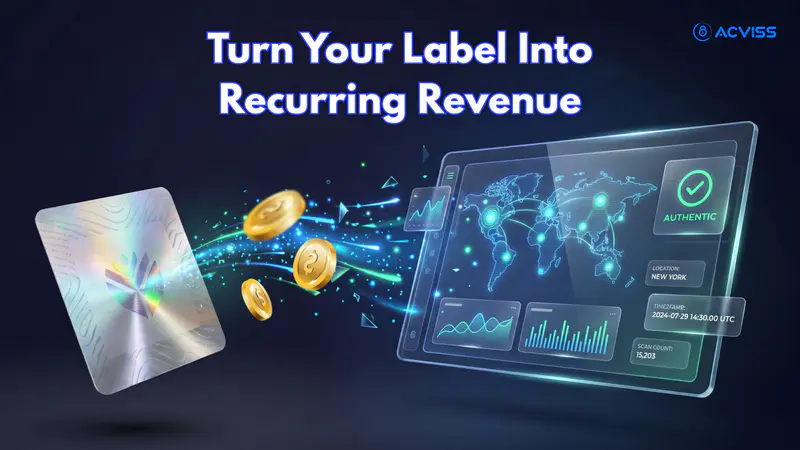
When you embed a serialised digital identity into a physical label and connect it to a cloud platform, something fundamental changes. The label is no longer a finished product. It is an access token to a software service.
That service generates entirely new billing lines that sit on top of your existing print contract:
Platform access fees:
The brand pays a monthly or annual subscription to access the dashboard where scan data, authentication events, and supply chain intelligence are stored and visualised. This is pure software margin.
💡According to DealHub's SaaS gross margin benchmarks, SaaS businesses typically operate at gross margins between 70% and 85%, compared to the single-digit to low-double-digit margins common in physical label manufacturing.
ERP and integration fees.
When the brand wants to scan data feeding into their SAP or Oracle system, that is a billable integration. Typically, a setup fee in year one, followed by an annual maintenance charge.
Analytics upsell tiers.
Premium access to geo-fencing alerts, grey market diversion heatmaps, and consumer engagement analytics forms a natural upsell for clients who start to rely on the data.
Loyalty and engagement modules.
Every consumer scan is a first-party data capture moment. Brands will pay to convert that event into a loyalty trigger. That module is your next revenue line after the subscription is live.
The physical label still gets invoiced at your existing rates. What changes is that it now opens a door to services that scale in value as the client grows, without requiring you to print a single additional label to capture that revenue.
Why Brands Need It (The Data a Connected Label Generates)

Every scan of a connected label produces a structured data event:
product ID,
timestamp,
location,
device type,
authentication result.
At volume, across multiple markets and SKUs, this becomes a live intelligence feed on how a brand's products are actually moving through the world.
Brands cannot get this from a cheaper printer. They get it from the platform.
This intelligence answers questions that their internal teams have no other way to answer.
Which geographies are generating unusual scan clusters that suggest grey market diversion?
Which distribution channels show consistently low scan rates, pointing to counterfeits entering the supply chain?
Which consumer segments are actively verifying product authenticity and could be enrolled in a loyalty programme?
The key distinction here is ownership. The brand owns its data. You own the infrastructure that processes it and makes it legible. That means you are not holding anything over them. You are providing the engine that turns their raw scan events into decisions. That is the difference between being a vendor and being a strategic partner, and it is a distinction that changes every conversation about contract renewal.
The Procurement Bypass: How Brands Budget for the Platform Layer

One of the most practically important things about this model shift is how it changes who you talk to inside a client organisation.
Selling a physical label puts you in front of the procurement manager. Their KPI is cost reduction. Their annual performance review is partly tied to how much they squeezed out of supplier negotiations. They see your label as a cost line, and they will fight you on every cent.
Selling a connected platform puts you in a different room entirely. You need to think strategically and connect with the right people. Here are a few angles you can look at:
1. The Supply Chain Director is accountable for recall readiness, channel visibility, and distribution integrity. They have access to budgets for track-and-trace infrastructure that are an order of magnitude larger than any packaging procurement budget. Their KPI is risk reduction, not cost reduction.
2. The Chief Marketing Officer wants first-party consumer data, brand trust metrics, and loyalty programme scale. They control demand generation budgets that the procurement team has no visibility into.
3. The Chief Risk Officer or General Counsel is managing the cost of grey market litigation, regulatory non-compliance, and reputational exposure from counterfeit incidents. The global anti-counterfeit packaging market is valued at over $200 billion in 2025 and growing at approximately 12% annually, which reflects exactly how seriously large organisations are now pricing this risk.
These are different people with different budgets and different definitions of value. A brand that resists a $5,000 increase in its annual print contract will sign a $50,000 platform contract without hesitation if it can demonstrably address a multi-million dollar risk. The budget exists. You just need to access it through the right door.
Why Platform Clients Rarely Switch
In the physical print model, switching costs are structurally low. Your artwork is portable. A competitor can produce comparable labels in 60 days. The relationship is transactional by nature, and clients know it.
The platform model is different in every material respect.
When a brand is running authentication through your platform across millions of units, the digital identity of every product in their active supply chain lives in your system. Changing providers does not just mean finding a new printer. It means migrating an operational system that is embedded in their warehouse management, their ERP integrations, their consumer-facing verification app, and in many cases, their regulatory compliance reporting.
You become infrastructure. Not in a vague sense, but in the literal IT-architecture sense. Ripping out your software requires a project with a dedicated team, a migration budget, a timeline, and a business continuity risk assessment. The procurement conversation that used to happen every contract cycle has almost entirely.
This is not loyalty in the emotional sense. It is a structural, operational dependency built on genuine value. And because the client is getting intelligence and capabilities from the platform that they could not access before you arrived, they do not resent the dependency. They rely on it.
The Five-Year Revenue Comparison
To make this concrete, consider a mid-sized consumer goods client ordering 10 million labels annually. Here is what the revenue comparison looks like over five years across the two models:
The 70% increase in Customer Lifetime Value is driven almost entirely by high-margin software revenue. More importantly, the margin profile moves in opposite directions across the two models. Print-only margins compress over time as clients consolidate spend and negotiate harder. Platform margins expand as the client goes deeper into the product, adds integrations, and builds internal processes that depend on your infrastructure.
This is the compounding effect of the platform model. Year one looks similar. By year three, the software revenue has become a meaningful share of total contract value. By year five, neither side has any real appetite to unwind the relationship.
How to Start the Conversation With an Existing Client

The most common reason label manufacturers do not make this shift is not technical capability. It is uncertain how to raise the conversation without disrupting a relationship that is already working.
The answer is to position it as an upgrade to what you already do together, not a replacement.
The physical label stays identical. The unit cost barely changes. What you are offering is an additional layer of intelligence attached to the same label they have been ordering.
A practical opening for that conversation:
"We are currently printing your standard security seals. Before your next production run, I want to show you something we have been building out. We can add a serialised digital layer to the exact same label, no changes to the physical spec or the unit cost. What it unlocks is a live dashboard showing exactly where your products are being scanned, with alerts if anything unusual shows up in a particular region. It takes about 15 minutes to demo. Worth a look?"
There is no procurement escalation in that framing. No budget anxiety. You are offering more capability at effectively the same cost. The demo does the selling. Three months later, when they are looking at a heatmap showing a grey market leak in a geography they had not flagged, the conversation about a full platform subscription is one they will initiate themselves.
How Acviss Helps
Most label manufacturers are world-class at materials, presses, and security feature engineering. Building an enterprise-grade authentication and traceability cloud from scratch is a different discipline entirely, and not one that makes sense to develop in-house.
Product Authentication
Instant consumer and field-agent verification via mobile
Real-time scan analytics, geo-fencing alerts, and a counterfeit intelligence dashboard
Supply Chain Traceability
Blockchain-enabled supply chain visibility from unit to pallet
Tamper-proof event records for regulatory audits and recall management
Parent-child serialisation for complex, multi-tier distribution networks
Value outcomes
A white-label platform with your brand name
Manufacturers move from vendor to strategic platform partner
Clients gain operational intelligence with no other accessible source
Structural switching costs replace transactional loyalty
Revenue per client grows substantially over a five-year engagement
You bring the print expertise. Acviss brings the platform. The combined offering is what the market is moving toward.
Increase your recurring income with Acviss. [Book a free demo]
Conclusion
The security printing companies that will define this industry in the next decade are not the ones running the highest volumes. They are the ones who understood early that the label is the beginning of a relationship, not the fulfilment of an order.
The recurring revenue model does not ask you to replace what you do. It asks you to extend it. The presses keep running. The clients stay. What changes is the value you sit on top of every production run, and the conversation you are qualified to have with people inside your client's organisation who have never spoken to a label printer before.
The label is on the press. The model is what is shifting.
Frequently Asked Questions
Is this a white-label solution?
Yes, Acviss security label printing partnership program is a white-label solution. The entire software and infrastructure will be of Acviss with your brand name on it.
How does a label manufacturer generate SaaS revenue?
By embedding serialised digital identities, such as non-cloneable QR codes, into physical labels and charging brands a recurring subscription to access the cloud platform that tracks, authenticates, and analyses scan data generated by those labels. The physical print contract stays in place; the software subscription sits on top of it as a separate, high-margin billing line.
What is a smart label platform service?
A smart label platform service is a combination of physical security printing and cloud-based software. It allows brands to trace products through the supply chain, authenticate items at any touchpoint, and engage directly with consumers through verified scan events, all managed through a centralised digital interface connected to the label manufacturer's infrastructure.
Why is the security printing business model shifting toward digital services?
Traditional print is increasingly commoditised, with price competition driving margins down across the industry. Adding a software layer to the physical label creates high-margin recurring revenue, embeds the manufacturer into the client's core operations, and gives them access to budgets and decision-makers that a purely physical supplier cannot reach.
What is connected label recurring revenue?
It refers to the ongoing subscription, integration, and analytics revenue that a label manufacturer earns after the initial print contract, specifically from the cloud platform that manages the digital identity of each labelled unit. Unlike print revenue, this income scales with usage and deepens over time rather than getting renegotiated downward at each renewal.
How do you introduce the platform model to an existing print client without disrupting the relationship?
Frame it as an upgrade to the existing label, with the same physical specification and minimal cost difference, but with an added digital identity layer that generates live supply chain and consumer intelligence. Lead with a short demo of the dashboard before any commercial discussion. Let the data make the case for the full subscription conversation.