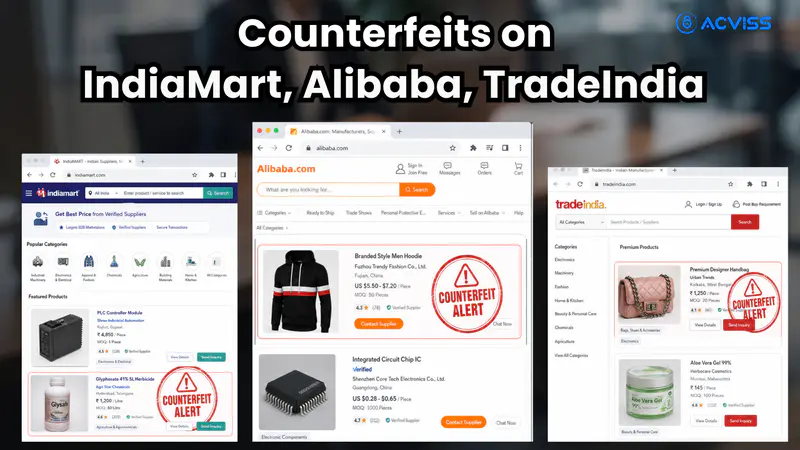
Counterfeit on B2C platforms like Amazon, Flipkart, and Myntra is very common, and people know about it. These are the platforms where the problem is visible, discussed, and at least partially regulated as well. Platforms have invested heavily in detection systems, and brands have teams dedicated to filing takedowns.
But there is a layer above this that almost no one talks about. B2B marketplace counterfeiting. IndiaMart has over 7.8 million sellers across 56 industries and 98,000 product categories. Alibaba connects manufacturers and wholesale buyers across 190+ countries. TradeIndia operates across pharmaceuticals, chemicals, auto components, electronics, and dozens of other sectors. None of these platforms sell to consumers. They sell to manufacturers, distributors, importers, and procurement teams, who then push those products into entire supply chains, retail shelves, and downstream markets.
A fake listing on Amazon typically surfaces in a consumer review within days. A fake component supplier on IndiaMart can fulfil bulk orders for months before anyone connects the dots back to the source. The USTR placed IndiaMart on its Notorious Markets List across multiple consecutive reviews through 2024, citing its failure to implement adequate anti-counterfeiting practices.
This blog breaks down how B2B marketplace counterfeiting actually operates on these wholesale platforms and why it is structurally harder to police.
Why B2B Marketplaces Are Structurally More Vulnerable to Counterfeiting

On a B2C platform, red flags are relatively easy to spot. Price looks off. Reviews mention quality problems. A test purchase costs twenty dollars and delivers an answer within a week.
B2B marketplace counterfeiting operates under entirely different conditions, and the structure of these platforms works in the counterfeiter's favour.
1. Pricing is hidden behind RFQs: Most B2B listings don't display a fixed price. Buyers submit a Request for Quotation, and negotiation happens bilaterally. There is no visible price signal to flag a product as suspiciously cheap.
2. Listings borrow legitimacy: Fake B2B sellers regularly use stolen product images, copied technical specifications, and brand names in their listing titles. A procurement officer comparing two suppliers sees nearly identical listings. One is authorised. One is not. There is often no visual way to distinguish them.
3. Transactions move off-platform: Once a buyer responds to a listing, the conversation typically migrates to WhatsApp, email, or a private channel. The actual negotiation, payment terms, and shipping logistics happen completely outside the platform's visibility.
4. The barrier to listing is extremely low: On IndiaMart, basic free listings require only a phone number, company name, and email. Free listings don't even require GST verification. This means virtually any entity can create a seller presence and start receiving enquiries within minutes.
5. Platform liability has been legally limited. In June 2025, the Delhi High Court classified IndiaMART as a "directory" rather than an active marketplace, effectively ruling that the platform bears no liability for counterfeit listings because it only connects buyers with sellers and does not participate in transactions. The enforcement burden was placed entirely on brand owners.
B2B marketplace counterfeiting is structurally harder to detect, slower to surface, and online brand protection B2B becomes very difficult in such conditions.
TradeIndia and Indiamart Fake Products Listing That Look Identical to Real Ones
When we talk about a B2B marketplace, one of the top companies that comes to mind is Indiamart. The B2B marketplace counterfeiting problem is not primarily about Indiamart's fake products listing. It runs much deeper into the supply chain.
Search for specific industrial bearings, pharmaceutical APIs, agricultural chemicals, or electronic components, and hundreds of suppliers appear. A significant portion of these listings sit alongside authorised distributors with near-identical presentation. They use the same brand names, the same technical specifications, and the same "Authorised Wholesaler" or "Certified Supplier" claims. From a listing page alone, there is no reliable way to distinguish a legitimate supplier from one selling counterfeits.
Industry estimates put the share of counterfeit listings in pharma, electronics, and textiles at over 50% on the platform, particularly in high-demand, high-margin component categories where authentication is difficult and buyer urgency is high.
TradeIndia operates under broadly similar structural conditions. Its "Trusted Seller" badge and payment protection features are real, but neither covers product authenticity or IP authorisation. A seller can be a verified, registered business while simultaneously listing products they have no right to manufacture or sell under a specific brand name.
Alibaba and the OEM Grey Zone
Alibaba's brand protection for counterfeiting problems has a structural dimension that most B2B platform discussions miss entirely: the OEM grey zone.
Many global brands outsource manufacturing to factories in China and Southeast Asia. These are legitimate, contracted arrangements. The factory produces the brand's goods under licence, to spec, at volume. The relationship is real, and the output is genuine.
The problem starts after the authorised production run ends.
Some factories, using the same moulds, the same designs, the same materials, run an unauthorised third shift. The output is physically identical to the genuine product. It was made in the same facility, by the same workers, on the same equipment. But it was never authorised, and it is sold on Alibaba in bulk to whoever is buying. This is commonly referred to as a ghost shift, and it creates one of the most difficult enforcement scenarios in brand protection. How do you challenge a product that was technically manufactured in your own contracted facility?
Alibaba does have an IP Protection Platform (IPP), and it is a real mechanism. However, Alibaba explicitly states in its own supplier verification documentation that it does not verify the authenticity of goods listed by sellers, and does not verify whether sellers have the IP rights or authority to offer specific branded products for sale. The Gold Supplier and Verified Supplier badges confirm that a business is legally registered and that the contact person is an authorised employee. They confirm nothing about what that business is actually allowed to sell.
For large brands enrolled in formal alliance programmes, Alibaba's enforcement tools are functional. For the majority of brand owners, the IPP process is documentation-heavy, reactive, and slow.
The Bulk Purchase Multiplier: Why One B2B Transaction Does More Damage
The scale difference between B2C and B2B marketplace counterfeiting is big and this is because of the structural changes.
A single B2B wholesale transaction does not stay in one place. Those units travel downstream to retailers, sub-distributors, hospitals, auto workshops, and contract manufacturers and none of them have any visibility into the sourcing history of what they are receiving.
The industries where this multiplier effect is most dangerous are also the industries where product failure is not just a commercial problem. According to the WHO, 1 in 10 medical products in low- and middle-income countries is substandard or falsified, with countries spending an estimated $30.5 billion per year on ineffective or harmful medicines. A bulk purchase of counterfeit pharma APIs through a B2B platform produces thousands of bad patient outcomes.
The same logic applies to counterfeit electrical components, substandard auto parts, and adulterated raw materials in food manufacturing. The harm from a single B2B counterfeit transaction is distributed across an entire downstream network that had no part in the sourcing decision.
What Brand Owners Are Currently Doing (And Why It's Not Enough)

Most brands managing B2B marketplace exposure are still doing manual keyword searches, legal notices, and platform takedown filings. The results are reactive, slow, and incomplete.
Manual monitoring means a team member periodically searches the platform for the brand name and key SKUs, identifies suspicious listings, screenshots them, and files a report. By the time this cycle completes, a seller may have already negotiated and shipped multiple bulk orders through off-platform channels.
Legal notices and C&D letters are effective only when a listing is found and the seller can be reached. On B2B platforms where much of the communication happens via WhatsApp and anonymous email IDs, follow-through is difficult. Platforms themselves require documented evidence before acting, and assembling that documentation for each listing is time-consuming.
Seller trust badges are often misread as quality signals. A procurement team that sees a "Gold Supplier" or "TrustSeal" badge typically interprets it as some form of product authenticity assurance. It is not. These badges verify business registration, not IP rights.
The core gap running through all of these approaches is that there is no continuous, automated monitoring of B2B listing pages for IP misuse, brand impersonation, or seller network behaviour. Everything is reactive. By the time a brand owner acts, the damage is usually already downstream.
What B2B Platforms Are (and Aren't) Doing About Verification
Alibaba, IndiaMart, and TradeIndia all have seller verification systems, trust badges and reporting mechanisms. But they all share the same fundamental limitation, which is that their accountability architecture is built around financial fraud, not IP infringement.
The problems platforms are structurally equipped to address are payment disputes, non-delivery claims, and fraudulent transactions.
Alibaba's brand protection platform, also known as the IPP platform, is comprehensive for large enrolled brands and offers genuine enforcement tools. For the broader population of brand owners, it is reactive and requires significant upfront documentation investment. Alibaba's own verification documentation explicitly disclaims responsibility for product authenticity regardless of a seller's verification tier.
IndiaMART's TrustSeal is a paid membership that verifies business registration. The 2024 USTR Notorious Markets review noted that rights holders described IndiaMART's enforcement procedures as seemingly designed to discourage rather than facilitate action. The June 2025 Delhi HC ruling, which classified IndiaMART as a directory rather than an active marketplace, further removed platform liability from the equation.
TradeIndia's Trusted Seller badge and payment protection features address buyer-seller trust in financial transactions. There is no IP-specific product screening built into the seller onboarding process.
The result across all three platforms is the same: enforcement is entirely the brand owner's responsibility, and the tools available to brand owners are manual, reactive, and platform-by-platform.
Read about the Unique Brand Protection Challenges D2C Brands Face
How Online Brand Monitoring Closes the B2B Protection Gap

The shift that matters in the B2B marketplace counterfeiting problem is the shift from reactive to proactive. Filing a complaint after finding a listing is not a protection programme. By the time a brand owner identifies a fake listing and completes a takedown, the seller has almost certainly already processed bulk orders and moved on to a new profile.
Effective B2B marketplace monitoring looks fundamentally different.
It starts with continuous scanning of B2B listing databases for brand name misuse, stolen product images, copied technical specifications, and fabricated authorisation claims. It extends to seller behaviour analysis: unusual minimum order quantities, cross-platform aliases, image manipulation patterns, and listing duplication across geographies. When a seller pattern is flagged, the system packages the evidence in a format ready for takedown filing, rather than requiring a brand owner to manually build the case each time.
The goal is to remove a listing as well as identify the seller network behind it before the next bulk order ships. A single fake supplier often operates multiple profiles across multiple platforms simultaneously. Monitoring one listing in isolation misses the broader network.
For brand owners with significant B2B marketplace exposure, this means shifting from a "find and report" model to a "detect and prevent" model. That requires automation, cross-platform visibility, and the ability to act on behavioural signals before a bulk transaction completes.
How Acviss Helps
Truviss by Acviss
Truviss is Acviss's AI-powered online brand monitoring solution. It detects and acts on digital threats across paid search, marketplaces, social platforms, and beyond. It gives brand teams the visibility and evidence they need to shut down abuse before it reaches the consumer.
AI-powered continuous monitoring of B2B and online marketplaces for fake listings, brand name misuse, and IP infringement
Seller network analysis to identify connected fake profiles and repeat offenders across platforms
Automated evidence packaging for faster, documentation-ready takedown filing
Cross-platform visibility across IndiaMart, Alibaba, TradeIndia, and other online channels in a unified view
Value Outcomes
Earlier detection before bulk orders ship
Faster takedown cycles with less manual effort
Visibility into seller networks rather than isolated listings
Reduced downstream contamination from bulk counterfeit transactions

Frequently Asked Questions
What makes B2B marketplace counterfeiting harder to detect than B2C?
B2B platforms have no consumer reviews, no fixed pricing, and transactions happen off-platform via WhatsApp or email. Listings mimic legitimate ones using stolen specs and brand names. Problems surface only after bulk delivery, by which time fakes are already distributed downstream across multiple buyers.
Are Gold Supplier or TrustSeal badges a guarantee of product authenticity?
No. Alibaba's Gold Supplier badge and IndiaMart's TrustSeal both verify that a business is legally registered and that the contact person is authorised. Alibaba explicitly states in its own documentation that it does not verify whether sellers have IP rights or authority to sell specific branded products.
How does the OEM grey zone on Alibaba work?
Some factories contracted to manufacture branded goods run unauthorised production shifts after the legitimate run ends, using the same moulds, materials, and designs. The output is physically identical to genuine product but was never authorised. These goods are then listed on Alibaba in bulk, making them extremely difficult to distinguish from legitimate stock.
Why is a single counterfeit B2B transaction more damaging than multiple B2C purchases?
A single B2B wholesale order can place tens of thousands of counterfeit units into a downstream supply chain that spans multiple retailers, sub-distributors, and end users — none of whom have visibility into the sourcing history. In categories like pharma or auto components, product failure at that scale creates safety risks, regulatory exposure, and recall liability.
How can brands proactively monitor B2B platforms for counterfeit listings?
Proactive B2B monitoring requires automated, continuous scanning across listing databases for brand misuse, seller behaviour patterns, and cross-platform alias activity. Manual keyword searches are too slow and too narrow. An AI-driven monitoring platform can detect fake seller networks before bulk orders are placed and package evidence for faster takedown action.