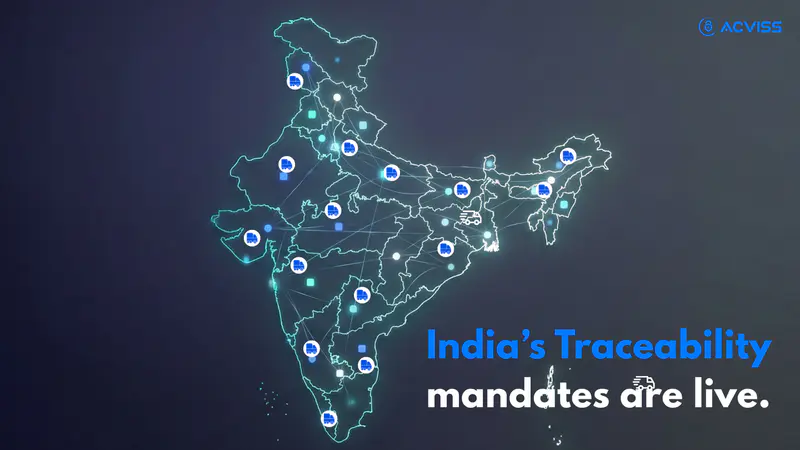
Deadlines are no longer theoretical. Across pharmaceuticals, industrial goods, and automotive supply chains, India has moved from advisory frameworks to enforceable traceability mandates. What used to be a compliance discussion confined to the EU or US is now a pressing operational reality for Indian manufacturers.
For brand owners, supply chain managers, and compliance heads, the challenge is not just meeting requirements. It is understanding what each mandate actually expects and how to respond without creating fragmented systems that increase cost and complexity.
Three mandates define this shift: CDSCO pharmaceutical serialisation, the BIS QR code mandate, and automotive traceability under evolving frameworks such as iVEDA. Together, they signal a structural transition toward product traceability, product authentication, and digitally verifiable supply chains.
Why 2024–2026 Changed the Regulatory Landscape for Indian Manufacturers

India’s manufacturing ecosystem is undergoing a fundamental realignment. The shift is from documentation-based compliance to data-driven accountability.
Historically, compliance meant maintaining records. Today, compliance means proving authenticity, traceability, and product safety in real time.
Several macro drivers are shaping this transition:
National push toward global manufacturing leadership
Alignment with the WHO, the EU, and global export standards
Increasing incidents of counterfeit goods are affecting brand protection and customer satisfaction
The need for transparent supply chain management across fragmented vendor ecosystems
This transformation is often described as a move toward a “digital thread” where every product carries a verifiable identity from origin to consumption.
The implication is clear. Labels are no longer sufficient. A digital product identity layer is becoming mandatory.
CDSCO Pharma Serialisation: What Schedule M Now Requires
The revised Schedule M under CDSCO represents the most significant overhaul of pharmaceutical compliance in India in over two decades.
From GMP to Quality Systems
The regulatory philosophy has shifted from basic Good Manufacturing Practices to a risk-based Quality Management System. This includes:
Pharmaceutical Quality Systems (PQS)
Quality Risk Management (QRM)
Data integrity aligned with ALCOA+ principles
Mandatory Serialisation and QR Codes

Since January 2023, Active Pharmaceutical Ingredients (APIs) must carry QR codes containing critical data points such as:
Global Trade Item Number (GTIN)
Batch number and batch size
Manufacturing and expiry dates
Manufacturing licence details
This is not just labelling. It is a product verification embedded into the packaging.
Timeline and Scope
Large manufacturers: compliance deadlines began mid-2024
MSMEs: deadline extended to December 2025
Full enforcement: January 2026
Cost of Non-Compliance
Failure to comply is not a minor penalty. It includes:
Suspension or cancellation of manufacturing licences
Product recalls
Export restrictions
Legal consequences under drug safety laws
For pharmaceutical brands, this is not just about compliance. It directly impacts product safety, trademark protection, and IP protection.
BIS QR Code Mandate: Expanding Traceability Beyond Pharma
The Bureau of Indian Standards has expanded traceability into industrial and consumer goods through its QR code mandate.
What the BIS Mandate Covers
Under the Omnibus Technical Regulation (OTR) 2024:
Industrial machinery
Electrical equipment
Electronics
must carry BIS certification along with digitally verifiable identifiers.
What the QR Code Must Do
Unlike traditional static QR codes, these must:
Link to product certification details
Identify the manufacturer and factory origin
Enable verification of compliance status
This creates a direct interface between the product and regulatory validation.
Enforcement Timeline
Enforcement deadline: September 1, 2026
Certification pathways include continuous licensing or one-time conformity certification
Why This Matters
The BIS mandate effectively introduces product authentication into mainstream manufacturing. It is no longer limited to high-risk sectors like pharma.
For brands, this intersects with:
Brand authentication
Customer engagement through verification interfaces
A QR code is no longer a marketing tool. It is a compliance instrument.
iVEDA and Automotive Traceability: The Move to Part-Level Accountability

The automotive sector presents the most complex traceability challenge due to multi-tier supply chains.
Emerging frameworks such as iVEDA, along with broader national initiatives, are pushing toward granular traceability at the component level.
The Scale of the Problem
Modern vehicles contain:
Thousands of components
Up to 50 Electronic Control Units (ECUs)
Increasing semiconductor dependency
Failure rates illustrate the risk:
Component level: ~1 ppm
ECU level: ~100 ppm
Vehicle level: ~5000 ppm
Autonomous systems could reach 4.5% failure rates without intervention
What Part-Level Traceability Means
For OEMs and Tier 1 suppliers, this requires:
Unique identification for each component
Integration with Product Lifecycle Management (PLM) systems
Electronic Data Interchange (EDI) for supplier coordination
Operational Impact
Traceability enables:
Precision recalls instead of mass recalls
Faster root cause analysis
Improved product safety and reliability
This is not optional. It is becoming foundational to automotive manufacturing and compliance.
The Common Thread: A Digital Product Identity Layer

Despite differences in sectors, all three mandates converge on a single requirement.
They require a digital identity for every product.
Not just a label. Not just a barcode. A persistent, verifiable identity linked to data.
What This Identity Must Enable
Product authentication and product verification
Track and trace across the entire supply chain
Real-time compliance validation
Consumer-level verification for trust and transparency
Data Carriers Are Only the Surface
Different sectors use different carriers:
DataMatrix codes in pharma
Secure QR codes in BIS-regulated goods
RFID or NFC in automotive
However, the carrier is only the interface. The real requirement is the underlying system.
Without a unified backend, these become isolated compliance efforts.
The Risk of Treating Each Mandate Separately
Many organisations are currently approaching these mandates as separate projects:
One system for pharma serialisation
Another for BIS QR compliance
A third for automotive traceability
This approach creates:
Data silos
Higher operational costs
Integration challenges
Increased risk of compliance failure
More importantly, it misses the strategic opportunity.
Traceability is not just about compliance. It is about building a resilient, transparent, and trustworthy supply chain.
Building One System That Satisfies All Three Mandates
The smarter approach is to implement a unified product traceability and authentication layer.
Core Principles of a Unified System
1. Persistent Identity Layer
Every product unit should carry a unique, non-replicable identity linked to:
Manufacturing data
Supply chain events
Compliance records
2. Event-Based Tracking
Capture data at every stage:
Production
Packaging
Distribution
Retail
This ensures complete supply chain management visibility.
3. Multi-Tier Integration
Suppliers across tiers must be part of the system. This is critical for:
Automotive ecosystems
Pharmaceutical ingredient sourcing
4. Real-Time Validation
Systems should flag inconsistencies before products leave the facility.
Where Plays a Role
This is where advanced anti-counterfeiting solutions and traceability technologies become essential.
Origin, designed as a track-and-trace layer, can serve as a foundational system that integrates across mandates.
When combined with non-cloneable product authentication technologies, it enables:
Tamper-proof product authentication
Seamless product verification across channels
Strong trademark protection and IP protection
Enhanced customer satisfaction through transparent verification
Rather than implementing three separate systems, brands can build a single infrastructure that adapts to regulatory requirements.
Beyond Compliance: Strategic Advantages for Brands
While mandates create urgency, they also unlock long-term value.
Improved Brand Protection
Counterfeiting remains a major threat in India. A digital identity layer enables:
Brand verification at the consumer level
Faster identification of counterfeit distribution channels
Enhanced Customer Engagement
Verification interfaces can double as engagement platforms, allowing brands to:
Educate customers
Build trust
Improve customer satisfaction
Better Supply Chain Visibility
Real-time track and trace capabilities improve:
Inventory management
Recall efficiency
Operational decision-making
Global Market Access
Compliance with Indian mandates aligns with international expectations, enabling smoother exports.
The Road Ahead: Compliance as a Competitive Advantage
India’s traceability mandates are not isolated regulatory changes. They represent a structural shift toward accountability, transparency, and digital verification.
Brands that treat this as a checkbox exercise will meet minimum requirements but struggle with scalability and efficiency.
Those who invest in a unified product authentication and traceability system will gain:
Stronger brand protection
More resilient supply chains
Higher customer trust
Better readiness for future regulations
The direction is clear. The only variable is how prepared each organisation is.
Conclusion
The era of static labelling is ending. India’s regulatory environment now demands dynamic, verifiable, and data-driven product identities.
CDSCO pharma serialisation, the BIS QR code mandate, and automotive traceability frameworks like iVEDA are not separate challenges. They are parts of a single transformation.
A unified approach built on product traceability, track-and-trace systems, and advanced product authentication technologies is no longer optional. It is essential.
For brands navigating these changes, the question is not whether to act, but how quickly and strategically they can adapt.
Interested in learning more? Get in touch with us to explore how a unified traceability and authentication system can help your brand stay compliant, protected, and future-ready.