Manufacturing today does not suffer from a lack of output. It suffers from a lack of certainty.
Across pharma, FMCG, agrochemicals, and consumer electronics, brands produce millions of units every day. Yet once these products leave the production line, visibility begins to fade. As products move through distributors, wholesalers, marketplaces, and cross-border routes, the connection between what was manufactured and what is finally sold becomes increasingly fragile.
This fragility has consequences. Counterfeits infiltrate legitimate channels. Grey market products undercut authorised distributors. Customers lose confidence, not always because a product fails, but because they cannot be sure it is genuine.
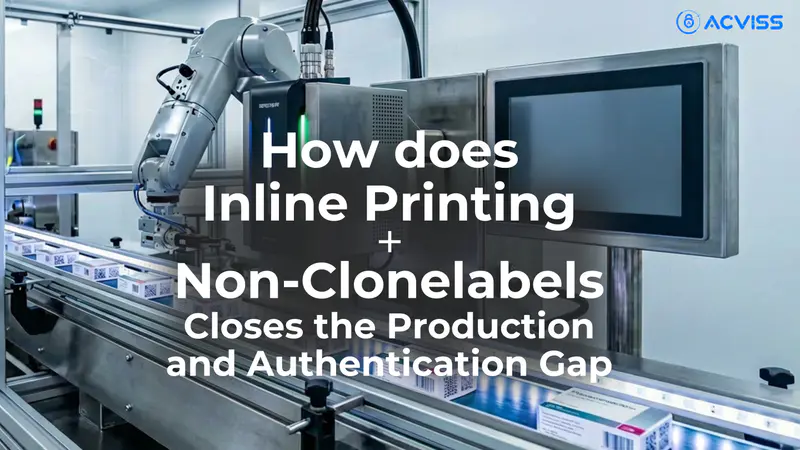
The solution is no longer about adding security after the fact. The shift underway is far more structural. It begins on the production line itself, where inline printing and non-cloneable codes are redefining how product authentication and verification should work.
Why Traditional Brand Protection Breaks Down at Scale
For years, brand protection strategies were built around external controls. Labels applied post-production. Stickers added at warehouses. Static QR codes reused across batches. On paper, these measures looked sufficient. In reality, they created gaps that counterfeiters quickly learned to exploit.
The core issue was separation. Production happened in one system. Authentication data lived in another. Enforcement relied on yet another layer.
This fragmentation created three systemic weaknesses:
Identity was detachable from the product
The data was retrospective, not real-time
Verification relied on visual similarity, not manufacturing truth
As counterfeit networks became more sophisticated, these weaknesses widened. In India’s pharma supply chain alone, losses due to counterfeit drugs are estimated to run into billions annually, with serious implications for product safety and public health.
The lesson is clear. If identity is not created within production, it cannot be reliably defended in the market.
Inline Printing QR: Identity Born on the Production Line
Inline printing QR represents a decisive break from legacy thinking. Instead of attaching identity to a finished product, identity is generated as the product is made.
Each QR code is printed directly onto packaging, labels, or cartons during live production. No manual handling. No secondary application. No opportunity for substitution.
What makes this powerful is not the QR code itself, but the context in which it is created.
An inline-printed code can be linked to:
Manufacturing date and time
Production line and facility
Batch and shift details
Machine and operator metadata
This turns every unit into a traceable data point. From a supply chain management perspective, this enables true product traceability, not just at the pallet or batch level, but at the level regulators and brands increasingly require.
In pharma manufacturing, this approach aligns naturally with serialisation mandates and strengthens compliance without adding operational friction.
Variable Data Printing and the End of “Generic” Authentication
Variable Data Printing, or VDP, is what allows inline printing to scale without compromise. Every code printed is unique. Every identity is singular.
This is where many authentication systems fail conceptually. They validate whether a code exists, not whether it should exist.
VDP-based authentication asks harder questions:
Was this code generated by this production line?
Does it belong to this product variant?
Has it appeared elsewhere before?
When a consumer or distributor scans a product, the system is not merely confirming a number. It is validating a manufacturing event.
This distinction is critical for product verification and brand authentication. It shifts trust away from surface-level markings and towards data-backed certainty.
Non-Cloneable Codes: When Copying Is No Longer Enough

Counterfeiters are excellent imitators. Given enough time, most visible security features can be copied. What they struggle to replicate is unpredictability.
Non-cloneable codes introduce this unpredictability at the identity level. These codes are designed so that even if they are visible, they cannot be meaningfully reproduced.
Unlike traditional serial numbers, non-cloneable codes rely on:
Cryptographic generation logic
Structural randomness
One-time validation behaviour
When combined with inline printing, these codes become inseparable from the production process. They are not added to the product. They are part of its origin story.
From an anti-counterfeiting solutions standpoint, this raises the barrier significantly. Copying the appearance of a code is no longer enough. The data behind it must also behave correctly, something counterfeit systems struggle to replicate at scale.
Closing the Loop Between Manufacturing and Market Reality
One of the most overlooked benefits of inline authentication systems is feedback.
Traditionally, once a product left the factory, manufacturers heard little until something went wrong. A complaint. A recall. A legal notice.
Inline printing combined with authentication closes this loop.
Every scan in the market becomes a signal.
A scan in an unexpected geography can indicate diversion
Multiple scans of the same code can suggest duplication
Absence of scans in key regions can highlight channel breakdowns
This transforms product authentication into a live intelligence layer. Track and trace is no longer limited to logistics milestones. It extends into real-world consumption and verification behaviour.
How Inline Identity Compares to Legacy Approaches
This comparison highlights why many legacy brand protection solutions struggle under modern supply chain pressures.
Brand Protection as a Customer Trust Function
Brand protection is often framed as an internal risk-control exercise. In reality, it is increasingly a customer-facing trust mechanism.
Consumers today expect proof. They want reassurance that what they are buying is authentic, safe, and backed by the brand itself.
Product authentication through secure QR-based verification provides this reassurance instantly. A simple scan can confirm legitimacy, reinforce brand credibility, and support customer satisfaction without adding friction.
When implemented thoughtfully, this moment of verification can also open doors to customer engagement. Programmes such as Bonus can build on authentication touchpoints to educate or reward genuine customers, without diluting the core security objective.
Production Line Traceability as Strategic Infrastructure

Traceability is no longer just about recalls. It is about resilience.
With increasing regulatory pressure, including frameworks such as EUDR, brands must demonstrate visibility across sourcing, manufacturing, and distribution. Inline-printed, non-cloneable identities make this visibility verifiable.
When issues arise, manufacturers can trace affected units precisely. When disputes occur, brands have data-backed evidence. When markets question authenticity, verification is immediate.
This level of control turns product traceability into a competitive advantage rather than a compliance burden.
Manufacturing and Secure ID: A Necessary Convergence
The most effective authentication systems are those that do not feel bolted on. They work because they are aligned with how factories already operate.
When secure ID generation, inline printing, and manufacturing execution systems work together, identity becomes an output of production itself. Solutions such as Certify by Acviss operate in this space, acting as a digital certificate that confirms origin without disrupting throughput or design.
The emphasis remains where it should be: on strong manufacturing fundamentals supported by invisible but robust identity infrastructure.
Trust Is Engineered, Not Claimed
In an era of complex supply chains and rising counterfeit risk, trust cannot be asserted. It must be engineered.
Inline printing and non-cloneable codes represent a shift from reactive brand protection to proactive brand assurance. They connect manufacturing truth with market verification. They strengthen product safety, support IP and trademark protection, and restore confidence across the value chain.
For brands serious about product authentication, brand verification, and long-term customer trust, the future lies in the production line.
Interested in learning more about how inline printing and secure, non-cloneable identities can strengthen your brand? Get in touch with us to explore what is possible.