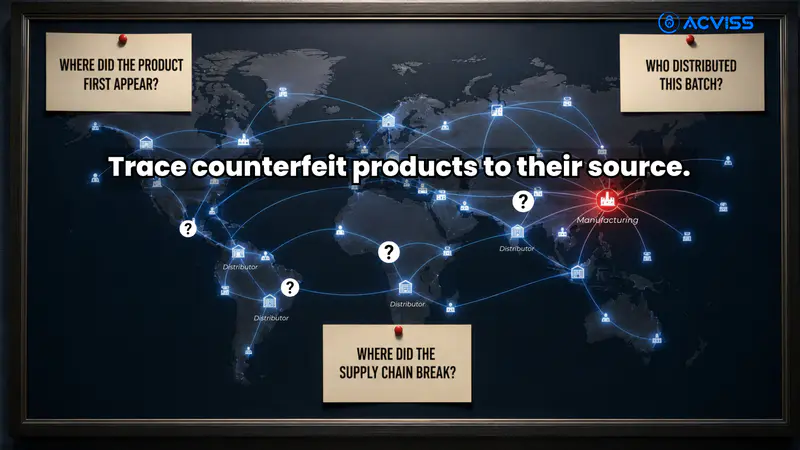
Counterfeit products rarely appear out of nowhere. Yet many investigations begin with a flawed assumption: the products must have originated overseas, often from a factory in China. That assumption sends teams down lengthy investigative paths while the real source remains untouched.
In reality, many counterfeit incidents originate much closer to the legitimate supply chain. A distributor moving unauthorised inventory, a contract manufacturer running undocumented production shifts, a packaging supplier producing excess labels, or a regional reseller feeding products into grey channels can all become entry points. The challenge is not identifying that counterfeits exist. The challenge is identifying precisely where the supply chain was compromised.
For brands dealing with recurring counterfeit incidents, supply chain counterfeit detection requires a forensic approach rather than intuition. Effective investigations rely on serialisation data analysis, distribution mapping, covert purchases, marketplace intelligence, and structured evidence collection. The objective is not simply to locate counterfeit goods. It is to establish a defensible chain of evidence that identifies the source and supports decisive legal and operational action.
Why Most Supply Chain Investigations Fail
Many counterfeit investigations fail before they begin because organisations either react too slowly or investigate too broadly.
A common scenario starts when a customer complaint, distributor report, or online listing raises suspicion. The organisation launches a large-scale review involving procurement, sales, operations, and legal teams. Months later, the investigation has produced hundreds of pages of documentation but very little actionable evidence.
The problem is often scope.
Investigators attempt to examine every supplier, distributor, warehouse, and sales channel simultaneously. Instead of narrowing the possibilities, they create overwhelming amounts of noise.
Another frequent mistake is delaying evidence collection. Counterfeit networks move quickly. Listings disappear. Inventory gets relocated. Communication records are deleted. By the time the investigation gains momentum, crucial evidence may already be gone.
Successful counterfeit source investigations focus on three questions:
Without these answers, investigations often become expensive exercises in speculation.
The Four Most Common Counterfeit Entry Points in Indian Supply Chains
Brands frequently assume counterfeits originate entirely outside their ecosystem. Experience suggests otherwise. Across Indian manufacturing and distribution networks, four entry points appear repeatedly.
1. Rogue Distributors
Distributors often sit closest to market demand and pricing pressures.
Some distributors source unauthorised stock from secondary channels to improve margins or satisfy inventory shortages. Once counterfeit products enter legitimate distribution networks, distinguishing them from genuine products becomes significantly more difficult.
This is particularly common in FMCG, agrochemicals, automotive components, and consumer electronics.
2. Contract Manufacturing Overruns
A manufacturer may receive approval to produce a specific quantity of products. The authorised batch is completed and documented. However, additional units are produced using the same machinery, materials, and packaging after normal operating hours.
These "ghost shift" products can appear nearly identical to legitimate inventory because they often originate from the same facility.
3. Packaging and Label Suppliers
Counterfeit operations frequently require authentic-looking packaging.
Suppliers responsible for cartons, labels, holograms, inserts, and promotional materials sometimes become inadvertent or deliberate leakage points.
An investigation focused solely on finished goods may completely overlook this source.
4. Distribution Diversion and Grey Market Networks
Not all problematic inventory is counterfeit initially. Products diverted from authorised channels often mix with counterfeit stock before re-entering the market. This creates a complex environment where genuine and fake products coexist within the same distribution network.
The result is a counterfeit distribution network that becomes increasingly difficult to trace.
How Serialisation Data Reveals the Origin of Counterfeit Products

Brands investing in product authentication often focus on customer verification. The greater value frequently lies elsewhere.
Serialisation data analysis provides one of the strongest tools for determining how to find the source of counterfeit products in your supply chain.
Every scan generates a digital event containing:
Location
Timestamp
Device information
Product identifier
User behaviour patterns
Scan frequency
When viewed individually, these events reveal very little.
When analysed collectively, patterns emerge.
Geographic Anomalies
Suppose a batch intended exclusively for Karnataka begins generating verification scans in Assam, Gujarat, and Delhi within a few days of production. The issue is not necessarily counterfeit activity. However, the distribution pathway requires investigation.
Similarly, a single serialised code appearing in multiple cities within impossible timeframes often indicates duplication.
Duplicate Authentication Events
One product identifier should correspond to one physical product. When identical codes appear repeatedly across multiple locations, investigators gain an early indication that replication may have occurred.
Volume Outliers
Investigators should pay particular attention to:
Unexpected scan spikes
Regional scan concentrations
Scans occurring after product expiry
Authentication failures clustered in specific markets
This is where solutions such as Acviss Certify become operationally valuable. Authentication scans are not merely verification events. They become intelligence signals that help identify geographic anomalies and potential leakage points.
Example Investigation Pattern
The goal is not to prove counterfeiting immediately. The goal is to identify where further investigation should begin.
Working With Distributors During an Investigation

One of the most delicate phases of any counterfeit supply chain audit process involves distributor engagement. Many organisations share too much information too early.
While transparency is important, investigators must recognise that distributors themselves may be under examination. Information should be shared selectively.
What Should Be Shared
Distributors typically need:
Affected SKU information
Batch numbers
Product photographs
Verification procedures
Temporary containment instructions
This information allows them to support the investigation without compromising evidence collection.
What Should Be Held Back
Avoid disclosing:
Suspected individuals
Specific investigative findings
Monitoring techniques
Surveillance activities
Internal evidence thresholds
Premature disclosure often causes evidence to disappear. Inventory suddenly moves. Records become unavailable. Communication trails stop. A controlled information strategy preserves investigative integrity.
Why Covert Purchase Operations Matter
One of the most effective yet underutilised techniques in counterfeit source investigation is the covert purchase. Rather than relying solely on reports and assumptions, investigators purchase suspect products directly from the market.
The objective extends beyond obtaining the product itself.
Investigators seek:
Invoices
Shipping labels
Courier records
Seller communication
Packaging characteristics
Payment details
These artefacts frequently reveal information that counterfeit operators never intended to disclose.
The Online-to-Offline Investigation Path
A structured covert purchase often follows this progression:
Conduct anonymous communication.
Complete purchase.
Analyse shipping information.
Trace fulfilment location.
Identify warehouse or distribution point.
Conduct physical verification.
Many counterfeit networks that appear highly sophisticated online become surprisingly vulnerable once investigators follow the logistics trail.
This online-to-offline methodology has become increasingly important as counterfeit operators shift from traditional wholesale channels to digital marketplaces.
Digital Breadcrumbs That Lead to Physical Sources

Online listings frequently provide far more intelligence than sellers realise. Marketplace investigations should not focus solely on product images and pricing. Operational signals often reveal deeper supply chain connections.
Key Digital Red Flags
Beyond marketplaces, investigators should examine:
Social media seller accounts
WhatsApp business numbers
Payment gateways
Website registrations
Logistics partnerships
Patterns emerge when multiple data points connect to the same physical region.
In several investigations, the first indication of a manufacturing source came not from factory audits but from repeated shipping records linked to a particular warehouse cluster.
This is where digital monitoring and online brand protection initiatives complement traditional supply chain investigations.
When Internal Teams Should Step Aside
Not every investigation requires external support. However, certain situations create conflicts, limitations, or evidentiary risks that internal teams cannot easily overcome.
Consider External Investigators When:
Employees become suspects
Manufacturing partners are involved
Multiple jurisdictions are affected
Evidence collection requires surveillance
Digital forensic analysis is needed
Legal action is being prepared
External investigators provide objectivity. More importantly, they often possess specialised capabilities unavailable internally.
These may include:
Computer forensics
Deleted data recovery
Physical surveillance
Undercover operations
Expert witness testimony
The transition point usually occurs when the investigation shifts from identifying a problem to building a legally defensible case.
At this stage, procedural rigour becomes more important than speed.
A Practical Counterfeit Supply Chain Audit Framework
Brands seeking a repeatable supply chain investigation methodology can follow this structure:
Supply chain traceability solutions from Acviss can support this process by creating visibility into product movement across manufacturing, warehousing, distribution, and retail stages.
Combined with product authentication intelligence, organisations gain both physical traceability and market-level visibility. Neither capability replaces investigation.
Together, however, they significantly reduce the time required to identify anomalies and narrow potential sources.
Building an Airtight Evidence Package for Legal Action
The final objective of any counterfeit source investigation is not merely discovering who is responsible. The objective is establishing proof that withstands scrutiny.
An effective evidence package typically includes:
Product authentication records
Serialisation analysis
Distribution documentation
Purchase records
Shipping evidence
Photographic evidence
Witness statements
Audit reports
Forensic findings
Each piece should contribute to a clear narrative demonstrating how counterfeit products entered the supply chain and who enabled their movement.
Without a structured evidence package, enforcement actions often stall.
With one, brands can move confidently toward civil action, criminal complaints, distributor termination, regulatory engagement, or coordinated enforcement operations.
Final Thoughts
The most damaging assumption in any counterfeit investigation is believing the answer is obvious.
Counterfeit products rarely emerge from a single source. They are usually the result of multiple operational weaknesses intersecting across manufacturing, packaging, distribution, and digital commerce. Organisations that rely on assumptions often spend months chasing the wrong leads while the actual source continues operating unnoticed.
The brands that consistently succeed treat counterfeit investigations as structured forensic exercises. They use serialisation data, traceability records, covert purchases, marketplace intelligence, and disciplined evidence collection to move from suspicion to proof. As counterfeit networks become more sophisticated and supply chains grow increasingly fragmented, investigation capabilities will become just as important as prevention technologies.
If your organisation is looking to strengthen supply chain visibility, identify counterfeit leakage points, or build a more effective investigation framework, interested to learn more?
Get in touch with us.