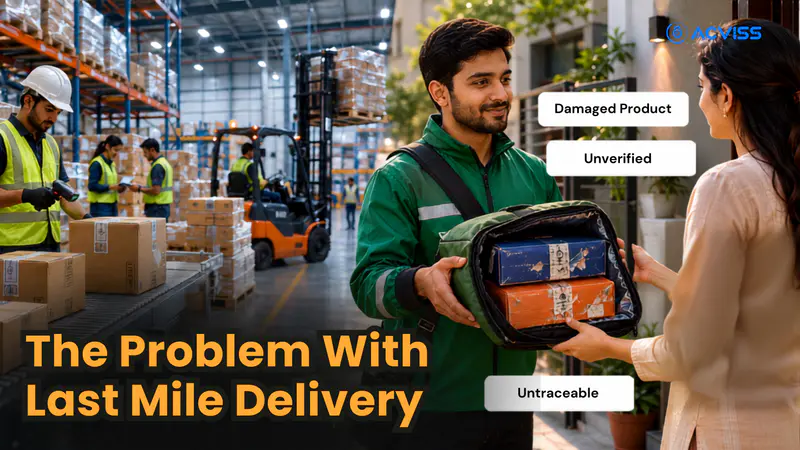
A product may leave the factory perfectly authenticated, fully serialised, quality-checked, and compliant with every traceability requirement. Yet the moment it enters the final delivery journey, many of those controls effectively disappear.
This is one of the least discussed realities in modern supply chains.
Manufacturers invest heavily in production controls, warehouse audits, distributor verification, track and trace systems, and anti-counterfeiting programmes. However, the last mile, the journey from a fulfilment centre, dark store, pharmacy, retailer, or distribution hub to the customer's hands, remains one of the least visible and least protected segments of the entire supply chain.
As quick commerce, direct-to-consumer fulfilment, and outsourced logistics networks continue to expand, a growing number of product integrity failures are occurring after products have already passed through every traditional supply chain checkpoint.
The industry often assumes that once a product leaves the distribution centre, the integrity challenge has largely been solved.
Operational reality suggests otherwise.
Why Last Mile Product Integrity Is Fundamentally Different
Most anti-counterfeiting programmes are designed around controlled environments.
Manufacturing facilities operate under defined procedures. Warehouses maintain inventory accountability. Distributors follow documented handling protocols. Regulatory inspections typically focus on these stages.
The last mile operates differently.
Instead of structured supply chain environments, products move through highly fragmented delivery ecosystems involving:
Gig economy delivery personnel
Third-party logistics providers
Micro fulfilment centres
Dark stores
Temporary storage locations
Multiple handoffs
Dynamic route optimisation systems
Each handoff introduces a new integrity risk.
Unlike warehouses or factories, last-mile operations are optimised primarily for delivery speed and cost efficiency. Product authentication and chain-of-custody verification rarely sit at the centre of operational design.
This creates a dangerous blind spot.
A product may remain fully traceable until the moment it enters final delivery, only to become effectively invisible during the most customer-facing stage of its lifecycle.
The Growing Visibility Gap in Modern Supply Chains
Yet visibility is often misunderstood. Many organisations assume visibility means knowing where a shipment is.
True visibility means understanding:
Most last-mile networks provide location visibility. Very few provide the remaining four. That distinction matters.
A package can arrive on time while simultaneously being substituted, tampered with, mishandled, or fraudulently delivered.
The Three Most Common Forms of Last Mile Product Fraud
1. Package Substitution
Package substitution is often associated with high-value electronics, luxury goods, pharmaceuticals, and premium consumer products.
The fraud occurs when the original product is replaced with:
A counterfeit version
A lower-value alternative
A previously returned item
A defective product
An empty package
From an operational perspective, package substitution is particularly difficult to detect because traditional tracking systems continue showing a successful delivery event.
The shipment history remains intact.
The product inside does not.
Many organisations discover substitution only after customer complaints begin accumulating across multiple delivery regions.
By then, the forensic investigation becomes significantly more difficult.
The final delivery chain frequently lacks the authentication checkpoints necessary to determine precisely where the substitution occurred.
2. Seal Tampering During Transit
Seal tampering represents a more subtle but increasingly common threat.
Rather than replacing the entire product, fraudsters manipulate packaging during transit.
Examples include:
Opening and resealing pharmaceutical cartons
Accessing premium cosmetics
Removing promotional items
Extracting product samples
The challenge is that conventional retail packaging was rarely designed with last-mile threats in mind.
Shelf-facing packaging focuses primarily on:
Product presentation
Consumer appeal
Regulatory labelling
Cost optimisation
Delivery-facing packaging requires additional considerations:
Transit integrity
Authentication verification
Environmental resistance
Chain-of-custody validation
Many packaging systems successfully deter retail theft while offering limited protection against transit manipulation.
3. Fake Delivery Confirmation
One of the fastest-growing forms of delivery fraud involves fraudulent proof of delivery.
This typically includes:
Marking deliveries as completed without an actual handoff
Delivering products to unauthorised recipients
Photograph manipulation
GPS spoofing
Signature falsification
Delivery event fabrication
The rise of rapid fulfilment models has intensified these risks. Performance metrics often prioritise delivery completion rates and speed. Integrity verification receives considerably less attention.
As a result, brands frequently encounter situations where logistics records indicate successful delivery while customers insist the product never arrived.
Resolving such disputes becomes expensive, time-consuming, and damaging to customer trust.
How Quick Commerce Has Amplified Last Mile Integrity Risks

Quick commerce has transformed customer expectations. Thirty-minute deliveries and same-hour fulfilment have become competitive differentiators.
The operational model behind these services introduces new vulnerabilities.
Rapid fulfilment networks depend upon:
High delivery volumes
Fast inventory turnover
Large contractor workforces
Continuous routing adjustments
Minimal handling time
Every efficiency gain reduces available time for verification. Historically, supply chains relied on structured validation processes. Today, many delivery ecosystems prioritise velocity.
This shift has unintentionally expanded opportunities for:
Product substitution
Inventory leakage
Unauthorised diversion
Grey market activity
Delivery fraud
A particularly underreported issue involves promotional abuse and arbitrage.
Certain actors exploit discounted products from quick commerce channels and redirect them into secondary markets.
What appears to be strong customer demand can actually represent inventory diversion and unauthorised resale activity.
Brands often discover the problem only after noticing pricing inconsistencies, distributor complaints, or regional stock imbalances.
The Cold Chain Problem Nobody Wants to Talk About
Cold chain products face a unique last-mile integrity challenge. For many products, authenticity alone is insufficient.
Condition integrity becomes equally important. Vaccines, biologics, speciality medicines, premium dairy products, frozen foods, diagnostic materials, and temperature-sensitive chemicals depend on controlled environmental conditions.
A product can remain authentic yet become unsafe. This creates a fundamentally different risk model. Traditional authentication programmes answer one question:
Is this genuine?
Cold chain environments require a second question:
Has this remained within acceptable environmental parameters?
The last mile is often where temperature control becomes weakest.
Several operational realities contribute:
Delayed deliveries
Traffic disruptions
Route consolidation
Uncontrolled vehicle conditions
Temporary storage stops
Failed refrigeration equipment
The consequence extends beyond customer dissatisfaction.
It directly impacts:
Product safety
Regulatory compliance
Recall exposure
Liability risk
Brand reputation
The final delivery stage remains one of the weakest links.
What Last Mile Tamper-Evident Packaging Should Actually Look Like

Many organisations mistakenly assume existing anti-counterfeit packaging is sufficient.
It often is not.
Packaging designed for retail shelves differs significantly from packaging designed for delivery environments.
Traditional Shelf-Level Protection
Typically focuses on:
Brand presentation
Visual authentication
Consumer appeal
Last Mile Protection
Requires additional capabilities:
This is where technologies such as non-cloneable label systems become particularly valuable.
Unlike conventional QR codes, non-cloneable labels can help establish stronger authentication assurance during delivery verification.
Solutions such as Acviss Certify allow brands to create unique digital identities for products that can be verified at multiple checkpoints throughout the product lifecycle, including delivery-stage authentication events.
The objective is not merely proving authenticity at purchase.
The objective is to prove authenticity at every critical handoff.
Delivery Scans Should Become Authentication Checkpoints
Most delivery scans today serve logistical purposes. They confirm movement, but they rarely confirm integrity. That distinction creates a significant opportunity.
Every delivery event can become an authentication checkpoint. Instead of recording only location data, scan events can verify:
Product authenticity
Packaging integrity
Delivery personnel accountability
Temperature compliance
Customer receipt confirmation
This transforms delivery scans from operational records into a trust infrastructure.
The approach aligns closely with broader track and trace principles increasingly adopted across regulated industries.
Under emerging regulations such as the EU's evolving product traceability frameworks and supply chain transparency initiatives, event-level verification will become increasingly important.
Authentication should not stop at manufacturing. It should continue until consumption.
Turning Customer Reports into Supply Chain Intelligence

One of the most underutilised assets in brand protection is customer feedback. Most organisations treat fraud reports as customer service issues. Leading brands increasingly treat them as intelligence signals.
Consider what happens when customers can instantly report:
Packaging damage
Authentication failures
Missing contents
Delivery discrepancies
Suspected counterfeit products
Temperature concerns
Individually, these reports appear operational. Collectively, they become a powerful fraud detection network. Patterns emerge. Specific delivery routes may show abnormal incident rates.
Particular fulfilment centres may exhibit recurring integrity failures. Certain logistics partners may generate disproportionate complaints.
The data becomes actionable.
Modern brand protection programmes increasingly combine authentication technologies, customer engagement systems, loyalty programmes, and fraud reporting mechanisms into a single intelligence framework.
This creates a feedback loop capable of identifying threats much earlier than traditional audits.
Why Last Mile Integrity Deployments Often Fail
Many organisations recognise the problem yet struggle with implementation.
Several recurring issues appear across deployments.
Technology Without Process Governance
Authentication technologies cannot compensate for weak operational discipline.
Without defined escalation workflows, exception handling, and accountability structures, even sophisticated systems generate limited value.
Poor Logistics Partner Alignment
Third-party logistics providers may not share the same priorities as brand owners.
Unless authentication requirements become contractual obligations, compliance often remains inconsistent.
Scan Fatigue
Adding excessive verification requirements can reduce workforce adoption.
Successful deployments balance security with operational practicality.
ERP and Traceability Synchronisation Gaps
Authentication systems frequently operate separately from logistics systems.
This creates data fragmentation and weakens investigation capabilities.
Weak Consumer Participation
Consumer-facing verification programmes fail when reporting processes become complicated.
Participation rises dramatically when verification, authentication, loyalty, and support experiences are integrated into a single workflow.
Building a Future-Ready Last Mile Integrity Framework
Organisations that view last-mile protection purely as a logistics challenge are increasingly missing the broader picture.
It is becoming a convergence point between:
Product authentication
Brand protection
Customer engagement
Regulatory compliance
Product traceability
Anti-counterfeiting solutions
Warranty validation
Supply chain intelligence
The most effective future models will combine:
Unique product identities through serialisation and authentication technologies.
Non-cloneable labels that support trusted verification.
Scan events at every critical handoff.
Consumer verification and reporting mechanisms.
Real-time analytics that convert fraud signals into operational intelligence.
Integrated track and trace infrastructure extending beyond distribution centres and into final delivery.
The last mile should no longer be treated as a black box.
It should become a verified segment of the supply chain.
Final Thoughts
For years, brands have concentrated their anti-counterfeiting investments where they had the greatest visibility: factories, warehouses, distributors, and retail channels.
Yet the final delivery journey has quietly become one of the most exposed parts of the modern supply chain.
As quick commerce expands, home delivery volumes increase, and third-party logistics ecosystems become more fragmented, last mile product integrity will move from a niche operational concern to a board-level brand protection issue. Product authenticity, product safety, customer satisfaction, and regulatory compliance increasingly depend on what happens after a package leaves the warehouse.
The organisations that succeed will be those that extend authentication, track and trace, and brand protection capabilities all the way to the consumer's doorstep. Technologies such as non-cloneable label systems, delivery-stage verification, customer engagement workflows, and intelligent reporting frameworks will become essential components of future-ready supply chain management strategies.
The last mile may be the shortest part of the journey.
It is often where the greatest trust risks now exist.
Interested in learning more? Get in touch with us.
Frequently Asked Questions
What is last-mile product integrity?
Last-mile product integrity refers to maintaining product authenticity, condition, traceability, and chain-of-custody during the final delivery stage from the fulfilment centre or distribution hub to the end customer.
Why is the last mile vulnerable to counterfeiting?
The last mile often involves multiple third-party participants, limited oversight, fewer authentication checkpoints, and operational pressure to prioritise delivery speed over verification.
How does product authentication help reduce delivery fraud?
Authentication technologies allow products to be verified during delivery, helping detect substitution, tampering, and unauthorised handling before products reach consumers.
Are QR codes enough for last-mile protection?
Standard QR codes alone are often insufficient because they can be copied or reused. More advanced approaches incorporate non-cloneable labels, dynamic authentication methods, and event-based verification workflows.
How can brands use customer engagement to improve supply chain security?
Customer verification, reporting, loyalty interactions, and authentication scans can generate valuable intelligence that helps identify fraud patterns, logistics vulnerabilities, and emerging counterfeit risks.