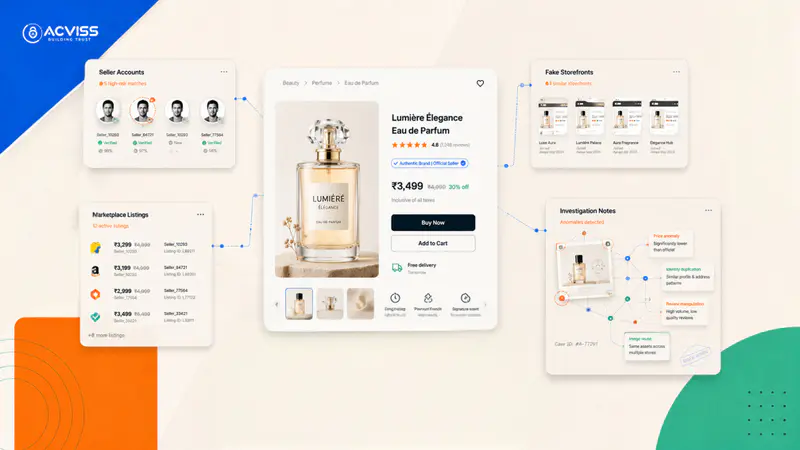
A counterfeit listing rarely appears by accident. Behind what looks like an ordinary product page is often a coordinated operation designed to exploit marketplace algorithms, consumer trust, and gaps in brand monitoring. Within hours of going live, a counterfeit product can begin competing with authorised sellers, attracting buyers through copied product information, manipulated pricing, and misleading claims.
Removing a listing is only one step in a much larger investigation. The real challenge lies in detecting suspicious activity early, gathering evidence that platforms will accept, and understanding how counterfeit sellers repeatedly return under new identities. Examining the full lifecycle of a counterfeit listing reveals where brands have the greatest opportunity to intervene before financial losses, reputational damage, and customer complaints begin to escalate.
Counterfeit Listings Are Built to Evade Detection
A desk with multiple monitors showing:
product photos being edited
copied product descriptions
several marketplace dashboards
pricing comparisons
multiple seller accounts
No criminals or dramatic imagery. Focus on the scale and organisation of the operation.
Many organisations still view counterfeit listings as isolated incidents. In reality, successful counterfeit operations function more like organised commercial networks than individual sellers. A single group may control dozens of seller accounts, operate across multiple marketplaces, rotate product listings, and continuously adapt their tactics to avoid enforcement.
The listing itself is often the final stage of preparation rather than the starting point. Before publishing a product, counterfeiters typically collect official product images, copy technical specifications, recreate marketing content, and monitor authorised pricing to ensure their listings appear credible.
Artificial intelligence has accelerated this process considerably. Product descriptions can now be generated in seconds, images enhanced automatically, and listings translated into multiple languages with minimal effort. As a result, counterfeit products increasingly resemble legitimate listings, making manual detection far less effective than it once was.
Some operations also test different marketplaces and geographic regions before scaling. A listing that attracts little attention in one country may perform exceptionally well in another where enforcement is slower or authorised distribution is limited. This allows counterfeit networks to optimise their approach while remaining below the radar of many brands.
The objective is not simply to upload a fake product. It is to create enough legitimacy that both marketplace algorithms and customers treat the listing as trustworthy.
Stage 1: Listing Creation
The creation of a counterfeit listing is carefully designed to mirror legitimate product pages. Counterfeiters understand that consumers rarely compare every detail before making a purchase. Instead, they focus on replicating the signals that influence buying decisions.
These commonly include:
Official product photographs copied from brand websites
Product titles containing genuine trademarks
Technical specifications reproduced from authorised listings
Manufacturer descriptions copied verbatim
Competitive pricing designed to appear believable rather than suspicious
Rather than dramatically undercutting authorised sellers, counterfeiters frequently price products just below the market average. Significant discounts can attract unwanted scrutiny, while modest price differences encourage purchases without immediately raising suspicion.
Seller credibility is also manufactured. Some counterfeit accounts accumulate positive reviews by selling inexpensive genuine products before introducing counterfeit inventory. Others purchase fake reviews or inherit established seller accounts, making them appear legitimate from the outset.
The listing itself therefore becomes an engineered asset rather than a simple advertisement.
Stage 2: Discovery and Marketplace Amplification
Show an authentic-looking product listing appearing simultaneously on:
shopping search results
social media feeds
online ads
comparison websites
The interfaces should be blurred or generic to avoid resembling specific platforms too closely. The visual communicates how quickly one listing gains visibility.
Publishing a counterfeit listing does not automatically generate sales. Visibility comes from marketplace algorithms that reward engagement, competitive pricing, and customer interaction.
When a counterfeit listing begins attracting clicks or purchases, recommendation engines often amplify its reach. The product may appear in search results, sponsored placements, "Customers Also Bought" recommendations, or comparison panels alongside genuine products.
This algorithmic amplification allows counterfeit listings to spread much faster than many brands anticipate.
Discovery increasingly extends beyond marketplaces themselves. Consumers may encounter counterfeit listings through:
Search engine shopping results
Paid social media advertisements
Influencer promotions
Affiliate websites
Messaging applications
Product comparison portals
Each additional discovery channel expands the counterfeit seller's reach while making enforcement more complex. Removing a marketplace listing does not necessarily eliminate advertisements, promotional posts, or cloned content directing customers towards similar listings elsewhere.
Brands that rely solely on periodic marketplace reviews often detect counterfeit activity only after listings have accumulated significant engagement, customer reviews, or sales.
Stage 3: Assessing Which Listings Matter Most
Not every counterfeit listing presents the same level of business risk. Organisations with hundreds or thousands of infringements cannot realistically investigate every case with equal urgency.
An effective response begins with prioritisation.
Several factors influence the potential impact of a counterfeit listing, including product category, sales velocity, pricing behaviour, customer complaints, and regulatory implications. Counterfeit pharmaceuticals, automotive components, agrochemicals, and food products generally require faster intervention because consumer safety risks extend well beyond financial losses.
Listings demonstrating unusually high engagement or repeated appearances across multiple marketplaces should also receive greater attention. These often indicate organised operations rather than isolated infringements.
A practical risk assessment framework helps investigation teams allocate resources more effectively.
Prioritisation also reduces investigation fatigue. Instead of reacting to every infringement, teams can focus on listings most likely to damage revenue, customer trust, or regulatory compliance.
Stage 4: Evidence Collection Is Where Many Investigations Break Down
Finding a counterfeit listing is only the beginning. Successful enforcement depends on presenting evidence that marketplaces, payment providers, registrars, and legal teams can verify.
Many organisations underestimate this stage. A single screenshot may confirm that a listing existed, but it rarely provides sufficient evidence to support a comprehensive enforcement action.
A stronger evidence package typically includes:
Complete listing URLs
Seller account identifiers
Time-stamped screenshots
Product descriptions
Pricing history
Customer reviews
Marketplace identifiers
Archived versions of listings were available

Where counterfeit activity extends beyond marketplaces, investigators may also collect WHOIS information, SSL certificate records, domain registration details, and hosting evidence. These data points help establish links between multiple domains, seller identities, and wider counterfeit networks.
For pharmaceutical products and other regulated industries, digital evidence alone is often insufficient. Counterfeit medicines can closely replicate packaging, holograms, batch numbers, and authentication features while containing incorrect or dangerous ingredients.
In such cases, brands frequently initiate anonymous test purchases to preserve the integrity of the investigation. Proper chain-of-custody documentation, recorded unboxing, laboratory analysis, and payment records create an evidence package that is far more difficult to dispute during marketplace enforcement or legal proceedings.
Evidence collection should therefore be viewed as an operational process rather than an administrative task. Strong evidence not only improves the likelihood of successful takedowns but also supports broader investigations into repeat offenders, supply chain leakages, and organised counterfeit networks.
Stage 5: Enforcement and Takedown
Once sufficient evidence has been collected, enforcement moves from investigation to action. This is where many brands discover that removing counterfeit listings is far from a standardised process. Every marketplace has its own reporting procedures, evidentiary requirements, response times, and intellectual property policies.
The type of infringement also determines the most effective enforcement strategy. While a listing may appear counterfeit, the complaint itself often needs to be framed around a specific intellectual property right that the platform recognises.
Leading marketplaces have introduced dedicated programmes to streamline enforcement. Amazon's Brand Registry and Project Zero accelerate reporting for verified rights owners, while eBay's Verified Rights Owner (VeRO) programme and Alibaba's Intellectual Property Protection Platform provide structured workflows for submitting evidence.
However, successful enforcement is rarely achieved by simply filing complaints. Poorly documented cases, incomplete evidence, or incorrect classification of infringement often result in rejected requests or lengthy review cycles.
Brands should also recognise that marketplaces balance multiple interests during enforcement. They must protect intellectual property while ensuring legitimate sellers are not wrongly removed. Well-prepared evidence packages therefore improve both response speed and enforcement success.
Removal Does Not Mean the Threat Has Disappeared
One of the biggest misconceptions in online brand protection is that removing a listing solves the problem. In reality, experienced counterfeit networks treat takedowns as an expected business cost rather than a meaningful deterrent.
A removed listing is frequently replaced within days, or even hours, through another seller account, a different marketplace, or a newly registered domain. Some operators maintain multiple dormant accounts specifically to minimise disruption when enforcement actions occur.
Recent advances in automation have made this even easier. AI-generated product descriptions, cloned storefronts, and automated listing tools allow counterfeiters to recreate listings at scale with minimal effort. At the same time, techniques such as homograph domains, fast-flux hosting, and rotating infrastructure make digital impersonation increasingly difficult to track using manual methods alone.
For brands, this creates an important shift in mindset. Success should not be measured solely by the number of listings removed, but by how effectively repeat offenders are identified, monitored, and disrupted over time.
Moving Beyond Takedowns with Continuous Online Brand Protection

A modern enterprise dashboard monitors:
thousands of online listings
counterfeit hotspots on a map
seller networks
domain monitoring
takedown status
AI-generated alerts
Include subtle indicators like "New Listing Detected" or "High Risk" without overwhelming the image with text.
This reinforces the shift from reactive takedowns to continuous intelligence.
Reactive enforcement has become increasingly difficult as counterfeit operations expand across marketplaces, websites, social media platforms, and messaging applications. Brands need greater visibility into how counterfeit activity evolves rather than focusing exclusively on individual listings.
This is where continuous online brand protection becomes significantly more valuable than periodic monitoring.
Acviss Truviss are designed to monitor a broad digital ecosystem rather than isolated marketplaces. Instead of identifying counterfeit listings after customer complaints emerge, continuous monitoring helps detect suspicious activity across marketplaces, websites, domains, mobile applications, and social platforms before it develops into a larger commercial threat.
The intelligence generated through this process extends beyond individual takedowns.
Repeated seller identities, pricing anomalies, geographic hotspots, domain impersonation, and recurring product categories can reveal larger patterns that point towards organised counterfeit operations. These insights enable brands to prioritise investigations, allocate enforcement resources more effectively, and strengthen long-term brand protection strategies.
When combined with supply chain visibility, this intelligence becomes even more valuable. Counterfeit listings appearing consistently within specific regions, distributors, or product categories may indicate grey market diversion, unauthorised distribution channels, or broader supply chain vulnerabilities that warrant further investigation.
Rather than treating online enforcement as a standalone activity, organisations can use marketplace intelligence to strengthen product authentication, improve supply chain governance, and support legal or regulatory action where necessary.
Common Mistakes Brands Make During Counterfeit Enforcement
Even organisations with dedicated enforcement teams often encounter recurring operational challenges that reduce the effectiveness of their programmes.
Some of the most common include:
Treating every counterfeit listing as equally urgent instead of prioritising by business risk.
Relying on screenshots rather than building comprehensive evidence packages.
Focusing only on major marketplaces while overlooking websites, social commerce, and mobile applications.
Measuring success by the number of takedowns instead of tracking repeat offenders and enforcement outcomes.
Conducting investigations in isolation without sharing intelligence across legal, compliance, supply chain, and brand protection teams.
Stopping investigations once listings are removed instead of monitoring for reappearance.
Addressing these issues requires governance as much as technology. Clear ownership, repeatable investigation workflows, and continuous monitoring are essential for building a sustainable online brand protection programme.
The Future of Counterfeit Listing Investigations
Counterfeit listings are becoming faster to create, more convincing to consumers, and increasingly difficult to detect through manual processes alone. Artificial intelligence is lowering the cost of producing realistic product pages, while cross-platform commerce allows sellers to shift between marketplaces with minimal disruption.
At the same time, regulatory expectations around product safety, consumer protection, and digital platform accountability continue to evolve. Brands will need to demonstrate not only that they respond to counterfeit activity, but also that they have appropriate monitoring, investigation, and governance processes in place.
The organisations that succeed will be those that treat counterfeit listings as intelligence sources rather than isolated incidents. Every investigation can reveal insights into seller behaviour, distribution networks, pricing manipulation, and supply chain vulnerabilities that strengthen future enforcement efforts.
Counterfeit listings are unlikely to disappear. The advantage lies in detecting them earlier, investigating them more effectively, and using every enforcement action to build a stronger understanding of the networks behind them.
Interested in learning how continuous online brand protection can help detect, investigate, and remove counterfeit listings before they scale? Get in touch with the Acviss team to explore how Truviss combines online monitoring, supply chain visibility, and actionable intelligence to strengthen long-term brand protection.