For many companies, the sale is treated as the finish line. Marketing campaigns chase conversions, sales teams celebrate closed deals, and quarterly numbers move forward. Yet seasoned business leaders understand something fundamental that younger organisations often overlook.
The real relationship with a customer begins after the purchase.
What happens in the hours, days and weeks following a transaction determines whether a buyer becomes a repeat customer, a brand advocate, or a silent detractor. Behavioural research repeatedly shows that acquiring a new customer can cost between five and twenty-five times as much as retaining an existing one. Even more striking is the impact of loyalty. A modest five per cent improvement in retention rates can increase profits by up to 95%.
Understanding the psychology of post-purchase satisfaction, therefore, becomes a strategic advantage. Brands that master this stage of the customer journey create long-term loyalty with remarkable consistency.
Why the Post-Purchase Moment Matters More Than Ever
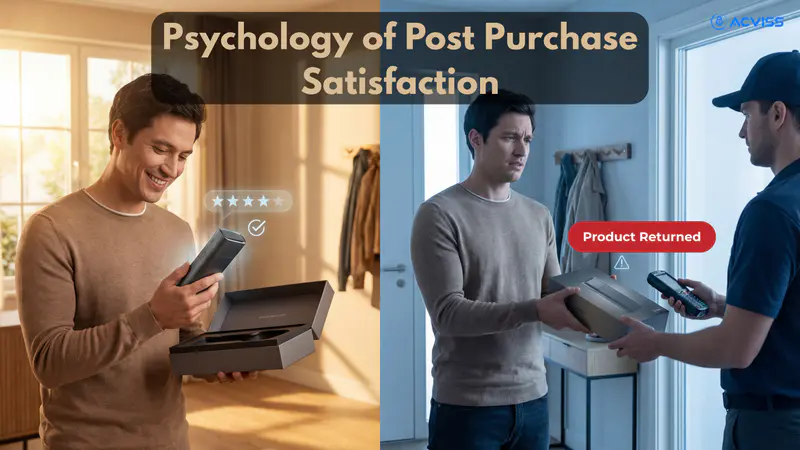
The moment after a purchase is psychologically delicate. Consumers have just committed their money, reputation and expectations to a product or service. During this period, they subconsciously evaluate whether their decision was correct.
If the experience reassures them, satisfaction strengthens, and loyalty grows. If doubt creeps in, the result may be post-purchase dissonance, more commonly known as buyer’s remorse.
This psychological tension explains why operational decisions such as delivery communication, product quality, and customer engagement are so powerful. They do more than solve logistical problems. They shape how customers emotionally interpret their decision.
Three key psychological mechanisms strongly influence this process.
The Cognitive Biases Behind Post-Purchase Satisfaction
Choice-Supportive Bias

Human beings have a natural tendency to justify their decisions. Psychologists call this phenomenon choice-supportive bias.
After choosing a product, consumers begin to emphasise its positive attributes while subconsciously downplaying its weaknesses. They may even misremember facts, recalling the product as faster, stronger or better than it originally appeared.
This mental process protects emotional well-being by reducing regret. For brands, it creates an opportunity. If the customer receives reinforcement immediately after purchase, this bias strengthens and satisfaction increases.
However, if the experience contradicts expectations, the opposite happens. The mind begins searching for reasons why the decision was wrong.
The IKEA Effect
Another powerful behavioural phenomenon is known as the IKEA effect. Consumers tend to value products more when they feel personally involved in their creation or customisation.
The classic example comes from IKEA furniture. Customers who assemble their own furniture often perceive it as more valuable than pre-assembled alternatives.
This principle extends far beyond furniture. When brands allow customers to personalise products, participate in communities or interact with loyalty programmes, they create psychological ownership.
That ownership strengthens attachment and long-term loyalty.
Reward Psychology and Habit Formation
Loyalty programmes leverage the brain’s reward system. When customers receive rewards or recognition, the brain releases dopamine, reinforcing the behaviour that triggered the reward.
One particularly important concept is the goal gradient effect. Motivation increases as people get closer to a reward. A customer who has collected eight out of ten loyalty points becomes significantly more likely to make another purchase than someone starting from zero.
Variable rewards further amplify this effect. When rewards appear unpredictably, engagement increases because the brain anticipates the possibility of a positive surprise.
This is why well-designed loyalty programmes are not merely promotional tools. They are behavioural systems designed to build habits.
Preventing Post-Purchase Dissonance
Even the strongest brands must manage the risk of post-purchase dissonance.
Dissonance occurs when reality fails to match expectations. Customers may begin to question whether they made the right decision.
Several operational factors influence whether this doubt emerges:
Product quality and reliability
Transparent communication about delivery and availability
Simple return and refund policies
When brands manage these elements carefully, they transform potentially negative experiences into opportunities for trust building.
For example, streamlined returns often improve customer satisfaction rather than harming it. Customers feel reassured that the brand stands behind its promises.
Case Study: Amazon Prime and the Membership Ecosystem

Few companies illustrate the power of post-purchase loyalty systems better than Amazon.
Amazon Prime is widely regarded as one of the most successful membership ecosystems in modern commerce.
The numbers reveal why.
Prime members convert at a rate of approximately seventy-four per cent, compared with thirteen per cent for non-members. Once subscribed, customers also spend significantly more each year.
The psychological drivers behind this success are subtle but powerful.
First, the subscription creates commitment. Customers subconsciously want to justify the cost of their membership. This encourages them to shop within the ecosystem.
Second, the service reduces friction. Fast shipping, easy returns and integrated services such as video streaming make Amazon part of everyday life.
Third, Prime reinforces post-purchase satisfaction. Every fast delivery confirms that the customer made a smart decision to join.
The result is a retention machine built on behavioural psychology rather than traditional marketing.
Case Study: Starbucks Rewards and the Power of Gamification

Starbucks provides another compelling example of loyalty psychology at scale.
The company transformed a simple punch-card system into one of the most sophisticated digital loyalty ecosystems in retail.
Today, Starbucks Rewards members account for more than half of the company’s United States revenue. These customers also spend roughly three times more per visit than non-members.
The programme’s success lies in its gamification structure.
Customers earn stars for purchases and unlock rewards as they accumulate points. Limited-time challenges such as double-star days create urgency and excitement.
Each reward reinforces the behaviour of returning to the brand.
Another remarkable feature of Starbucks Rewards is its prepaid balance system. Customers store funds within the app, effectively giving Starbucks access to billions of dollars in advance payments.
This transforms loyalty engagement into financial advantage.
Case Study: Patagonia and Trust-Driven Loyalty

Not all loyalty strategies revolve around points and rewards.
Patagonia has built one of the most loyal customer communities in retail by focusing on transparency and environmental responsibility.
The brand’s “Worn Wear” initiative encourages customers to repair clothing rather than replace it. Over half a million garments have been repaired through this programme.
Patagonia also provides detailed information about the environmental footprint of its products. Customers can trace the materials and production processes behind each item.
This level of transparency reinforces Brand Authentication and strengthens customer trust.
Consumers feel aligned with the brand’s values, which creates a powerful emotional bond.
Case Study: Lululemon and Community-Driven Retention

Lululemon demonstrates another dimension of post-purchase loyalty: community.
Rather than positioning itself purely as an apparel retailer, the company has built a lifestyle ecosystem around wellness and fitness.
Local instructors act as ambassadors, hosting events and workshops that connect customers to the brand beyond the store.
The company’s digital fitness platform further extends this engagement into customers’ homes.
This approach transforms the relationship from transactional to experiential. Customers are not simply buying products. They are participating in a community.
Loyalty Programmes in the Era of Product Verification
While emotional engagement is crucial, modern loyalty strategies increasingly rely on technology.
In sectors such as pharma, consumer goods and electronics, Product Authentication and Product Verification are becoming central to post-purchase experiences.
Customers want assurance that their purchase is genuine, safe and traceable.
This is where advanced Track and trace systems and Product traceability solutions play an important role.
When customers verify a product through a digital interface, brands gain valuable insights into real-world product movement. These interactions support Supply chain management transparency and strengthen Brand protection.
Strengthening Loyalty Through Verified Engagement
Bonus by Acviss provides a framework that integrates loyalty engagement with secure product verification.
When connected with non-cloneable technology, Bonus ensures that loyalty rewards are tied to genuine product interactions rather than duplicated codes or fraudulent claims.
This approach delivers several advantages.
It protects loyalty budgets by ensuring that rewards correspond to authentic purchases. It strengthens Product Authentication and Brand Verification by linking rewards to verified product identities. It also generates real-world insights into customer engagement and regional demand patterns.
For brands facing counterfeit threats, integrating loyalty programmes with Product Verification creates an additional layer of protection.
It reinforces Trademark Protection, supports IP Protection and enhances product safety across the supply chain.
Turning Buyers into Brand Advocates
The brands that retain customers most effectively share a common philosophy.
They treat the post-purchase experience as a carefully designed journey rather than an operational afterthought.
This journey includes:
Clear communication after the transaction
Reliable delivery and service experiences
Opportunities for participation and personalisation
Loyalty rewards that reinforce positive behaviour
Authentication mechanisms that protect trust
When these elements work together, the psychological dynamics of satisfaction take over. Customers begin to justify their purchase, invest emotionally in the brand and return repeatedly.
Over time, this cycle transforms ordinary buyers into loyal advocates.
Conclusion
Customer retention is rarely accidental. It is the result of understanding how people think and feel after they buy.
Choice-supportive bias encourages customers to validate their decisions. The IKEA effect creates emotional ownership. Reward psychology turns purchasing into a habit.
Brands like Amazon, Starbucks, Patagonia and Lululemon demonstrate how these psychological forces can be translated into powerful loyalty ecosystems.
When combined with modern Product Authentication, Track and trace infrastructure and secure engagement platforms like Bonus, powered by non-cloneable technology, loyalty programmes evolve into strategic assets.
They protect revenue, strengthen Brand protection and deepen customer engagement.
Interested to learn more about building a data-driven loyalty strategy that strengthens Product Authentication and long-term customer satisfaction? Get in touch with us.