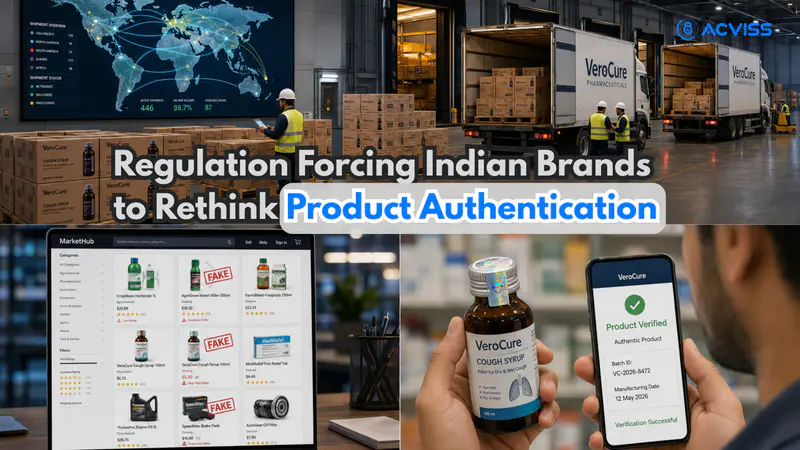
For years, product authentication in India occupied an unusual position. Many regulations required manufacturers to provide product information, maintain records, and comply with quality standards, yet the adoption of authentication and traceability technologies remained largely voluntary. Most brands viewed anti-counterfeit measures as a commercial decision rather than a regulatory necessity.
That assumption is becoming increasingly difficult to sustain. Across the food, jewellery, pharmaceuticals, and agricultural inputs sectors, regulators are introducing digital identification requirements, traceability mandates, and verification systems to improve transparency and reduce fraud. What was once considered a brand protection initiative is rapidly becoming a compliance requirement. For Indian businesses, product authentication is no longer just about protecting revenue or consumer trust. It is becoming a prerequisite for market access, regulatory compliance, and operational resilience.
The Old Model: When Product Authentication Was Mostly Optional
Historically, authentication technologies were adopted unevenly across industries.
Large pharmaceutical companies invested in serialisation to meet export requirements. Premium consumer brands implemented QR codes or holograms to combat counterfeiting. Luxury goods manufacturers explored product verification mechanisms to protect brand equity.
However, outside these specific use cases, many organisations continued to rely on conventional packaging controls, distributor relationships, and periodic audits.
This approach was often driven by practical considerations.
Authentication programmes required investment in technology, packaging modifications, supply chain integration, employee training, and ongoing management. Unless counterfeit activity became apparent or customers raised concerns, many businesses struggled to justify the expenditure.
As a result, compliance and authentication frequently operated as separate functions.
Compliance teams focused on meeting regulatory requirements. Brand protection teams focused on counterfeit prevention. Supply chain teams focused on logistics and distribution efficiency.
That separation is becoming increasingly difficult to maintain.
Today's regulatory environment is pushing organisations towards systems that simultaneously support compliance, verification, traceability, investigation, and consumer transparency.
What's Changed: The Regulatory Push Across Multiple Industries

India's regulatory landscape has entered a new phase.
Rather than relying solely on documentation and inspections, regulators are increasingly requiring products themselves to carry verifiable digital identities.
The objective extends beyond compliance reporting.
Regulators are attempting to solve several persistent challenges:
Counterfeit products entering legitimate supply chains
Lack of traceability during recalls
Unregistered agricultural products reaching farmers
Misleading product claims
Quality assurance failures
Difficulty investigating supply chain violations
The result is a growing convergence between compliance systems and authentication systems.
The following sectors illustrate how this shift is unfolding.
The common theme is clear: regulators increasingly expect products to be digitally verifiable rather than merely documented.
FSSAI and Food Labelling: What QR Code and Transparency Requirements Mean for FMCG Brands
Food safety regulations are evolving beyond traditional packaging disclosures.
The Food Safety and Standards Authority of India (FSSAI) has strengthened labelling requirements with greater emphasis on transparency, nutritional information, ingredient visibility, allergen declarations, and consumer access to product information.
For FMCG brands, compliance is no longer limited to placing mandatory information somewhere on the pack.
Brands must ensure that information is accurate, accessible, readable, and consistent across products and distribution channels.
Failure to comply can result in fines of up to ₹3 lakh, product seizure, destruction of inventory, and potential legal action.
From an operational perspective, this creates several challenges.
Many FMCG organisations manage hundreds or even thousands of SKUs across multiple manufacturing facilities. Updating packaging, validating data, synchronising information across suppliers, and ensuring consistent compliance becomes increasingly difficult as portfolios grow.
This is where the authentication infrastructure begins to serve a dual purpose.
A well-designed QR-based system can support:
Consumer information access
Product verification
Batch-level identification
Recall management
Consumer engagement initiatives
The important shift is that digital identity is becoming part of regulatory readiness rather than purely a marketing feature.
Brands that already maintain product-level digital records are significantly better positioned to adapt to future regulatory requirements.
BIS Hallmarking: What Jewellery Brands Must Now Prove

The jewellery industry provides one of the clearest examples of how authentication has transitioned from a trust-building measure into a compliance mechanism.
India's mandatory hallmarking framework has expanded substantially, reaching 380 districts by 2026.
The cornerstone of this system is the Hallmark Unique Identification (HUID), which enables consumers to verify hallmarked jewellery through official verification platforms.
More than 60 crore gold items have already been hallmarked under the programme.
For jewellery brands, the challenge extends beyond obtaining certification.
They must demonstrate:
Product authenticity
Hallmark validity
Supply chain integrity
Source verification
Enforcement activity has also intensified.
Authorities have conducted multiple raids and investigations targeting hallmarking violations, and penalties may include fines, seizure of stock, cancellation of registration, and imprisonment in serious cases.
What makes the jewellery sector particularly instructive is that authentication is no longer viewed as an optional value-add.
Without verifiable identity systems, compliance itself becomes difficult to demonstrate.
This is a trend that other industries are increasingly beginning to experience.
Pharma Track-and-Trace: Where India Sits in the Global Compliance Curve

Few industries illustrate the intersection of regulation, public safety, and authentication better than pharmaceuticals.
India remains one of the world's most significant pharmaceutical producers, supplying approximately 42% of medicines prescribed in the United States and nearly half of all generic prescriptions.
The scale of these exports means Indian manufacturers operate within increasingly demanding regulatory environments.
Global pharmaceutical markets have spent years implementing:
Serialisation
Product identification systems
Verification mechanisms
Anti-diversion controls
While India's domestic implementation journey continues to evolve, the broader direction is unmistakable.
Regulators worldwide are moving towards product-level traceability.
The reasons are practical rather than theoretical.
When quality issues emerge, manufacturers need to know:
Without digital traceability, these investigations become slower, more expensive, and less reliable.
For pharmaceutical manufacturers, authentication increasingly serves both compliance and operational risk management objectives.
Agri Inputs: The QR Mandate That Many Brands Overlooked
Among recent regulatory developments, the agricultural sector may be one of the most significant yet least discussed.
Counterfeit fertilisers, pesticides, and agricultural inputs have long created challenges for farmers, regulators, and legitimate manufacturers.
The consequences extend well beyond financial losses.
Poor-quality agricultural products can affect crop yields, farmer income, food security, and environmental outcomes.
Recognising these risks, the Ministry of Agriculture and Farmers' Welfare introduced QR code requirements for biostimulants.
The objective is straightforward.
Farmers should be able to verify whether products are registered, genuine, and approved before use.
While the requirement appears simple on paper, implementation is often more complex.
Many agricultural supply chains involve:
Multiple distributors
Regional stockists
Rural retail networks
Seasonal demand fluctuations
Fragmented inventory flows
Deploying QR-based verification across such environments requires coordination across packaging, manufacturing, distribution, compliance, and channel partners.
Brands that underestimate these operational realities frequently encounter delays, data quality issues, and adoption challenges.
The mandate signals something larger than a packaging change.
It demonstrates growing regulatory willingness to use authentication technologies as enforcement mechanisms.
Why Compliance Programmes Often Fail in Practice

One of the most common misconceptions is that compliance mandates automatically produce effective authentication systems.
In reality, many deployments struggle because organisations focus on the technology rather than the operating model.
Common implementation failures include:
Treating Compliance as a Packaging Project
Many organisations simply add a QR code or identifier to packaging without establishing supporting processes.
A code without data governance, verification workflows, and investigation procedures delivers limited value.
Lack of Cross-Functional Ownership
Authentication affects:
Compliance teams
Manufacturing operations
Packaging teams
Supply chain functions
IT departments
Customer service teams
Projects frequently stall when ownership remains fragmented.
Poor Data Management
Verification systems are only as reliable as the data supporting them.
Inaccurate batch information, inconsistent serialisation, or disconnected databases can undermine the entire programme.
Failure to Plan for Scale
Pilot projects often work well.
Enterprise deployment introduces significantly greater complexity across facilities, suppliers, products, and geographies.
The most successful organisations design for scale from the beginning.
From Compliance Cost to Competitive Advantage
Forward-looking brands are increasingly recognising that regulatory compliance and business value do not need to be separate objectives.
The same infrastructure that supports regulatory requirements can also create operational benefits.
Examples include:
This changes the economics of authentication programmes.
Rather than viewing compliance investments solely as a cost centre, organisations can leverage the same systems to improve visibility, customer engagement, and supply chain intelligence.
The strongest programmes create value across multiple functions simultaneously.
Building for the New Compliance Environment
As regulations become increasingly focused on verification and traceability, organisations need to think beyond individual compliance requirements.
The more strategic question is whether the business possesses the infrastructure required to adapt as regulations evolve.
An effective framework typically combines:
Authentication
Verifying that products are genuine and untampered.
Traceability
Tracking product movement across the supply chain.
Compliance Reporting
Supporting audits, inspections, and regulatory submissions.
Consumer Verification
Providing transparency and trust at the point of purchase.
Investigation Support
Enabling rapid response to quality issues, recalls, and counterfeit incidents.
Organisations that build these capabilities together are generally better prepared for future regulatory changes than those responding to each mandate individually.
How Certify and Origin Support Compliance-Driven Authentication
As regulatory expectations continue to evolve, businesses increasingly require systems that support both compliance obligations and operational realities.
Acviss Certify enables product authentication through secure, non-cloneable identifiers that allow consumers, distributors, and brands to verify product authenticity while supporting compliance-driven verification requirements.
For organisations requiring deeper supply chain visibility, Acviss Origin provides traceability capabilities that help track products across manufacturing and distribution networks, supporting transparency, audit readiness, and regulatory reporting requirements.
Together, authentication and traceability provide a stronger foundation than either capability alone.
This is particularly important as regulators move beyond documentation and increasingly expect products themselves to carry verifiable digital identities.
The Bigger Shift Behind India's Regulatory Evolution
The most important development is not the individual mandates themselves.
It is the direction they collectively reveal.
Food regulators want greater transparency. Jewellery regulators want verifiable authenticity. Pharmaceutical regulators want traceability. Agricultural regulators want product verification at the point of use.
Different sectors are pursuing different objectives, yet they are increasingly arriving at the same conclusion: products need digital identities that can be verified throughout their lifecycle.
For Indian brands, this marks a fundamental shift.
Authentication is no longer simply a brand protection initiative, a customer trust exercise, or a response to counterfeiting incidents. It is becoming part of the regulatory infrastructure governing how products are manufactured, distributed, sold, and verified.
Businesses that continue treating authentication as an optional layer may find themselves reacting to compliance requirements one regulation at a time. Those that invest in scalable authentication and traceability frameworks today will be better positioned to navigate future mandates, strengthen operational visibility, and build trust across increasingly regulated supply chains.
Interested in learning how your organisation can prepare for the next phase of compliance-driven product authentication? Get in touch with us.