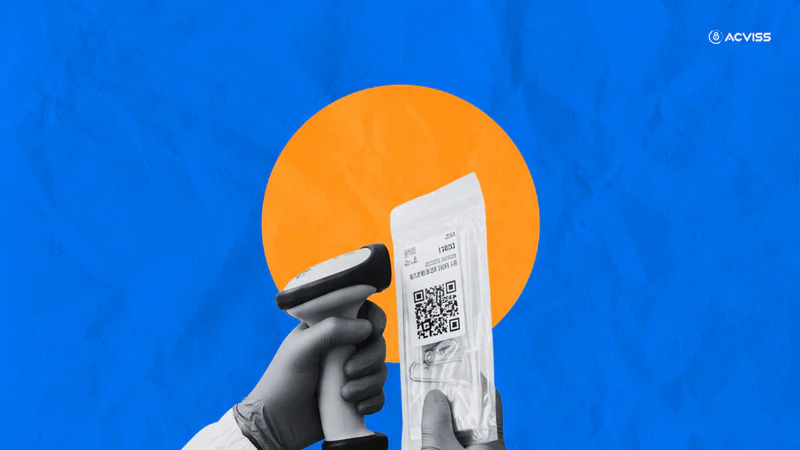
Your warehouse has cameras, controlled access, and audit logs. Your distributors are vetted and ISO-certified. But what about the $2M worth of devices sitting in your sales rep's car trunk?
In Orthopaedics, Spine, and Cardio, sales reps carry consignment kits worth millions. They fill out bill-only forms after surgery. They manage inventory outside your ERP.
And if something goes wrong, a swap, a missing device, a recall, you won't know until it's too late.
In short, field inventory that is with the sales reps sits in a visibility black hole. The reason behind this is that most traceability systems do not track beyond the warehouse or distributor. The rep-to-OR handoff? That's where control breaks down.
This blog breaks down why trunk stock is your weakest link and what you need to overcome this weakness and control your field inventory like a pro with complete visibility, even when it's in your sales rep’s car.
Why Trunk Stock Exists (And Why It's a Problem)
Surgeons demand immediate availability. And it is understandable, emergencies won't wait for central dispatch. In high-stakes specialities like Orthopaedics, Spine, and Cardiology, sales reps act as logistics managers, carrying consignment kits worth $250K to $2M in their cars or local storage.
Common terms you'll hear:
- Trunk stock
- Consignment kits
- Bill-only inventory
- Loaner sets
- Demo/sample inventory
Why does it create a traceability gap?
The stock is maintained in a very unorganised manner, and it’s not the people's issue; it's the industry's issue. Inventory rotates across hospitals, surgeons, and cases. Documentation happens after the procedure, not before. Reps enter usage data manually, often in Excel or on paper. There's no direct link between the physical device scan and the billing record.
The disconnect:
Your ERP shows inventory "assigned to Rep #123." But what's actually in the trunk? What was used versus what was billed? What expired or got swapped? You don't know.
And regulators never intended for million-dollar consignment kits to exist outside real-time systems.
Where Traditional Controls Break Down

Your warehouse is locked down. Your field inventory? Not so much.
Here's where visibility ends:
→ Warehouse: 100% visibility. Items scanned in/out. Audit logs. Temperature controls.
→ Distributor: 50% visibility. You track shipments, but what happens inside their warehouse? Less clear.
→ Sales Rep Trunk: 0% visibility. A complete black hole.
The bill-only process problem:
Most medical device companies rely on bill-only workflows. Here's how it works:
- The rep brings the consignment kit to the surgery
- Surgery happens
- Rep fills out a form afterwards: "Used 3 screws, 1 plate, 2 anchors"
- The hospital gets billed based on that form
What's missing:
- No scan at the point of use
- No verification that the items billed = items used
- No check that the items came from the official inventory
Hospitals trust reps. Systems trust paperwork. Neither verifies the physical product.
Why ERP systems don't catch this:
Most ERP/WMS systems track inventory to the distributor or hospital level. They don't enforce custody acceptance by reps. They can't detect swaps inside rep-managed kits.
Result? Your system shows inventory "assigned." Reality could be completely different.
How Fraud Happens in the Field
Now, let’s understand how people take advantage of this black hole. This isn't theoretical. It happens.
Scenario A: The Trunk Stock Swap
A rep carries official inventory and grey market inventory (bought cheaply from another region or third party). During a rush surgery, they hand the surgeon the grey inventory, but bill the hospital for the official inventory.
Or vice versa: use official inventory, bill for the premium version.
Why it works: Hospitals trust reps. The bill-only form is disconnected from the physical item.
Scenario B: Ghost Usage
Rep reports 5 screws used instead of 3. The hospital pays for 5. Rep pockets the commission on 2 "ghost" screws, or keeps them to sell later off-books.
Scenario C: Sample Leakage
Products marked as "samples" or "demo units" (often untracked) get reintroduced as full-price commercial units. The manufacturer loses revenue. The hospital pays full price for what should've been free.
Real case:
A spinal implant sales rep defrauded a Boston hospital by billing for devices never used and bringing unsterile implants into the OR to cover inventory gaps. He was charged with wire fraud in 2023.
The breach didn't happen in manufacturing or distribution. It happened at the rep + OR interface.
The common thread:
Reps have physical access. Systems lack real-time verification. Trust replaces controls.
The Regulatory and Liability Risks
This isn't just about lost inventory. It's about compliance exposure as well. Let’s take a look at some regulatory risks.
FDA Recall Nightmare
If a batch of pacemakers is recalled, you check your warehouse records. But if the rep swapped that batch with trunk stock from a different region, your recall data is wrong.
You might leave a defective device inside a patient because your records say it's still in the rep's trunk.
UDI rules assume you can trace the implanted device to the patient. If trunk stock swaps occur, that traceability breaks. Manufacturer liability escalates sharply.
Sunshine Act Violations
If reps manipulate inventory to give "freebies" or swap SKUs to favour surgeons, the manufacturer faces Sunshine Act violations, even if leadership is unaware.
Recent cases: Medical device manufacturers have paid $2M to $9.2M in fines for kickback-related violations involving sales reps.
Anti-Kickback Statute (AKS)
Providing anything of value to induce referrals = AKS violation. If a rep masks discounts or incentives via inventory manipulation, your company is liable.
Even honest mistakes look like fraud if you can't prove the chain of custody.
What Field Inventory Controls Should Look Like

The principle: Trust, but verify.
You're not monitoring reps because you don't trust them. You're implementing controls because regulators, auditors, and liability insurers require proof.
Here's what modern field inventory governance looks like:
1. Custody Acceptance (Digital Handshakes)
When inventory leaves the warehouse, the rep must scan to "accept custody." This creates a chain-of-custody record.
If a rep tries to implant an item they didn't accept, the system flags it immediately.
2. Scan-to-Use Verification
Eliminate the bill-only paper form. The rep (or nurse) scans the device's secure label before opening it in the OR.
The system verifies:
- Is this item authentic?
- Is it assigned to this hospital/rep?
- Is it expired?
- Is it the correct SKU for this procedure?
Usage is recorded automatically. The rep can't fudge the numbers later.
3. Geo-Fencing and Location Stamping
If a rep claims to be doing a surgery in New York, but the product scan happens in New Jersey, the system triggers an "inventory diversion" alert.
GPS-stamped scans add a layer of accountability without invading privacy.
4. Real-Time Dashboards
Ops teams and compliance officers need visibility into:
- What inventory is in the field, by rep, by region
- What's expired, obsolete, or unaccounted for
- Usage patterns and anomalies (e.g., sudden spikes in "ghost usage")
This isn't micromanagement. It's operational intelligence.
The mindset shift:
Field inventory shouldn't be managed differently from warehouse inventory just because it's in a rep's car. The same controls should apply, just adapted for mobile workflows.
How Acviss Origin Closes the Visibility Gap

The problem: Your traceability stops at the warehouse door. Acviss Origin extends it all the way to the OR.
1. Chain-of-Custody Tracking
Every item scanned out to a rep requires custody acceptance. No acceptance? No handoff.
This creates an unbroken digital chain from manufacturer → warehouse → rep → hospital → patient.
2. Scan-to-Implant Authentication
Reps scan devices before use. The system verifies authenticity, assignment, and compliance in real time. Usage is logged automatically, no manual forms, no post-facto data entry.
3. Geo-Fencing and Diversion Detection
GPS-stamped scans flag location anomalies. If inventory moves outside expected zones, compliance teams get instant alerts.
4. Real-Time Field Inventory Visibility
Dashboards show what's in the field, what's been used, what's expired, and what's unaccounted for, updated in real time.
Outcomes for medical device brands:
- Fewer inventory discrepancies and shrinkage
- Faster, cleaner audits and recall responses
- Reduced compliance risk and liability exposure
- Trust without blind spots

What to Do Next
Start by auditing your field inventory visibility.
Ask your ops team:
- Can we track inventory from the warehouse to the patient in real time?
- Do we know what's in each rep's trunk right now?
- Can we verify that billed items = used items?
- If we had a recall tomorrow, could we trace every device?
If the answer to any of these is "no," you have a gap.
Implement custody acceptance:
Make reps scan to accept inventory when it leaves the warehouse. This simple step creates accountability.
Eliminate bill-only paper forms:
Move to scan-based usage logging. It's faster for reps, more accurate for ops, and audit-proof.
Add geo-fencing for high-value kits:
You don't need to track every move. But flagging anomalies, like scans happening in unexpected locations, catches problems early.
The reality:
Field inventory won't go away. Surgeons will always need immediate access. But that doesn't mean it has to be a black hole.
You can have speed and control. You just need the right system.
Conclusion
Your warehouse is secure. Your distributors are vetted. But if your traceability stops before the OR, you're in danger.
Trunk stock isn't going away; it's operationally necessary in high-stakes specialities. But it doesn't have to be a visibility gap.
The fix is simple: trace the entire supply chain smartly with Acviss Origin. It's extending the same controls you apply in the warehouse to the field. Custody acceptance. Scan-to-use verification. Real-time dashboards.
Start by asking: Can we trace every device from the warehouse to the patient? If not, that's your weakest link.
Because when regulators come asking, or when a recall hits, "the rep filled out a form" isn't going to be enough.
Close the gap before it becomes a liability.

Frequently Asked Questions
1. What is trunk stock in medical devices?
Trunk stock refers to high-value consignment inventory (often worth $250K–$2M) that sales reps carry in their cars or local storage. Common in Orthopaedics, Spine, and Cardiology, it enables immediate availability for surgeries but creates traceability gaps.
2. Why is the bill-only process a compliance risk?
Bill-only processes rely on reps manually reporting usage after surgery, often on paper or in Excel. There's no verification that items billed match items used. This enables ghost usage, SKU swaps, and fraud while creating audit and recall risks.
3. How do sales reps commit fraud with field inventory?
Common fraud patterns include trunk stock swaps (mixing grey market with official inventory), ghost usage (over-reporting quantities to inflate commissions), and sample leakage (selling demo units as commercial products). These work because systems lack real-time verification.
4. What controls can prevent field inventory fraud?
Implement custody acceptance (reps scan to accept inventory), scan-to-use verification (log usage at point of implant), geo-fencing (flag location anomalies), and real-time dashboards (monitor field inventory by rep/region). These create chain-of-custody proof without manual forms.
5. How does trunk stock impact medical device recall accuracy?
When reps swap trunk stock between regions or facilities, recall tracking becomes unreliable. If your system shows a recalled device in a rep's trunk but it was actually implanted in a patient, you risk leaving defective devices unrecovered. UDI traceability requires accurate chain-of-custody from warehouse to patient.
6. What is consignment inventory management in medical devices?
Consignment inventory refers to medical devices physically stored at hospitals or with sales reps but still owned by the manufacturer until used. Payment occurs only after implantation. This model requires real-time tracking, usage verification, and audit trails to prevent revenue loss and compliance violations.
7. How do medical device companies track field inventory?
Modern field inventory tracking uses custody acceptance scans, GPS-stamped verification, blockchain traceability, and real-time dashboards. These systems log every handoff from warehouse to rep to hospital, eliminating manual processes and providing audit-ready chain-of-custody documentation.
8. What are the penalties for Sunshine Act violations in medical devices?
The Physician Payments Sunshine Act imposes penalties of $1,000 to $100,000 per violation, with knowing violations capped at $1.4 million annually. Medical device manufacturers have faced $2M to $9.2M fines for kickback-related violations involving sales reps manipulating field inventory.
9. How can geo-fencing prevent medical device inventory diversion?
Geo-fencing uses GPS-stamped scans to verify that devices are used in authorised locations. If a rep scans inventory outside expected zones, indicating potential diversion to grey markets or unauthorised facilities, compliance teams receive instant alerts, enabling rapid investigation and corrective action.
10. What is UDI compliance for medical devices in the field?
UDI (Unique Device Identification) compliance requires tracking devices from manufacturer to patient using unique identifiers. For field inventory, this means scanning devices when leaving warehouses, during custody transfers to reps, and at the point of implant. FDA's 21 CFR Part 801.20 mandates this traceability for recalls and patient safety.