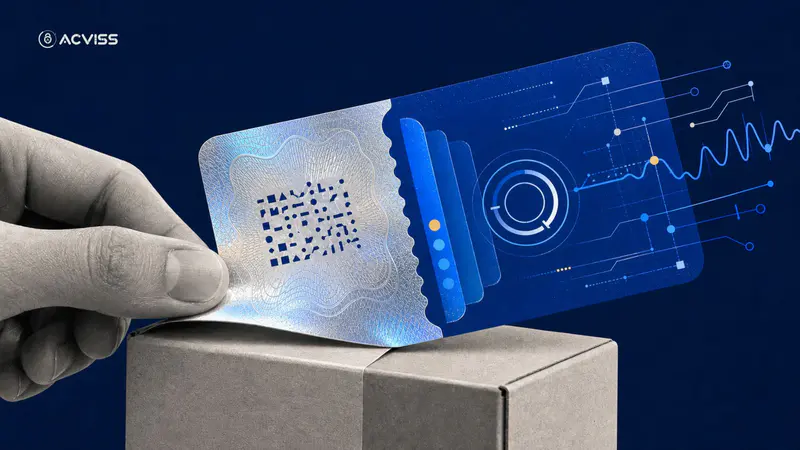
Every procurement cycle eventually arrives at the same question: How much does the security label cost? It is a logical place to begin, but increasingly the wrong place to end. Modern security labels are no longer static packaging components applied at the end of production. They have evolved into digital gateways that authenticate products, generate intelligence, connect supply chains, and provide brands with real-time visibility into how products move, where they are verified, and when something appears suspicious.
This shift has significant implications for packaging, procurement, operations, and brand protection teams. Organisations that continue evaluating security labels solely on print quality or unit price risk overlooking the far greater business value created by authentication data, supply chain intelligence, and post-sale visibility. Much like enterprise software, today's security labels require thoughtful deployment, ongoing governance, integration, and continuous optimisation to deliver measurable returns.
The Packaging Mindset Is Holding Security Labels Back
For decades, packaging teams have measured labels using familiar metrics:
Cost per label
Print quality
Adhesive performance
Durability
Lead times
Supplier reliability
These factors remain important. A poorly manufactured label can interrupt production, affect packaging quality, or create operational inefficiencies. However, when the label also serves as the first layer of product authentication, these traditional procurement criteria become only one part of a much larger evaluation.
Unlike ordinary packaging labels, intelligent security labels continue creating value long after leaving the production line. Every authentication event generates information. Every verification strengthens consumer trust. Every suspicious scan has the potential to uncover counterfeit activity before it spreads further through the market.
The conversation, therefore, shifts from purchasing a consumable to deploying a digital security infrastructure.
A Security Label Now Has a Digital Lifecycle
Software is rarely judged solely by its licence cost. Organisations evaluate how well it integrates with existing systems, whether it scales with business growth, how frequently it receives updates, and the operational intelligence it provides over time.
Security labels deserve the same mindset.
Rather than ending their purpose once a product is shipped, modern authentication labels remain active throughout the product lifecycle. They create a digital identity for every protected product, allowing brands to verify authenticity, monitor distribution patterns, detect anomalies, and improve operational decision-making through real-world data.
This evolution mirrors broader trends across connected products and digital infrastructure. The National Institute of Standards and Technology (NIST), through its cybersecurity labelling recommendations developed under Executive Order 14028, emphasises that secure systems should provide unique identification, controlled access, protected data, lifecycle management, and continuous support rather than functioning as isolated physical assets.
Although these recommendations were developed for consumer IoT devices, the underlying principle is equally relevant for product authentication: security should be treated as an ongoing operational capability rather than a one-time implementation.
Beyond Authentication: The Intelligence Hidden Inside Every Scan

One of the biggest misconceptions surrounding security labels is that their primary purpose is simply to confirm whether a product is genuine.
In reality, authentication is often just the beginning.
Each successful or failed verification contributes valuable operational intelligence that can help brands answer questions such as:
Which regions generate unusually high authentication activity?
Are multiple products sharing identical authentication credentials?
Are distributors verifying products as expected?
Which retail channels experience the most serious counterfeit attempts?
Where are consumers encountering suspicious products?
Are products appearing outside authorised distribution networks?
Individually, these scans may appear insignificant. Collectively, they reveal patterns that would otherwise remain invisible across complex supply chains.
Instead of functioning as passive identifiers, security labels become active sources of business intelligence.
Why Cheap Security Labels Often Become Expensive Decisions
Procurement teams naturally seek cost efficiencies. However, evaluating security labels solely on purchase price can create significantly higher costs elsewhere in the business.
The concept of Total Cost of Ownership (TCO) has long been applied to packaging decisions. Industry research consistently shows that packaging costs extend far beyond material prices, incorporating transportation efficiency, warehouse utilisation, production downtime, returns, product damage, quality failures, and operational complexity.
The same principle applies to authentication infrastructure.
A lower-cost security label may appear attractive during procurement, but introduce hidden costs through:
Higher counterfeit exposure
Limited product visibility
Manual investigation processes
Poor consumer verification experience
Inconsistent distributor participation
Absence of actionable authentication data
By contrast, an intelligent authentication platform continues delivering value throughout the product lifecycle by reducing investigation time, improving supply chain visibility, and supporting evidence-based decision-making.
The upfront investment may be higher, but the long-term operational return is often significantly greater.
Traditional Labels vs Intelligent Security Labels
Treat Security Labels Like Software Deployments

Enterprise software projects rarely succeed because of technology alone. Success depends on governance, integration, user adoption, ownership, and continuous improvement.
Authentication deployments follow remarkably similar patterns.
Many organisations invest in sophisticated security labels only to discover months later that distributors rarely scan products, consumers are unaware of verification methods, or authentication data remains disconnected from wider business systems. The technology itself is not the failure.
The deployment strategy is. Successful implementations typically address four critical questions before rollout:
1. Who Owns the Authentication Programme?
Authentication sits across multiple business functions.
Packaging teams oversee implementation, procurement manages suppliers, operations coordinate production, IT handles integrations, quality teams monitor compliance, and brand protection investigates counterfeit activity.
Without clear ownership, authentication quickly becomes everyone's responsibility, and nobody's priority.
2. How Will Authentication Data Be Used?
Collecting scan data has little value unless organisations establish processes for interpreting and acting on it.
For example:
Who investigates suspicious authentication attempts?
How are counterfeit hotspots escalated?
What thresholds trigger investigations?
Which dashboards do leadership teams monitor?
How are insights shared across departments?
Authentication data should influence operational decisions rather than simply populate reports.
3. Can the System Scale?
Many authentication initiatives begin with a single product line before expanding across multiple factories, brands, distributors, and international markets.
If the underlying platform cannot scale operationally, organisations often face costly migrations just as adoption begins accelerating.
Scalability, therefore, extends beyond printing millions of labels. It also includes infrastructure, data processing, user management, API integrations, analytics, and governance.
4. Can Security Rules Evolve?
Threats evolve continuously.
Counterfeiters change techniques, supply chains expand, regulations shift, and customer expectations increase. A security label that cannot adapt effectively becomes obsolete.
Software evolves through updates, policy changes, and continuous improvement. Authentication platforms should offer similar flexibility, allowing organisations to refine verification rules, strengthen security layers, and improve investigation workflows without redesigning the entire packaging process.
Smart Labels Are Becoming Part of Supply Chain Infrastructure

Across multiple industries, labels are taking on responsibilities far beyond identification.
Smart packaging technologies increasingly monitor environmental conditions such as temperature, humidity, and handling throughout logistics networks. In regulated sectors like food and pharmaceuticals, this data helps organisations demonstrate product integrity while improving traceability across increasingly complex supply chains.
Regulatory developments reinforce this direction. The FDA's Food Safety Modernisation Act (FSMA) Rule 204, for example, places greater emphasis on traceability for high-risk foods, encouraging better visibility from production through distribution.
These developments reflect a broader industry trend.
Labels are no longer expected merely to identify products. They are expected to capture information, support compliance, strengthen transparency, and improve operational decision-making.
Authentication follows the same trajectory.
When designed as intelligent digital infrastructure rather than packaging consumables, security labels become an essential part of enterprise supply chain visibility rather than an isolated security feature.
How to Change Security Labels to Product Intelligence
Viewing security labels as digital infrastructure requires a platform capable of turning every product interaction into meaningful intelligence. This is where product authentication moves beyond simply proving that a product is genuine and begins supporting broader operational objectives.
Acviss Certify is designed around this philosophy. Rather than functioning as a standalone security label, it combines non-cloneable authentication with a connected digital platform that enables brands to authenticate products, monitor verification events, and gain visibility across the supply chain.
At the centre of this ecosystem is the Axion Non-Cloneable Label, which provides every protected product with a unique digital identity. Each label is engineered to resist duplication, making it significantly more difficult for counterfeiters to reproduce genuine authentication credentials at scale.
More importantly, every verification becomes a source of intelligence. Instead of simply displaying a "genuine" or "fake" message, each scan contributes to a growing dataset that helps organisations understand product movement, customer engagement, and emerging risks across their distribution network.
Security Labels Should Support the Entire Product Journey
A common limitation of traditional authentication programmes is that they focus almost exclusively on the point of sale. Once a customer verifies a product, the label has effectively completed its purpose.
Modern authentication systems should continue delivering value long after that first scan.
With a connected authentication platform, brands can monitor interactions throughout the product lifecycle, including:
Authentication during manufacturing
Verification at warehouses and distribution centres
Distributor and retailer validation
Consumer authentication
Warranty verification
Investigation of suspicious verification attempts
This continuous flow of information transforms authentication from a reactive security measure into a proactive operational capability.
Instead of waiting for counterfeit complaints to surface, organisations can identify unusual verification patterns earlier and investigate potential issues before they become larger commercial problems.
Building Supply Chain Visibility Through Authentication

Supply chain visibility is often associated with enterprise systems such as ERP, warehouse management, and transportation platforms. While these systems provide valuable operational data, they frequently lose visibility once products move beyond controlled environments.
Authentication data helps bridge this gap.
Every legitimate verification adds another data point that strengthens visibility across the product journey. When combined with production information and distribution records, brands gain a more complete understanding of how products move through authorised and unauthorised channels.
This intelligence supports several operational priorities:
Identifying counterfeit hotspots
Monitoring distributor compliance
Validating retailer participation
Supporting recall investigations
Improving demand forecasting using field-level verification data
Rather than replacing existing supply chain systems, authentication complements them by adding product-level intelligence that traditional logistics platforms cannot always provide.
Authentication Alone Is Not Enough
Many organisations assume that deploying a secure label automatically solves their counterfeit problem. In practice, authentication is only one component of a much broader product integrity strategy.
An effective programme combines multiple capabilities that work together.
When these capabilities operate together, authentication evolves from a security initiative into an enterprise intelligence function.
What Procurement Teams Should Really Evaluate
Procurement has traditionally focused on obtaining the best possible price for packaging materials. While cost discipline remains essential, intelligent security labels should be evaluated using broader business criteria.
A lower-cost solution that cannot generate actionable intelligence may ultimately deliver less value than a platform that supports authentication, visibility, and investigation throughout the product lifecycle.
Before selecting a security label provider, organisations should consider questions such as:
Does every product receive a unique digital identity?
Is the security technology resistant to cloning rather than simply difficult to copy visually?
Can authentication data be accessed through dashboards and analytics?
Does the solution integrate with existing ERP or supply chain systems?
Can the authentication rules evolve as threats change?
Does the platform support both consumer and enterprise verification?
Can suspicious verification events trigger investigations?
Will the solution scale across multiple product lines, factories and geographies?
These questions shift procurement discussions from unit price towards long-term operational value.
The Future of Security Labels Is Intelligent, Connected and Continuously Evolving
Security labels have followed a path similar to enterprise software over the past two decades. What began as standalone tools has evolved into connected platforms that generate data, support business decisions, and improve continuously over time.
Authentication technology is undergoing the same transformation.
Growing regulatory expectations, increasingly sophisticated counterfeit networks, expanding global supply chains, and rising consumer demand for transparency are all changing what organisations expect from their product protection strategies.
Security labels are therefore becoming permanent digital assets rather than disposable packaging components. They create product identities, generate operational intelligence, strengthen supply chain visibility, and support faster responses to emerging threats.
For packaging and procurement leaders, this represents a significant mindset shift. Success is no longer determined by choosing the least expensive label or the most visually secure design. It depends on selecting an authentication platform that can continue delivering value long after production has finished.
As organisations increasingly treat security labels as connected digital infrastructure instead of packaging consumables, they position themselves to respond more effectively to counterfeiting, improve operational visibility, and make better decisions using real-world authentication intelligence.
Interested in building a smarter product authentication strategy? Get in touch with our team and discover how Acviss Certify can help transform security labels into enterprise intelligence that protects products, strengthens supply chain visibility, and supports long-term brand protection.