The most profitable part of many modern product businesses is not the product itself. It is what comes after.
Printers are sold at competitive prices, sometimes even at a loss. Water purifiers are priced to acquire households quickly. Razor handles are nearly disposable. Coffee machines are marketed as lifestyle devices. The real revenue lies in the refill. Ink cartridges, filter replacements, blades, pods, fluids and consumables create a recurring income stream that sustains the business.
This model is elegant, predictable and scalable. It is also deeply vulnerable.
Counterfeiters have understood this far better than most brands.
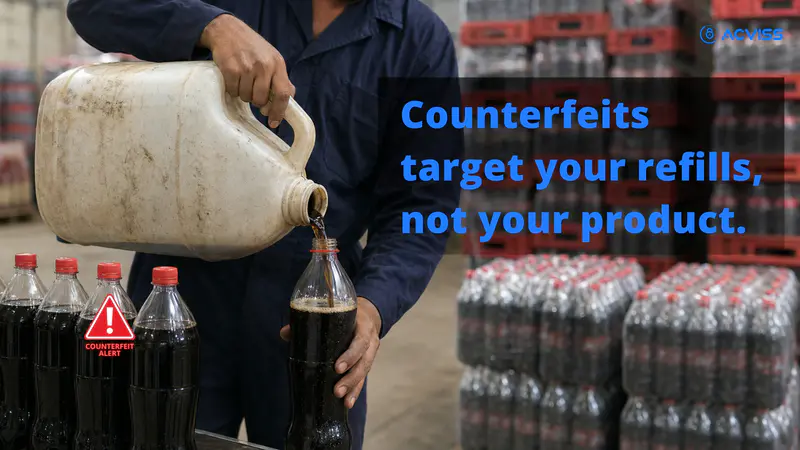
They are not interested in replicating the original unit. They target the refill. And in doing so, they quietly capture the most valuable portion of the revenue chain while leaving the brand to deal with the consequences.
This is the refill trap.
Understanding the Structural Vulnerability of Refill Products
Consumable products operate within a fundamentally different economic and operational structure compared to primary products. They are designed for repetition, convenience and affordability. That very design creates exposure.
Refill products typically have:
Lower individual unit value
High purchase frequency
Simplified packaging formats
Limited space for product authentication
Wide distribution across fragmented retail networks
Unlike the original device, which is often sold through controlled channels, refills move through a much broader ecosystem. E-commerce platforms, local distributors, third-party sellers and grey markets all become entry points.
This fragmentation makes product traceability significantly more complex.
From a supply chain management perspective, refills lack the rigidity of the primary product’s distribution. They are handled more frequently, repackaged more often and stocked in environments where oversight is minimal.
This creates the ideal conditions for counterfeit refill products to blend in.
The Economic Logic Behind Counterfeit Refills
Counterfeiters are not random actors. They are rationale operators driven by margin, scale and risk minimisation.
Refills offer all three.
Producing a fake printer cartridge or water filter is significantly cheaper than manufacturing a full device. There are fewer components, lower regulatory scrutiny and less engineering complexity. Yet, the selling price remains attractive because consumers already accept the cost of refills.
Consider the economics:
A printer may be sold at a minimal margin
Ink cartridges can generate margins upwards of 50–70%
Replacement filters often cost a fraction to produce compared to their retail price
This gap is where counterfeiters thrive.
They bypass Trademark Protection and IP Protection, replicate the external appearance, and flood the market with low-cost alternatives. For them, the risk is lower and the reward is immediate.
For brands, the impact is severe:
Loss of recurring revenue
Erosion of customer lifetime value
Increased warranty claims and service costs
Damage to brand trust
The refill is not just a product. It is the revenue engine. When counterfeiters capture it, they disrupt the entire business model.
High-Risk Categories: Where the Problem is Most Visible
While counterfeiting affects multiple industries, certain categories are disproportionately exposed due to their reliance on consumables.
1. Printer Ink and Toner
Ink cartridge counterfeiting is one of the most documented cases. Fake cartridges often use substandard ink formulations, leading to poor print quality, leakage and hardware damage.
2. Water Purification Filters
Independent laboratory testing has revealed alarming results. Counterfeit filters have shown a 100% failure rate in reducing contaminants such as lead and cysts, with some introducing harmful substances like arsenic and carcinogenic compounds into drinking water.
This transforms a product safety issue into a public health concern.
3. Automotive Fluids and Filters
Engine oils, brake fluids and air filters are frequently counterfeited. Substandard formulations can lead to engine failure, reduced efficiency and long-term damage.
4. Medical and Pharma Consumables
In the pharma sector, counterfeit consumables such as syringes, diagnostic kits and filters pose life-threatening risks. Here, product verification is not optional. It is critical.
5. Personal Care and Household Refills
Shampoo refills, detergent packs and skincare consumables are often replicated due to their high volume and low production complexity.
Across all these categories, the pattern remains consistent. Counterfeiting enters through the refill, not the original product.
When the Refill Fails, the Brand Takes the Blame

Consumers rarely differentiate between the original product and the refill. To them, the experience is unified.
If a fake cartridge damages a printer, the printer brand is blamed.
If a counterfeit water filter contaminates water, the purifier brand loses trust.
If a substandard blade irritates, the razor brand is questioned.
This is where brand authentication intersects with customer satisfaction.
The failure of counterfeit refills creates:
Negative product reviews
Increased customer complaints
Loss of repeat purchases
Long-term erosion of brand loyalty
The irony is stark. Brands invest heavily in designing high-quality primary products, only to have their reputation compromised by unauthorised consumables.
Without product authentication at the refill level, the brand’s integrity remains exposed.
Why Traditional Authentication Fails for Refills
Most anti-counterfeiting strategies have historically focused on high-value products. Refills require a different approach.
The challenges are unique:
1. Limited Packaging Space
Flexible pouches, small cartridges and compact packs leave little room for labels or tags.
2. Cost Sensitivity
Refills operate on tighter margins. Expensive authentication technologies are often considered impractical.
3. High Volume
Billions of units move through the supply chain annually. Any solution must scale efficiently.
4. Consumer Behaviour
Consumers expect quick and seamless interactions. Complex verification processes reduce adoption.
Traditional tools, such as basic QR codes, provide limited protection. They can be copied, reproduced and reused across counterfeit products.
This is where non-cloneable technology becomes critical.
Securing the Refill: The Shift to Pack-Level Authentication

Forward-looking brands are redefining their brand protection solutions by focusing on the refill itself.
The shift involves embedding authentication directly at the pack level, ensuring that every unit carries a unique, verifiable identity.
Key Elements of Modern Refill Authentication
Unique, non-cloneable codes assigned to each refill unit
Tamper-evident labelling to detect unauthorised access
Track and trace systems that monitor movement across the supply chain
Integration with digital platforms for product verification
This approach transforms each refill into a digital asset.
Consumers can verify authenticity instantly. Brands gain visibility into distribution patterns. Counterfeit entry points become easier to detect.
The Role of Advanced Technologies in Refill Protection
The evolution of anti-counterfeiting solutions is closely tied to advancements in smart packaging.
1. Intelligent Packaging
Technologies such as NFC and RFID enable cryptographic authentication. Unlike visual codes, these cannot be easily replicated.
2. Dual-Layer Authentication
Combining consumer-facing verification with backend track and trace systems allows brands to monitor products across their lifecycle.
3. Real-Time Data Analytics
Every scan generates data. This enables brands to:
Identify suspicious geographic clusters
Detect supply chain leaks
Understand consumer engagement patterns
The global smart packaging market is projected to reach $144.23 billion by 2027, reflecting the growing importance of these technologies.
For refill products, the focus is on balancing cost with effectiveness. Scalable, lightweight and secure solutions are essential.
Building a Refill Authentication Programme: What It Looks Like in Practice
Implementing refill protection is not a single step. It is a structured programme that integrates technology, operations and consumer interaction.
1. Unit-Level Serialisation
Each refill is assigned a unique identity using non-cloneable codes. This forms the foundation of product traceability.
2. Supply Chain Integration
From manufacturing to distribution, every movement is recorded. This enhances supply chain management and reduces blind spots.
3. Consumer Verification Journey
Consumers interact with the product through a simple scan. The process must be:
Fast
Intuitive
Accessible without additional applications
This strengthens customer engagement and builds trust.
4. Data Capture and Insights
Every verification event provides actionable intelligence:
Where products are being scanned
Frequency of usage
Detection of duplicate scans indicating counterfeit activity
5. Enforcement and Response
Once counterfeit patterns are identified, brands can take targeted action:
Remove fake listings online
Strengthen distribution controls
Collaborate with enforcement agencies
Beyond Protection: Turning Authentication into a Growth Lever

While the primary goal is brand protection, refill authentication unlocks additional value.
1. Strengthening Customer Relationships
Authentication platforms can integrate loyalty programmes, rewards and personalised experiences.
2. Enhancing Customer Satisfaction
Consumers gain confidence in the authenticity of their purchase. This reduces friction and builds long-term loyalty.
3. Supporting Regulatory Compliance
In sectors such as pharma and food, traceability supports compliance with evolving regulations, including frameworks like EUDR.
4. Enabling Digital Transformation
Each authenticated refill becomes part of a connected ecosystem. This creates opportunities for predictive analytics, demand forecasting and improved inventory planning.
The Strategic Imperative for Brands
The refill economy is not going away. If anything, it is expanding.
Subscription models, sustainability initiatives and circular economy frameworks are increasing reliance on consumables. This makes refill protection a strategic necessity rather than a tactical response.
Ignoring counterfeit refill products is equivalent to leaving the most profitable part of the business unguarded.
Brands that invest in product authentication, track and trace and brand verification at the refill level gain:
Revenue protection
Supply chain visibility
Consumer trust
Competitive advantage
Those that do not risk losing not just sales, but credibility.
Protecting the Core of the Business Model
The refill trap is subtle but powerful. It operates quietly within the most reliable revenue streams of modern brands.
Counterfeiters have already adapted to this reality. The question is whether brands will do the same.
Securing the refill is not just about stopping counterfeits. It is about protecting the entire business model, ensuring product safety, strengthening IP protection, and delivering consistent value to customers.
Solutions built around non-cloneable technology, product authentication, and supply chain traceability are redefining how brands approach this challenge.
The shift is underway. The brands that act early will define the future of consumable product security.
Interested in learning more? Get in touch with us.