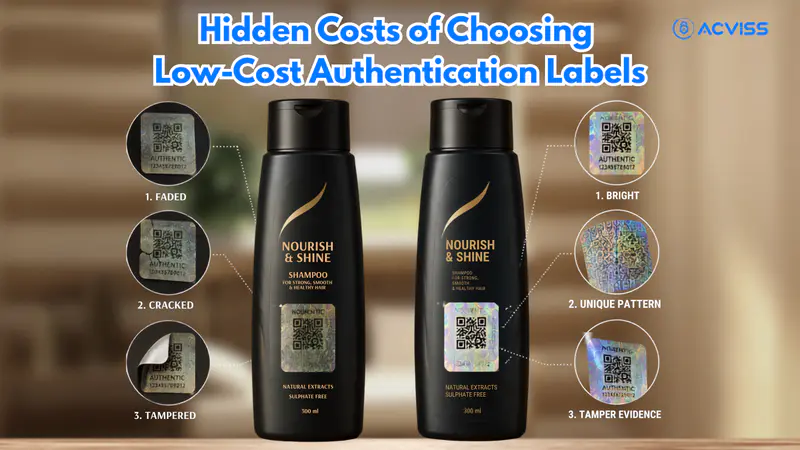
Why selecting authentication labels based solely on price often becomes the most expensive decision a brand makes
A few paise saved on an authentication label can look like a procurement success. When millions of products leave the production line every year, even a marginal reduction in packaging cost appears to deliver significant savings. It is therefore unsurprising that authentication labels are frequently evaluated alongside cartons, adhesives and other packaging components, with price becoming the primary deciding factor.
The challenge is that authentication labels are not ordinary packaging materials. They are a security infrastructure. When businesses choose a low-cost authentication solution without evaluating its resilience, scalability and long-term effectiveness, the initial savings are often eclipsed by counterfeit losses, warranty abuse, product recalls, customer complaints and reputational damage. The real cost of product authentication is measured over years of operation, not at the time of procurement.
Why Low-Cost Authentication Labels Often Win Procurement Decisions

Authentication labels are typically purchased in large volumes. Procurement teams naturally focus on unit economics, supplier negotiations and production budgets, making lower-priced alternatives attractive on paper.
This approach works well for many packaging materials, but security labels serve an entirely different purpose. Their value lies not in how cheaply they can be produced but in how effectively they prevent imitation, support investigations, and preserve customer trust.
Several factors encourage organisations to prioritise price over security.
Pressure to reduce packaging costs
Competitive bids from multiple label vendors
Limited understanding of counterfeit risks
Procurement metrics focused on immediate savings
Security is evaluated separately from business risk
The problem is not buying an inexpensive authentication label. The problem is assuming that every authentication label provides the same level of protection.
Counterfeiters do not compare prices. They exploit the weakest security system available.
The Price of a Label Is Not the Cost of Product Authentication
One of the biggest misconceptions in product authentication is that the cost of a label represents the cost of the authentication programme. In reality, the label accounts for only a small portion of the overall investment required to protect products and brands.
The real financial impact becomes visible only after products reach distributors, retailers and consumers.
Forward-looking organisations increasingly evaluate the Total Cost of Authentication (TCA) rather than simply comparing label prices. TCA considers the complete lifecycle of an authentication solution, including counterfeit prevention, operational efficiency, customer verification, investigation capabilities and long-term scalability.
A label that costs marginally more but significantly reduces fraud, counterfeit circulation and customer disputes often delivers a substantially lower total cost over its operational lifetime.
Where Low-Cost Authentication Labels Usually Fall Short

Not every low-cost label is ineffective. However, many budget-focused authentication solutions achieve their lower price by simplifying the very features that provide meaningful protection.
Limited Clone Resistance
Many inexpensive authentication labels rely on visible QR codes, predictable serial numbers or static identifiers that can be copied using readily available printing equipment.
Once a counterfeiter successfully duplicates one label, the same approach can often be replicated across thousands of counterfeit products. The authentication mechanism itself becomes the vulnerability.
Instead of preventing counterfeits, these labels merely create an appearance of security.
Weak Digital Verification
Authentication is no longer limited to what appears on the product.
Modern product authentication increasingly combines physical security with digital intelligence, enabling brands to analyse scan behaviour, identify suspicious verification attempts and detect abnormal geographic activity.
Low-cost solutions frequently stop at displaying a verification message without capturing meaningful intelligence that could support investigations.
Poor Investigation Capability
Counterfeit investigations rarely begin with certainty.
A customer may report unusual packaging, a distributor may discover inconsistent serial numbers, or an online marketplace may receive complaints about suspicious products.
If authentication data is incomplete or easily manipulated, investigators have little evidence to determine where counterfeit products entered the supply chain or how widespread the problem has become.
Weak authentication systems, therefore, increase both the duration and cost of investigations.
The Hidden Costs That Appear After Deployment
The consequences of selecting an authentication label based purely on price often emerge months after implementation. By then, replacing the system becomes significantly more expensive than deploying a stronger solution from the outset.
1. Increased Counterfeit Penetration
Authentication labels are intended to raise the difficulty of copying genuine products.
When labels are easily replicated, counterfeiters gain confidence that fake products can move through distributors and retailers without attracting attention.
This not only increases counterfeit circulation but also undermines consumer confidence in the authentication process itself.
2. Warranty Fraud and Service Abuse
Weak authentication systems create opportunities for fraudulent warranty claims.
Counterfeit products carrying duplicated labels may be registered as genuine, leading to unnecessary repair costs, replacement expenses and customer support workloads.
Over time, service teams become occupied resolving disputes that originated from inadequate authentication rather than genuine product failures.
3. Brand Reputation Damage
Consumers rarely distinguish between counterfeiters and manufacturers.
If a fake product performs poorly, customers typically blame the brand whose logo appears on the packaging.
Negative reviews, social media discussions and marketplace ratings can reduce customer confidence long before an investigation identifies the counterfeit source.
Rebuilding trust often requires substantially more investment than implementing effective authentication in the first place.
4. Operational Disruption
Once weaknesses become apparent, organisations often have to redesign their authentication strategy.
This may involve replacing labels, updating packaging artwork, retraining manufacturing teams, educating distributors and modifying mobile applications.
These activities consume operational resources that could have been avoided with a more robust initial deployment.
5. Investigation and Inspection Costs
Authentication failures shift expenditure from prevention to investigation.
The electronics industry offers a useful example. Detailed analytical inspection of suspected counterfeit electronic components can cost between USD 800 and USD 2,000 per lot, depending on the testing required.
Techniques such as X-ray inspection, XRF analysis, de-capsulation and scanning acoustic microscopy require specialised equipment and expertise. While these methods are primarily used for electronic components, they illustrate a broader reality across industries: identifying counterfeit products after they enter the supply chain is considerably more expensive than preventing them from entering in the first place.
6. Compliance and Regulatory Risks
Regulatory expectations around product authenticity and traceability continue to increase.
Industries such as pharmaceuticals, food and beverage, agrochemicals, automotive and electronics face growing pressure to demonstrate product integrity throughout the supply chain.
Weak authentication mechanisms may satisfy short-term procurement objectives while creating long-term compliance challenges.
Lessons from the Electronics Industry
The counterfeit electronics market demonstrates why evaluating security purely on price creates significant long-term risk.
The iNEMI Counterfeit Components Project found that counterfeit components frequently enter supply chains through independent distributors, brokers, manufacturing shortages and obsolete product sourcing. High-reliability industries such as aerospace, defence, medical devices and automotive are particularly vulnerable because many systems remain in service for decades.
Several findings from the research translate directly to authentication labels.
Perhaps the most valuable lesson is that counterfeit prevention cannot rely on inspection alone. Once counterfeit products reach customers, the financial and reputational consequences have already begun.
Looking Beyond Price: How to Evaluate Authentication Labels
Selecting an authentication solution requires evaluating both technical capability and operational performance.
Decision-makers should ask questions that extend beyond printing quality and unit cost.
The cheapest authentication label is rarely the lowest-cost authentication solution.
The objective should not be purchasing the least expensive label but deploying a system that remains effective as counterfeit techniques evolve.
Beyond Security Labels: Building an Enterprise Product Authentication Strategy

Authentication labels deliver the greatest value when they operate as part of a broader product integrity ecosystem rather than as standalone security elements.
An enterprise-grade authentication programme should combine several complementary capabilities.
Product authentication
Secure consumer verification
Distributor verification
Authentication analytics
Warranty validation
Counterfeit investigation workflows
Supply chain intelligence
Integration with online brand protection
This layered approach provides brands with visibility across the product lifecycle while making counterfeiting significantly more difficult.
How Acviss Certify and Axion Label Strengthen Product Authentication
Product authentication has evolved far beyond placing a QR code on packaging. Modern solutions must combine physical security with digital intelligence, allowing brands not only to verify genuine products but also to detect suspicious activity, identify counterfeit hotspots and improve supply chain visibility.
Acviss Certify is designed around this broader philosophy of product authentication. Rather than functioning as a simple verification tool, it enables brands to authenticate products, monitor verification behaviour, generate actionable insights and support counterfeit investigations from a unified platform.
At the core of this approach is the Axion Label, a non-cloneable authentication label engineered to make duplication significantly more difficult than conventional security labels.
Unlike standard labels that rely primarily on visible identifiers, Axion Label combines advanced security features with digital verification, helping brands establish a stronger link between each physical product and its digital identity.
When deployed as part of an enterprise authentication strategy, organisations benefit from capabilities such as:
Non-cloneable product identities
Secure consumer authentication
Supply chain verification
Authentication analytics
Duplicate scan detection
Counterfeit intelligence
Integration with broader brand protection initiatives
The greatest value comes from viewing authentication not as a packaging expense but as an operational intelligence platform that supports product protection throughout its lifecycle.
Procurement Checklist Before Selecting an Authentication Solution
Before choosing an authentication label supplier, procurement, packaging and brand protection teams should collectively evaluate the following questions.
Is the authentication technology resistant to cloning?
Can counterfeit attempts be detected rather than simply verified?
Does every scan generate useful intelligence?
Can the solution integrate with warranty management?
Does it support supply chain verification?
Can it scale across multiple manufacturing facilities?
Does it integrate with ERP and business systems?
Can investigators identify duplicate authentication attempts?
Is the solution adaptable as counterfeit techniques evolve?
Does the supplier provide long-term security innovation rather than only printed labels?
Answering these questions early often prevents costly redesigns and security upgrades later.
Final Thoughts
Authentication labels should never be evaluated as ordinary packaging components. Their purpose is to protect products, preserve customer confidence and reduce business risk throughout the product lifecycle.
As counterfeit operations become more sophisticated and supply chains grow increasingly complex, organisations that prioritise long-term security over short-term procurement savings will be better positioned to safeguard their products, customers and reputation. The most resilient authentication programmes are those that combine clone-resistant technology, digital verification, operational intelligence and continuous monitoring into a unified product protection strategy.
A marginal saving on an authentication label may appear commercially attractive during procurement, but the hidden costs of counterfeit infiltration, warranty abuse, investigations and lost trust can far outweigh those initial savings.
Interested in strengthening your product authentication strategy? Discover how Acviss Certify and the non-cloneable Axion Label can help you build a more secure, scalable and intelligence-driven approach to brand protection. Get in touch with our experts today.