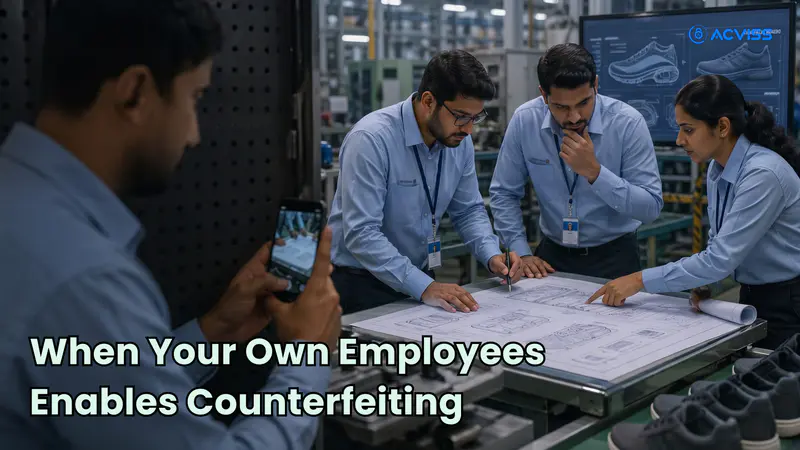
Counterfeiting is almost always framed as an external invasion. The narrative is familiar: shadowy manufacturers, cross-border networks, and anonymous sellers flooding markets with imitations. It is a convenient storyline because it places the threat outside the organisation’s walls.
Yet, in many cases, the breach begins much closer to home.
Factory-origin counterfeiting, internal supply chain fraud, and employee-enabled diversion are not anomalies. They are structured, repeatable, and often invisible operations embedded within legitimate business processes. For brand protection teams, this is an uncomfortable truth. The threat is not always external. It is operational.
This is the insider threat in counterfeiting. It is the least discussed, most underestimated, and often the most expensive vector of brand damage.
Why Insider Threat Counterfeiting Is the Costliest Risk
The financial impact of counterfeit goods is well documented. Estimates suggest that counterfeit and pirated products account for nearly 5 to 7 percent of global trade, with losses exceeding hundreds of billions of dollars annually. In India alone, fake goods are estimated to contribute to a market worth over ₹20,000 crores, with certain sectors such as automotive parts seeing counterfeit penetration as high as 35 percent.
However, these numbers often mask a critical nuance. Not all counterfeit products originate from rogue external factories. A significant proportion emerges from within legitimate manufacturing and supply chain ecosystems.
This makes insider threat counterfeiting particularly dangerous for several reasons:
1. It bypasses traditional Brand protection solutions
External threats can be countered with perimeter controls, legal enforcement, and market surveillance. Internal threats operate within authorised systems, making them harder to detect.
2. It produces high-quality counterfeits
Products manufactured using original moulds, materials, or processes are indistinguishable from genuine goods. This severely undermines product authentication and product verification mechanisms.
3. It erodes trust at multiple levels
From customer satisfaction to regulatory compliance in sectors like pharma, insider-driven counterfeiting directly impacts product safety and brand credibility.
4. It scales silently
Unlike external counterfeiters who require infrastructure, insiders leverage existing production lines, supply chain management systems, and distribution networks.
The result is a form of counterfeiting that is operationally efficient, difficult to detect, and deeply damaging.
When Insider Threats Become Real: High-Profile Incidents
To understand the seriousness of internal counterfeiting, it is useful to examine real-world cases where employees, contractors, or internal stakeholders played a direct role.
1. The Louis Vuitton Insider Leak
In one of the most striking cases, a sales associate at a Louis Vuitton store in Guangzhou became central to a counterfeit operation valued at over $15 million.The employee provided access to yet-to-be-released designs and products, allowing counterfeiters to replicate them before official launch. This demonstrated
2. The Hermès Case
In France, multiple former employees of Hermès were prosecuted for participating in an organised counterfeit ring producing high-end Birkin and Kelly bags. Insiders used authentic materials and production knowledge, making it nearly indistinguishable from genuine ones.
3. New Balance
A former contractor in China continued to produce and distribute a specific shoe style even after his license was terminated, eventually launching a competing brand, "Henkees," which used a logo strikingly similar to the original.
The Four Internal Roles Most Likely to Enable Counterfeiting

Insider threat counterfeiting is rarely the result of a single individual. It is often enabled by small, coordinated actions across different roles within an organisation.
1. Production Staff: The Origin Point
Production personnel have direct access to machinery, moulds, and production schedules. This makes them central to unauthorised manufacturing activities.
Common risks include:
Running excess batches beyond recorded production volumes
Using downtime or idle capacity for unauthorised production
Sharing or replicating moulds for external use
In industries such as FMCG and pharmaceuticals, even a small unauthorised production run can introduce thousands of counterfeit units into the market.
2. Procurement Teams: The Gatekeepers of Inputs
Procurement officers influence the sourcing of raw materials, components, and packaging.
Risks include:
Accepting diverted or substandard materials
Creating parallel supplier relationships
Facilitating grey market sourcing
This directly impacts product traceability and compromises the integrity of the supply chain.
3. Logistics and Distribution: The Silent Enablers
Logistics teams control movement across the supply chain. They are uniquely positioned to enable diversion.
Common patterns include:
Redirecting shipments to unauthorised distributors
Manipulating documentation
Mixing genuine and counterfeit inventory
Such actions disrupt track and trace systems and weaken supply chain management frameworks.
4. IP-Adjacent Roles: Design, Packaging, and R&D
Employees in design and R&D have access to sensitive intellectual property, including packaging templates, label designs, and proprietary formulations.
Risks include:
Selling or leaking packaging artwork
Replicating trademark elements
Sharing proprietary product specifications
This creates near-perfect counterfeits that pass visual and functional checks, undermining trademark protection and IP protection efforts.
How Unauthorised Production Runs Actually Happen

Insider-enabled counterfeiting does not always involve large-scale conspiracies. It often emerges through operational loopholes.
1. The Excess Batch Problem
Production lines frequently generate overages due to calibration, wastage buffers, or efficiency targets. When these excess units are not tightly controlled, they become a primary source of counterfeit goods.
2. The Mould-Sharing Problem
Moulds and tooling are often reused across facilities or subcontractors. Unauthorised replication or parallel usage leads to identical products being manufactured outside approved channels.
3. The After-Hours Shift Problem
Factories operating round the clock may have limited supervision during off-hours. Unofficial production runs during night shifts are a known but underreported issue.
4. The Packaging Leakage Problem
Packaging components, especially labels and authentication markers, may be diverted before reaching the final assembly stage. This allows counterfeiters to create products that appear legitimate.
Early Warning Signals of Internal Supply Chain Fraud
Insider threats rarely emerge without warning. Subtle signals often precede major breaches.
Inventory anomalies
Discrepancies between recorded and actual stock levels
Unexplained shrinkage or surplus
Unusual supplier patterns
New vendors without proper due diligence
Frequent changes in sourcing channels
Behavioural indicators
Sudden lifestyle changes in key personnel
Resistance to audits or process transparency
Data irregularities
Inconsistent production logs
Gaps in track and trace records
These indicators, when analysed collectively, provide early insights into potential internal risks.
Designing Internal Controls Without Breaking Trust

Organisations often face a dilemma. Increasing controls can reduce risk, but excessive surveillance may impact employee morale and productivity.
A balanced approach is essential.
1. Segmentation of responsibilities
No single individual should control production, verification, and dispatch processes end-to-end.
2. Digital traceability systems
Implementing robust track and trace solutions ensures visibility across the supply chain.
3. Periodic audits
Unannounced audits and process reviews help identify anomalies without creating a culture of distrust.
4. Training and awareness
Employees should understand the implications of counterfeiting on product safety, customer satisfaction, and regulatory compliance.
5. Ethical reporting mechanisms
Whistleblower systems encourage internal reporting without fear of retaliation.
Closing the Insider Window with Serialisation
One of the most effective ways to address insider threat counterfeiting is through serialisation and product authentication technologies.
The Limitation of Code-at-Dispatch Models
Traditional systems assign codes at the point of dispatch. By this stage, products have already passed through production, packaging, and internal handling.
This leaves a significant vulnerability window.
The Advantage of Code-at-Press Models
Assigning unique, non-cloneable codes at the point of packaging or printing fundamentally changes the security architecture.
Benefits include:
Each unit receives a unique identity at origin
Unauthorised production runs cannot generate valid codes
Real-time product verification becomes possible
Enhanced product traceability across the lifecycle
Solutions such as Certify, a non-cloneable label technology, exemplify this approach by enabling instant product authentication and brand verification at the unit level.
A Layered Approach to Anti-Counterfeiting Solutions
There is no single solution to insider threats. A layered strategy remains essential.
1. Overt technologies
Visible markers such as tamper-evident seals and holograms support customer engagement and enable frontline product verification.
2. Covert technologies
Hidden features allow internal teams to identify counterfeit products without alerting adversaries.
3. Forensic markers
Advanced chemical or molecular identifiers provide irrefutable proof of authenticity.
4. Track and trace systems
Serialisation and digital tracking enable end-to-end visibility across supply chains.
When combined, these technologies form a comprehensive brand protection framework that addresses both external and internal threats.
Responding to Confirmed Insider Counterfeiting
When internal investigations confirm employee involvement, the response must be structured and decisive.
Immediate containment
Isolate affected production lines
Secure compromised materials and assets
Forensic investigation
Analyse production and supply chain data
Identify scope and impact
Legal action
Recent legal developments in India recognise companies as victims in counterfeit cases, enabling them to pursue criminal proceedings and seek enhanced penalties.
Process redesign
Address vulnerabilities that enabled the breach
Strengthen internal controls and authentication systems
Stakeholder communication
Transparent communication with regulators, partners, and customers is essential to maintain trust.
The Strategic Shift: From External Defence to Internal Resilience
Counterfeiting is no longer just an external threat. It is an operational risk embedded within modern manufacturing and supply chain ecosystems.
For sectors such as pharma, where product safety is directly linked to human health, the stakes are even higher. The absence of robust product authentication and verification systems is not merely a business risk. It is a public safety concern.
Organisations must rethink their approach to brand protection.
Move from reactive enforcement to proactive prevention
Integrate anti-counterfeiting technologies into core supply chain management
Treat insider risk as a strategic priority, not an operational afterthought
The question is no longer whether insider threats exist. It is whether systems are designed to detect and prevent them.
Conclusion
The most sophisticated counterfeit operation does not always begin in a distant, unregulated market. It can start within a controlled factory environment, enabled by small gaps in processes, oversight, and accountability.
Addressing insider threat counterfeiting requires more than surveillance or policy changes. It demands a systemic shift towards transparency, traceability, and trust backed by technology.
Product authentication, track and trace, and non-cloneable labelling technologies are no longer optional. They are foundational to modern brand protection.
Organisations that recognise this early will not only protect their intellectual property and trademarks but also strengthen customer satisfaction, ensure product safety, and build long-term trust.
Interested in learning more? Get in touch with us.