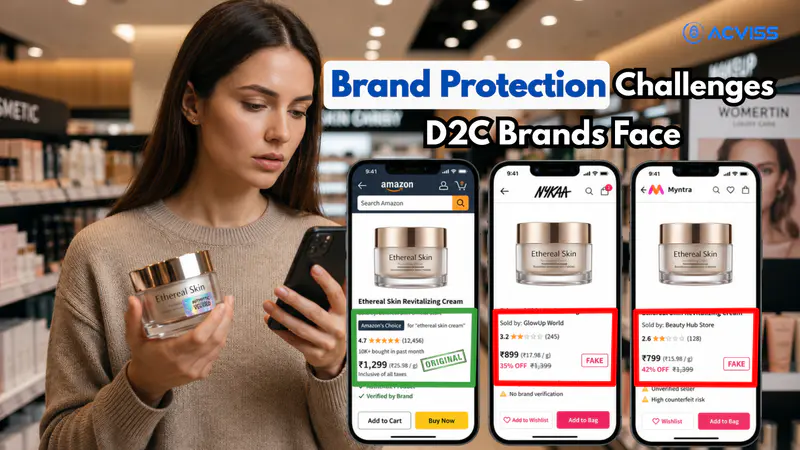
The direct-to-consumer model has given brands something previous generations could only dream of: direct access to customers. D2C businesses own the customer relationship, control the buying experience, collect first-party data, and build communities without relying heavily on retailers or distributors. That level of control has transformed industries ranging from cosmetics and nutraceuticals to consumer electronics, fashion, and premium food products.
Yet the same characteristics that make D2C attractive also create unique vulnerabilities. Counterfeiters no longer need to infiltrate retail shelves or exploit distributor networks. They can simply imitate the brand where customers already expect to find it. Fake social stores, marketplace impersonation, fraudulent websites, and counterfeit product listings increasingly target D2C brands because consumers are conditioned to buy directly. For modern brands, counterfeit risk has become as much a customer trust issue as a product authenticity issue.
How the D2C Model Changes the Counterfeiting Threat Profile
Traditional anti-counterfeiting programmes were largely designed around physical distribution. The focus was on controlling inventory movement, monitoring distributors, identifying grey market activity, and preventing unauthorised retail sales.
D2C brands operate differently. They may have fewer intermediaries, but they expose a much larger portion of their business to public digital channels. Product launches happen on social media. Marketing campaigns run across search engines and influencer networks. Customer conversations take place in public communities. Every successful campaign creates visibility, and visibility attracts imitation.
This shifts the attack surface considerably.
A traditional manufacturer may struggle to understand who ultimately buys its products. A D2C brand usually knows exactly who its customers are. However, counterfeiters can observe much of the same information. Popular products, successful campaigns, pricing strategies, customer reviews, and promotional tactics are all visible online.
As a result, many D2C brands discover that counterfeiting affects far more than sales. Customer acquisition costs rise, support teams become overwhelmed, reviews deteriorate, and trust erodes long before the organisation realises counterfeit activity is occurring.
The Social Commerce Impersonation Problem

One of the fastest-growing threats facing D2C brands comes from social commerce platforms.
Counterfeiters increasingly build fake Instagram stores, Facebook shops, TikTok storefronts, and WhatsApp business accounts that closely resemble genuine brands. Product images are copied from official websites. Customer testimonials are reused. Marketing creatives are replicated. Sometimes, even customer support scripts are cloned.
The objective is not merely to sell fake products. It is to exploit consumer trust before the brand notices.
This tactic works particularly well because D2C consumers already expect to buy through digital channels. A customer who discovers a product through Instagram is unlikely to question whether the storefront is genuine if the branding appears authentic and the experience feels familiar.
The sophistication of these operations has increased significantly. Many counterfeit storefronts now use professional e-commerce templates, AI-generated content, automated chat systems, and targeted advertising campaigns. Some counterfeit operators actively invest in search engine optimisation and paid advertising to ensure their stores appear alongside legitimate brand channels.
What makes enforcement difficult is their temporary nature. A fraudulent store may remain active for only a few weeks before disappearing and reappearing under a different name. By the time a takedown request is processed, the operator may already be targeting customers through another channel.
This is why modern brand protection increasingly relies on continuous monitoring rather than periodic enforcement.
Marketplace Listing Hijacks and Counterfeit Competition
Many D2C brands eventually expand beyond their own websites. Marketplaces provide access to larger audiences, additional revenue streams, and greater geographic reach. Unfortunately, they also create new opportunities for counterfeit activity.
A common misconception is that counterfeit sellers always create separate listings. In reality, many prefer to exploit existing demand.
Listing hijacks occur when counterfeit inventory becomes associated with product pages that consumers already trust. Customers may see genuine images, authentic descriptions, and legitimate reviews while unknowingly purchasing counterfeit products supplied by unauthorised sellers.
The damage extends far beyond lost revenue.
When counterfeit products reach consumers through trusted marketplaces, brands often experience:
Increased customer service complaints
Higher refund and replacement costs
Negative reviews linked to counterfeit products
Reduced customer satisfaction and retention
Warranty disputes and verification challenges
Erosion of marketplace performance metrics
The operational impact can be substantial. Marketing teams may spend heavily acquiring customers while counterfeit listings quietly undermine conversion rates and brand perception.
Many organisations initially treat this as a marketplace issue. In practice, it becomes a brand protection issue because customers rarely distinguish between the platform and the brand. They simply associate the poor experience with the product they purchased.
The Returns Fraud Problem Unique to D2C Operations

One of the least discussed counterfeit risks within D2C businesses originates from reverse logistics.
Returns are designed to improve customer experience. However, they can also create opportunities for counterfeit substitution.
A common scenario involves a customer purchasing a genuine product, retaining it, and returning a counterfeit version using the original packaging. If warehouse inspection processes fail to identify the substitution, the counterfeit item can re-enter inventory and eventually reach another customer.
The problem becomes more serious as return volumes increase.
Many fulfilment centres are optimised for speed and efficiency rather than authentication accuracy. Staff may be expected to process hundreds of returned items daily, leaving limited time for detailed verification procedures.
Several operational weaknesses frequently contribute to failure:
Inconsistent authentication procedures across warehouses
Limited training for returns processing teams
Missing serialisation validation processes
Poor integration between authentication systems and ERP platforms
Inadequate quarantine procedures for suspicious products
What begins as a returns issue can quickly become an inventory integrity problem.
In high-value categories such as electronics, beauty products, luxury goods, and specialised healthcare products, reverse logistics controls increasingly require the same level of scrutiny as outbound fulfilment.
First-Party Consumer Data: The Advantage D2C Brands Often Underutilise
While D2C brands face unique risks, they also possess an advantage that traditional brands rarely enjoy: direct access to customer behaviour.
Most anti-counterfeiting programmes focus on products. Increasingly, the strongest programmes focus on data.
Every authentication scan, warranty registration, loyalty interaction, support ticket, return request, and product verification event creates valuable intelligence. When analysed collectively, these signals can help identify counterfeit activity long before traditional enforcement methods.
For example, unusual authentication failures concentrated in a specific geographic area may indicate the circulation of counterfeit goods. A sudden increase in warranty registrations from unexpected regions may suggest unauthorised distribution. Repeated verification attempts for the same serialised product could indicate code cloning.
These signals are often available months before formal complaints emerge.
The challenge is that many organisations collect this data without connecting it to brand protection workflows. Information remains trapped within customer support platforms, CRM systems, loyalty programmes, and marketing tools rather than contributing to counterfeit intelligence.
Brands that successfully integrate these datasets gain a significant advantage in identifying emerging threats.
Integrating Product Authentication into the D2C Experience

One of the biggest mistakes organisations make when deploying product authentication is assuming consumers will tolerate complex verification processes.
In reality, every additional step introduces friction.
Authentication programmes that require lengthy registration forms, multiple downloads, or complicated instructions often experience low participation rates. Low participation reduces the value of the programme and limits the intelligence it can generate.
The most effective D2C product authentication systems are designed around simplicity. Consumers should be able to verify authenticity within seconds while receiving additional value from the interaction.
This is where authentication, loyalty, and customer engagement increasingly converge.
Certify combines non-cloneable label technology, product authentication, and customer engagement capabilities into a single workflow. Rather than treating verification as a standalone security process, brands can use authentication events to strengthen trust, support loyalty initiatives, gather customer insights, and improve brand protection outcomes simultaneously.
The authentication event becomes more than a verification exercise. It becomes part of the customer experience.
Turning Customers into a Counterfeit Reporting Network
Many D2C brands invest heavily in community building. What is often overlooked is the role that communities can play in counterfeit detection.
Customers frequently encounter suspicious listings, fake social media accounts, fraudulent advertisements, and impersonation attempts before the brand becomes aware of them. Yet many organisations provide no structured mechanism for reporting these incidents.
An effective community-driven reporting programme typically includes:
Simple counterfeit reporting channels
Education on identifying suspicious sellers
Authentication tools that encourage participation
Loyalty incentives for verified purchases
Clear communication regarding enforcement actions
When customers become active participants in brand protection, detection improves significantly.
Instead of relying exclusively on monitoring technologies or legal teams, brands gain access to thousands of additional observers distributed across markets, platforms, and communities.
For D2C businesses, this can become one of the most scalable forms of counterfeit intelligence available.
The Future of D2C Brand Protection
The next generation of counterfeiters is increasingly digital-first. They understand social commerce, performance marketing, marketplace algorithms, and consumer psychology. Many operate with the sophistication of legitimate e-commerce businesses.
As a result, D2C brand protection can no longer be treated as a narrow enforcement function. It must become part of a broader operational strategy, touching customer experience, fulfilment, authentication, marketplace governance, product traceability, and data intelligence.
The most resilient brands will combine product authentication, non-cloneable label technology, brand protection monitoring, loyalty programmes, and customer engagement into a connected ecosystem. They will use first-party data as an early warning system, integrate authentication into fulfilment workflows, and leverage customer communities to strengthen detection capabilities.
The direct-to-consumer model removes distance between brands and customers. Protecting that relationship increasingly requires the same level of attention that brands devote to acquiring it. As counterfeiters continue to evolve, the organisations that succeed will be those that treat trust as an operational asset rather than a marketing message.
