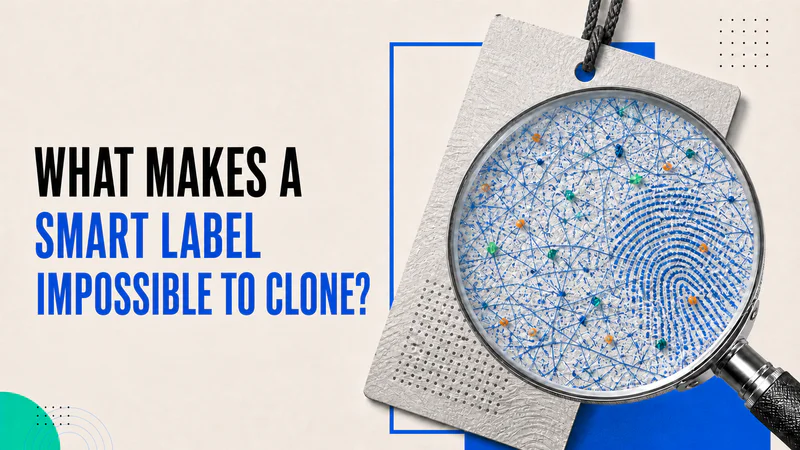
A QR code is often mistaken for a security feature simply because it is unique. In reality, uniqueness does not guarantee authenticity. A standard QR code is designed to store and retrieve information accurately, making it just as easy for a legitimate scanner to read as it is for a counterfeiter to photograph, reproduce, and print. The challenge is not creating a unique code, but ensuring that every physical copy can prove it is the original.
This distinction has become increasingly important as brands strengthen their product authentication strategies. Modern counterfeiters can replicate packaging with remarkable accuracy, leaving businesses with little protection if their verification process relies only on scanning a visible code. Secure authentication addresses this gap by combining advanced print science, AI-driven verification, and physical characteristics that cannot be recreated through ordinary copying. The result is a system that authenticates not only the information encoded in the QR code but also the authenticity of the label itself.
Why Most QR Codes Are Surprisingly Easy to Copy
The widespread adoption of QR codes has transformed customer engagement, inventory management, warranty registration, and digital product experiences. However, the technology was never designed to function as a security mechanism. Its primary objective is reliability, ensuring that information can be decoded quickly, even when the code is partially damaged or printed on different materials.
Ironically, these strengths also make standard QR codes attractive targets for counterfeiters. Modern cameras, scanners, and commercial printers are built to preserve the visual structure of a QR code with remarkable accuracy. If a code contains only static information, anyone who captures an image of it can reproduce a nearly identical version.
The problem becomes clear when product authentication depends solely on reading the encoded data. A scanner can confirm what information the QR code contains, but it cannot determine whether the printed label itself is genuine.
This difference explains why many counterfeit products continue to pass basic verification checks. The counterfeit label may display the correct information, but the physical characteristics that distinguish an authentic print from a copied one are missing entirely.
Why Copying a QR Code Is Not the Same as Copying Its Identity

A common misconception is that producing a visually identical QR code means producing an identical product identity. In practice, copying a QR code is similar to photographing a fingerprint. The image may look convincing, but it cannot reproduce the microscopic characteristics that make the original unique.
Every printed label develops tiny physical variations during production. Ink spread, toner distribution, paper fibres, printing pressure, and substrate behaviour introduce random patterns that are practically impossible to reproduce in the same way. These microscopic characteristics form what researchers describe as a Physical Unclonable Function (PUF), a naturally occurring fingerprint created during manufacturing.
The first print captures these random characteristics only once. When a counterfeiter photographs or scans the label and prints it again, the entire process introduces another layer of distortion. Fine texture becomes smoother, edges soften, compression removes subtle details, and the microscopic randomness begins to disappear.
While these changes are almost invisible to the human eye, they leave measurable signatures that modern authentication systems can detect. This is why advanced product authentication no longer depends solely on reading the QR code. Instead, it evaluates whether the physical label behaves like an original or a reproduction.
The Five Layers That Make a Smart Label Difficult to Clone
Building a secure code requires far more than encrypting information or generating a unique serial number. Modern authentication systems combine multiple layers of security, each designed to make copying progressively more difficult while allowing legitimate users to verify products with an ordinary smartphone.
1. Randomised Texture Creates Unpredictable Identity
One of the most significant advances in secure label technology is the introduction of controlled randomness beneath the visible code. Rather than relying on perfectly uniform black-and-white modules, advanced authentication labels incorporate microscopic texture generated using random distributions.
Texture-hidden anti-counterfeiting codes demonstrate how Gaussian-generated textures create highly complex patterns that are practically impossible to recreate through conventional scanning and printing. These textures introduce entropy into every label, ensuring that each printed instance develops its own physical identity.
Unlike serial numbers, which can simply be copied, random physical textures cannot be predicted or regenerated with perfect accuracy.
2. Hidden Information Is Embedded Within the Print
Secure authentication labels also reduce the visibility of their security structure. Instead of exposing every data point as a clearly defined QR module, parts of the authentication pattern are blended into carefully engineered background textures.
Techniques such as halftoning and refined QR module design allow security features to become visually integrated into the packaging artwork while remaining readable by authorised verification systems. This reduces the attack surface because counterfeiters cannot easily determine which visual characteristics contribute to authentication.
For an attacker, reproducing what appears to be a simple QR code becomes significantly more complex when the critical security information is hidden within the print itself.
3. Printing Behaviour Becomes Part of the Security
Printing is often viewed as a manufacturing step. In secure authentication, it becomes an active security layer.
Every production process introduces natural variation through factors such as:
Ink absorption into the substrate
Toner particle distribution
Printing pressure
Material texture
Environmental conditions during production
These variables create microscopic characteristics that cannot be replicated precisely, even using high-end commercial printing equipment. A copied label may appear identical under normal viewing conditions, yet its physical fingerprint differs from the original.
This principle shifts authentication away from digital information alone and towards verification of the physical product itself.
4. AI Detects the Behaviour of a Copied Label
Traditional verification systems often stop once the QR code has been decoded successfully. Modern authentication platforms continue much further by analysing how the printed code behaves under image processing.
Instead of comparing visible pixels, AI-powered authentication evaluates frequency patterns, texture consistency, print degradation, and microscopic irregularities that emerge during copying. Research has shown that spectral analysis techniques can reliably distinguish genuine prints from reproduced versions because each additional copy introduces measurable changes.
This means that authentication is based on physical evidence rather than visual appearance, making it significantly more difficult for counterfeiters to deceive the system.
5. Reading a QR Code Is Not the Same as Authenticating It
Perhaps the most important distinction is that decoding and authentication are fundamentally different processes.
A standard QR scanner answers a simple question:
"What information does this QR code contain?"
A secure authentication platform answers a much more valuable one:
"Is this physical label genuine?"
That difference determines whether a business is merely providing digital information or actively protecting its products against counterfeiting. As counterfeit operations become increasingly sophisticated, the ability to verify the physical authenticity of every label becomes just as important as verifying the data stored within it.
Why Most Counterfeit Copies Eventually Reveal Themselves
Counterfeiters rarely produce a label from scratch. In most cases, the process begins with an authentic product. The label is photographed or scanned, digitally processed, and then printed onto counterfeit packaging. While the resulting QR code often remains readable, every stage introduces subtle degradation that accumulates over successive generations.
A typical copy follows a predictable sequence:
Original print → Image capture → Digital processing → Reprint → Counterfeit packaging
Each transition removes a small amount of the original physical information. Image compression smooths fine texture, printing alters microscopic patterns, and repeated reproduction gradually changes the spectral characteristics of the label. Although these differences are almost impossible to detect visually, they become increasingly apparent to authentication algorithms designed to recognise copy behaviour rather than simply decode data.
This is precisely why modern product authentication has evolved beyond conventional QR codes. The objective is no longer just to confirm that a code exists, but to establish whether the physical label still carries the characteristics that only an original print can possess.
Beyond the QR Code: Building a Complete Product Integrity Platform
A clone-resistant QR code is a powerful foundation, but it is only one part of an effective product protection strategy. Counterfeiting rarely occurs in isolation. The same products that are copied often suffer from supply chain diversion, grey market activity, warranty fraud, and unauthorised online sales.
To address these risks, brands need authentication to operate as part of a broader product integrity ecosystem. Every verification event should contribute to greater visibility across the product lifecycle, turning individual scans into actionable business intelligence rather than isolated transactions.
The most resilient programmes combine multiple capabilities that work together:
Product authentication to verify every physical product.
Supply chain visibility to monitor product movement and identify anomalies.
Brand protection to detect and respond to counterfeit activity across online marketplaces.
Warranty verification to prevent fraudulent claims using copied labels.
Consumer engagement to build trust while encouraging genuine product verification.
Authentication intelligence to identify unusual scan behaviour, duplicate scans, and emerging counterfeit hotspots.
When these capabilities are connected, authentication evolves from a security feature into a continuous intelligence system.
How Acviss Strengthens Product Authentication Beyond the QR Code
A secure QR code is only one layer of product protection. Brands also need visibility into how products move through the supply chain, where counterfeit activity emerges, and whether products are being diverted, copied, or misused after leaving the factory.
Acviss addresses this through Certify, which combines non-cloneable label technology with AI-powered authentication. Instead of relying only on the information stored in a QR code, each label carries unique physical characteristics that are extremely difficult to reproduce through scanning or reprinting, allowing brands to verify both the code and the authenticity of the printed label.
Security can be strengthened further with Phantom Code, where authentication is embedded invisibly into the packaging artwork, reducing the attack surface for counterfeiters while maintaining the product's visual design. Alongside this, Axion Code analyses authentication data to identify duplicate scans, suspicious verification patterns, and signs of counterfeit distribution that would be impossible to detect through a static QR code alone.
Every verification also becomes a source of operational intelligence. Brands gain greater supply chain visibility, identify potential channel leakage, support warranty verification, monitor consumer engagement, and respond to counterfeit incidents with data rather than assumptions. This transforms product authentication from a simple verification step into a continuous brand protection and supply chain intelligence system.
Authentication intelligence can reveal:
When combined with online brand protection, these insights enable businesses to investigate suspicious activity across both physical and digital channels, creating a more complete defence against counterfeiting.
Choosing a Smart Label Solution: Questions Every Brand Should Ask

Many authentication solutions claim to provide secure codes, but their capabilities vary significantly. Before investing in any platform, businesses should evaluate whether it protects against real-world counterfeiting rather than simply generating unique identifiers.
A practical evaluation should include questions such as:
Can the solution distinguish an original label from a copied one?
Does it verify the physical characteristics of the printed label instead of only decoding data?
Can it detect duplicate scans and suspicious authentication patterns?
Does it provide actionable intelligence for investigations?
Can authentication data integrate with supply chain operations?
Does it support large-scale deployments across multiple product lines?
Can consumers verify products using standard smartphones without specialised hardware?
Does it contribute to brand protection beyond individual product scans?
The answers determine whether the platform functions as a true product authentication system or simply as another QR code generator.
The Future of Secure Product Authentication
Counterfeiters are becoming increasingly capable of reproducing packaging that appears authentic at first glance. As printing technology becomes more accessible and AI-assisted design tools continue to improve, visual inspection alone will no longer provide meaningful protection.
The next generation of product authentication will rely on technologies that combine physical uniqueness with intelligent verification. Authentication data will increasingly support supply chain visibility, Digital Product Passport initiatives, regulatory compliance, warranty validation, and brand protection programmes, making every verification event part of a broader intelligence network rather than an isolated security check.
For businesses, the question is no longer whether to use QR codes. The real question is whether those QR codes can prove authenticity, generate operational insights, and remain resilient against increasingly sophisticated counterfeiting techniques.
Interested in learning how non-cloneable authentication can strengthen your product security? Get in touch with the Acviss team to explore how our brand protection solutions help safeguard products across the entire supply chain.