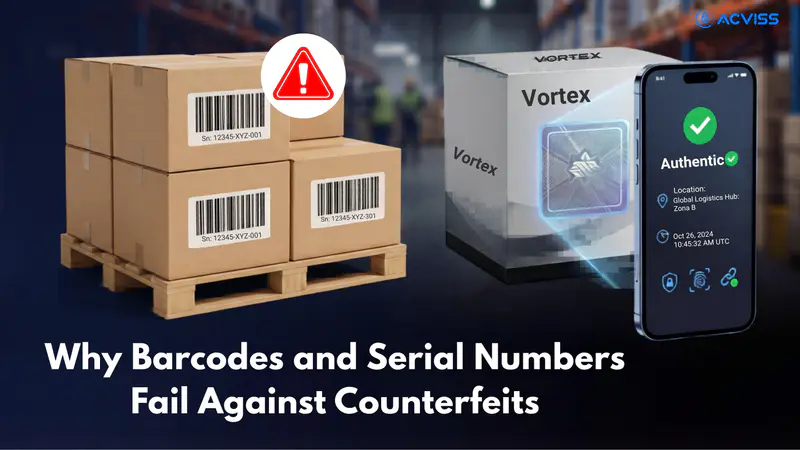
Modern supply chains were built on a simple promise: if every product carries a unique identity, it can be tracked, verified, and trusted. For decades, serial numbers and barcodes have served as the backbone of that promise. They enabled basic product authentication, improved inventory visibility, and helped standardise supply chain management across industries.
Yet, the very systems designed to protect brands and consumers are now being exploited with alarming ease.
Counterfeiting has evolved into a $467 billion global crisis. In pharmaceuticals alone, fraudulent products account for nearly 10% of global trade, rising to 30–50% in certain regions. Alongside this, grey-market diversion continues to erode margins, disrupt authorised distribution, and pose serious product safety risks.
The uncomfortable truth is this: serialisation, in its traditional form, is no longer enough.
This article explores why barcodes and serial numbers fall short, how counterfeiters exploit their weaknesses, and what brands must adopt to build a resilient product authentication lifecycle.
The Illusion of Security: What Serialisation Was Meant to Solve
Serial numbers and barcodes were introduced to create a unique identity for every unit of a product. In theory, this identity could be used for product verification, recall management, and supply chain traceability.
Regulatory frameworks such as the Drug Supply Chain Security Act (DSCSA) reinforced this model by mandating:
Unique product identifiers at the unit level
Track and trace systems across stakeholders
Digital transaction histories across the supply chain
For a time, this worked. It improved operational efficiency, reduced manual errors, and brought structure to fragmented supply chains.
However, these systems were designed for visibility, not security.
And visibility without protection is easily manipulated.
How Counterfeiters Outsmart Barcodes and Serial Numbers

1. Serial Numbers Can Be Cloned at Scale
A barcode is nothing more than a visual representation of data. Once that data is captured, it can be replicated infinitely.
Counterfeiters routinely:
Scan genuine barcodes from authentic products
Print them onto fake packaging
Distribute cloned products across markets
From a system perspective, both the original and the counterfeit product appear identical.
There is no inherent mechanism within traditional serialisation to distinguish between the first scan and the hundredth.
2. No Real-Time Authentication Layer
Most barcode-based systems rely on database lookups. A code is scanned, and the system checks whether it exists.
But existence does not equal authenticity.
A valid serial number does not confirm:
Whether the product has already been sold
Whether it has been duplicated
Whether it has been diverted from another geography
Without real-time intelligence, product authentication becomes reactive rather than preventive.
3. Lack of Context in the Product Authentication Lifecycle
A serial number tells you what the product is. It does not tell you:
Where it has been
Whether it followed the authorised route
If it was stored under safe conditions
This is particularly critical in industries like pharma, where improper handling can render a product ineffective or dangerous.
Without a complete product authentication lifecycle, brands are left with fragmented visibility.
4. Grey Market Diversion Goes Undetected
Grey market activity involves genuine products being sold outside authorised channels or geographies.
While the product itself may be authentic, the implications are severe:
Price erosion in premium markets
Conflict with authorised distributors
Regulatory non-compliance
Compromised product safety due to improper storage
A barcode cannot enforce geography. It cannot detect whether a product meant for one country is being sold in another.
This is where traditional track and trace systems reach their limit.
The Real-World Consequences
The limitations of serialisation are not theoretical. They have resulted in tangible, often dangerous outcomes.
In Pharma
Counterfeit drugs have led to:
Ineffective treatments due to placebo ingredients
Contaminated formulations causing hospitalisations
Failure of life-saving therapies
The financial impact is equally severe, with the pharmaceutical industry losing approximately $32 billion annually to counterfeit products.
In Consumer Goods and Food
Diversion and counterfeiting lead to:
Expired or improperly stored goods reaching consumers
Brand dilution due to inconsistent pricing
Loss of customer satisfaction and trust
In temperature-sensitive supply chains, the risk multiplies. A product may appear authentic but be unsafe due to storage violations.
Why Traditional Track and Trace Falls Short
Track and trace systems built on serial numbers focus on movement, not integrity.
They answer logistical questions:
Where was the product shipped?
Which distributor handled it?
But they fail to answer critical trust questions:
Is this the original product?
Has this code been duplicated?
Is this product in the right market?
Without authentication embedded into traceability, supply chain management remains incomplete.
The Shift Towards Intelligent Authentication

To combat modern threats, brands must move beyond identification and towards verification.
This requires a layered approach that combines:
Secure, non-cloneable identities
Real-time verification systems
End-to-end supply chain traceability
Consumer-facing authentication mechanisms
Non-Cloneable Labels: Moving Beyond Replication
Unlike traditional barcodes, non-cloneable labels introduce a physical or digital uniqueness that cannot be replicated.
These technologies may be used:
Microscopic patterns
Copy-detection elements
Material-based fingerprints
Even if a counterfeiter attempts to copy the label, the system can detect the duplication.
This transforms product authentication from a static check into a dynamic validation process.
Building a Complete Product Authentication Lifecycle
A robust system must track a product from manufacture to consumption.
This is where solutions like Origin come into play, enabling:
End-to-end product traceability across the supply chain
Real-time tracking of product movement
Integration with blockchain-backed systems for tamper-proof records
By creating a digital twin of each product, brands gain a single source of truth.
Every interaction becomes a data point.
Every scan becomes an insight.
Geofencing: Controlling Where Products Are Sold
Geofencing adds a critical layer of control by linking product authentication to geography.
When a product is scanned:
Its location is verified against authorised markets
Alerts are triggered if it appears in an unintended region
This is particularly effective in combating grey market diversion.
Instead of discovering diversion after the damage is done, brands can detect and act in real time.
Smart Label Consumer Engagement
Authentication is no longer limited to internal stakeholders.
Consumers themselves are becoming active participants in brand protection.
Smart labels enable:
Instant product verification via smartphones
Access to product origin, manufacturing details, and authenticity status
Direct engagement with the brand
This not only enhances customer satisfaction but also creates a feedback loop.
Every consumer scan contributes to a larger intelligence network, helping brands identify suspicious patterns.
The Business Case for Moving Beyond Barcodes

Adopting advanced anti-counterfeiting solutions is not merely a defensive strategy. It delivers measurable business benefits.
Improved Supply Chain Efficiency
Reduction in out-of-stock scenarios
Better inventory planning
Faster recall management
Studies have shown that advanced tracking technologies can reduce inventory costs by up to 60% and significantly improve fulfilment times.
Enhanced Brand Protection
Reduced exposure to counterfeit markets
Better control over distribution channels
Increased Customer Trust
Consumers today expect transparency.
When brands provide verifiable product authentication, it leads to:
Higher customer engagement
Improved customer satisfaction
Greater brand loyalty
Industries That Can No Longer Rely on Serialisation Alone
1. Pharma
With strict regulatory requirements and high patient risk, reliance on barcodes alone is inadequate. Product safety demands verifiable, tamper-proof systems.
2. Food and Beverage
Perishable goods require not just traceability but assurance of handling conditions. Counterfeiting and diversion can directly impact health outcomes.
3. Luxury and Consumer Goods
Brand value is closely tied to authenticity. Grey market activity can dilute exclusivity and damage long-term positioning.
4. Chemicals and Agri-Inputs
Improper handling or counterfeit substitution can lead to environmental and economic damage.
Rethinking Anti-Counterfeiting in a Digital Supply Chain

The future of brand authentication lies in convergence.
No single technology can solve the problem in isolation.
The most effective strategies combine:
Product authentication technologies
Supply chain traceability systems
AI-driven monitoring of online and offline channels
This integrated approach ensures that authentication is not a checkpoint but a continuous process.
Beyond Identification Lies Trust
Serial numbers and barcodes were never designed to combat today’s level of sophistication in counterfeit and diversion fraud.
They identify. They do not authenticate.
They track. They do not verify.
For brands operating in complex global supply chains, the question is no longer whether to upgrade their systems, but how quickly they can do so.
Building a secure product authentication lifecycle requires moving beyond visibility towards intelligence, beyond tracking towards trust.
Interested in learning more? Get in touch with us to explore how advanced anti-counterfeiting solutions, powered by non-cloneable technologies and end-to-end traceability, can protect your brand, your customers, and your reputation.