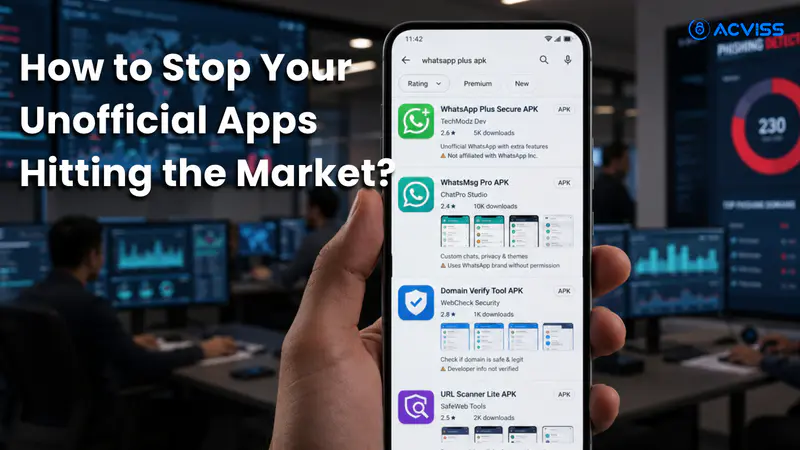
Counterfeiters no longer need factories, warehouses, or distribution networks to damage a brand.
Sometimes, all they need is an APK file, a copied logo, and a few hours of development time.
A customer searching for your loyalty app, warranty registration platform, or product authentication application may believe they are interacting with your official ecosystem. The app icon looks familiar. The screenshots appear convincing. The language mirrors your marketing. The promises sound legitimate. In some cases, the fake application may even rank surprisingly high in search results or appear inside third-party Android marketplaces alongside genuine software.
The customer downloads it confidently.
What happens next is where the real danger begins.
The counterfeit app may harvest personal information, steal login credentials, redirect transactions, manipulate reward systems, or falsely verify counterfeit products as genuine. Unlike fake websites, which consumers increasingly recognise as suspicious, fake mobile apps create a stronger psychological sense of legitimacy. Users inherently trust applications installed on their personal devices. That trust is precisely what cybercriminals are exploiting.
For brands investing heavily in product authentication, product verification, customer engagement, supply chain management, and anti-counterfeiting solutions, counterfeit mobile applications are among the most overlooked threats in the modern digital ecosystem.
The problem is expanding rapidly, particularly in sectors such as FMCG, pharma, and fintech-adjacent consumer services, where mobile applications now sit at the centre of customer interaction and brand trust.
The Counterfeit Economy Has Moved Beyond Physical Products

For years, brand protection conversations revolved around counterfeit products circulating through grey markets, unauthorised distributors, and illicit marketplaces. While those threats remain significant, digital impersonation has quietly become one of the fastest-scaling forms of brand abuse.
Mobile applications are especially attractive targets because they combine three valuable assets in one place:
Consumer trust
Sensitive data
Financial or behavioural value
A fake product can deceive a consumer once. A fake application can continue to harvest data, manipulate engagement, and damage brand reputation every single day it remains active.
This is why counterfeit app brand abuse is no longer a fringe cybercrime issue. It has become a structured business model.
The economics strongly favour attackers.
Modern app cloning tools, reverse engineering frameworks, AI-assisted coding systems, and automated UI replication platforms have dramatically reduced the technical expertise required to create counterfeit applications. What previously demanded a skilled development team can now be replicated by small cybercrime groups or even individuals using publicly available toolkits.
The emergence of AI-generated coding workflows has accelerated this further. Criminal operators can now reproduce functional application interfaces, duplicate workflows, and imitate user experiences within days of a legitimate app launch.
For high-growth brands, especially those expanding customer engagement initiatives or launching authentication ecosystems, the speed of imitation has become alarmingly fast.
How Fake Brand Apps Are Actually Created
Many organisations still imagine fake applications as poorly designed copies with obvious warning signs. That assumption no longer reflects reality.
Modern counterfeit apps are often highly polished and strategically engineered to mimic consumer expectations.
The process generally follows three distinct stages.
Reverse Engineering the Legitimate Application
Attackers begin by analysing the original application package. Android applications are particularly vulnerable because APK files can be decompiled relatively easily using widely available reverse engineering tools.
This allows attackers to inspect:
User interface structures
Verification workflows
Backend API calls
Product scanning logic
Reward redemption systems
Authentication pathways
Embedded assets and keys
For brands operating product authentication or track and trace platforms, this becomes particularly dangerous because attackers gain visibility into how verification systems function.
In poorly secured ecosystems, counterfeit developers may even identify opportunities to mimic or manipulate verification responses.
Modifying the App for Fraud
Once the structure has been understood, malicious actors begin altering the application.
Some fake apps are designed primarily for credential theft. Others inject malware, spyware, or adware into the device. In loyalty ecosystems, attackers often focus on reward fraud and account takeovers.
The most concerning category involves fake product verification applications.
Imagine a pharmaceutical consumer scanning medicine packaging through what appears to be an official brand authentication app. Instead of verifying authenticity, the counterfeit application may simply display a reassuring “Product Genuine” message regardless of whether the medicine is legitimate.
This creates a deeply dangerous situation. The counterfeit infrastructure does not merely bypass product safety systems. It actively weaponises consumer trust against the consumer.
For industries where product safety directly affects health outcomes, the implications are severe.
Distribution Through App Stores and APK Networks
After modification, the counterfeit application is distributed through multiple channels.
These may include:
Third-party APK stores
Fake websites
Telegram communities
Search engine manipulation
Sponsored app promotions
Occasionally, even official app stores
The assumption that Google Play Store or Apple App Store moderation automatically prevents brand impersonation is increasingly inaccurate.
At scale, moderation systems struggle to detect nuanced trademark abuse and sophisticated visual impersonation.
Why App Store Moderation Is Less Effective Than Brands Assume
Google and Apple process enormous volumes of applications every year. Their moderation systems are primarily optimised for identifying malware, policy violations, and harmful device permissions.
Brand impersonation is often harder to detect algorithmically.
Counterfeit developers intentionally avoid exact duplication. Instead, they create near-identical variations designed to remain just outside automated enforcement thresholds.
Common techniques include:
Slight spelling alterations
Alternate publisher names
Similar but modified icons
Keyword manipulation
Reworded descriptions
Region-specific naming adaptations
A counterfeit app does not need to be identical to deceive users. It only needs to feel familiar enough to create trust during the first interaction.
This becomes especially effective in customer engagement ecosystems where users already expect QR scanning interfaces, loyalty workflows, or product verification screens.
Consumers are conditioned to trust the process.
That behavioural familiarity is precisely what attackers exploit.
Read on How to Take Down Fake Apps from Play Store and App
Why FMCG and Pharma Brands Are Becoming Primary Targets

Certain industries have become disproportionately vulnerable to counterfeit app abuse because of how central mobile ecosystems have become to customer interaction.
FMCG Loyalty Ecosystems
Modern FMCG loyalty applications now function as behavioural and transactional ecosystems rather than simple rewards programmes.
Consumers regularly store:
Purchase histories
Personal details
Mobile numbers
Reward balances
Shopping preferences
Linked payment methods
Globally, unredeemed loyalty points are estimated to exceed $200 billion in value. Criminal groups increasingly treat loyalty platforms as lightly secured digital wallets.
A counterfeit loyalty application allows attackers to:
Harvest consumer data
Manipulate points systems
Conduct phishing attacks
Steal stored value
Redirect promotional campaigns
The financial incentive is enormous.
Pharmaceutical Product Authentication Platforms
The pharmaceutical sector faces a more dangerous variation of the problem.
As pharma companies invest in product verification, product traceability, track and trace systems, and anti-counterfeiting technologies, consumers increasingly rely on mobile apps to validate medicines.
A counterfeit authentication app fundamentally destroys the integrity of that trust chain.
If a fake application falsely authenticates counterfeit medicines, the consequences extend beyond trademark abuse or IP protection concerns. They become public health risks affecting patient safety and regulatory compliance.
For pharma brands, counterfeit mobile applications are not simply digital nuisances. They are operational and reputational threats with real-world consequences.
The Real Damage Extends Far Beyond Downloads
Many organisations underestimate the broader damage profile associated with fake brand apps.
The impact is rarely limited to a single fraudulent interaction.
Consumer Data Harvesting
Counterfeit applications frequently collect:
Login credentials
OTP codes
Payment information
Device identifiers
Email addresses
Behavioural analytics
This information may later be sold, reused for phishing campaigns, or deployed in account takeover attacks.
Reputation Damage and Loss of Trust
Consumers rarely distinguish between a counterfeit application and the legitimate brand being impersonated.
When fraud occurs, they blame the brand.
This leads to:
Negative app reviews
Customer dissatisfaction
Increased support escalations
Social media backlash
Declining trust metrics
For companies heavily focused on customer satisfaction and customer engagement, rebuilding trust becomes expensive and time-consuming.
Intellectual Property and Trademark Abuse
Counterfeit applications are routinely misused:
Logos
Brand names
UI elements
Marketing copy
Product imagery
Trademark assets
However, enforcement becomes difficult when publishers operate anonymously or distribute through offshore infrastructure.
This is why app store brand protection now requires continuous monitoring rather than occasional enforcement actions.
Why Third-Party APK Stores Are the Most Difficult Battlefield

Official app stores are only part of the problem.
In markets such as India, third-party Android ecosystems remain highly active due to:
Device limitations
Regional software preferences
Lower-cost smartphones
Sideloading familiarity
Pirated software culture
Alternative app ecosystems
These APK distribution platforms often have minimal moderation standards and weak enforcement mechanisms.
Applications removed from Google Play frequently continue circulating across:
APK mirror sites
File-sharing communities
Messaging platforms
Informal download repositories
For brands operating customer-facing authentication or loyalty systems in India and similar markets, ignoring third-party APK ecosystems creates a major blind spot in online brand protection strategy.
The threat does not disappear simply because one listing has been removed.
Monitoring Fake Apps Requires More Than Searching Your Brand Name
Most companies approach counterfeit app monitoring far too narrowly.
Searching for exact brand name duplication is no longer enough.
Effective monitoring requires analysis across:
Logo similarities
App icon variations
Metadata manipulation
Fake review activity
Publisher behaviour
Keyword stuffing
Visual UI mimicry
Regional naming variations
Behavioural intelligence is equally important.
Platforms such as Truviss by Acviss help brands monitor and identify counterfeit app brand abuse alongside broader digital impersonation threats, including fake domains, fraudulent listings, and online trademark misuse.
Early warning signals often appear through:
Increased customer complaints
Abnormal uninstall patterns
Unexpected loyalty fraud
Verification inconsistencies
Spikes in support tickets
Falling conversion rates
Brands need continuous visibility across official and unofficial app ecosystems.
Reactive enforcement alone is no longer sustainable.
The Future of Brand Protection Is Mobile, Behavioural, and Continuous
The relationship between consumers and brands is increasingly mediated through mobile applications.
Authentication systems. Loyalty programmes. Product verification workflows. Warranty registration. Customer engagement campaigns. Track and trace visibility. Brand verification systems.
All of them now depend heavily on digital trust infrastructure.
Counterfeiters understand this shift clearly.
They are no longer just copying products. They are copying the systems consumers trust to validate those products.
That changes the entire nature of brand protection.
Online brand protection now extends far beyond fake marketplaces and counterfeit listings. Mobile ecosystems have become one of the most critical frontlines for IP protection, trademark protection, and anti-counterfeiting solutions.
Because in today’s environment, protecting the product alone is no longer enough.
Brands must also protect the digital experience surrounding the product.
Interested in learning more?
If your brand operates customer-facing mobile applications for product authentication, product verification, loyalty management, warranty validation, or customer engagement, counterfeit app monitoring should already be part of your online brand protection strategy.
Get in touch with Acviss to learn more about Truviss and digital brand protection solutions