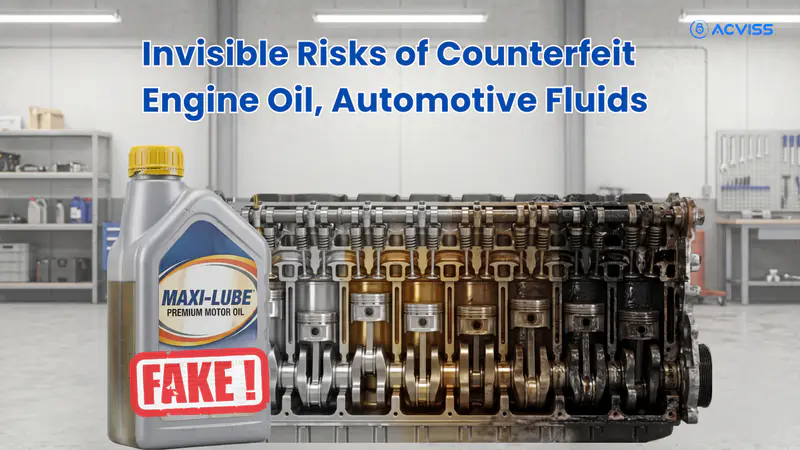
There are few products as deceptively simple and as critically important as engine oil. It sits quietly inside engines, out of sight and often out of mind, yet it determines performance, longevity, and in many cases, safety. What makes this category particularly dangerous is not just its importance, but how easily it can be faked and how difficult it is for consumers to detect.
Counterfeit engine oil and automotive fluids have evolved into a global, industrialised problem. Unlike counterfeit luxury goods, where the damage is largely reputational, fake lubricants operate silently, degrading machinery, voiding warranties, and eroding brand trust over time. For automotive and FMCG brands, this is not just an IP issue. It is a product safety crisis, a supply chain management failure, and a long-term brand protection challenge.
Why Engine Oil and Automotive Fluids Are Prime Targets for Counterfeiting
Automotive lubricants sit at the intersection of high demand, high margins, and low consumer verifiability. That combination makes them one of the most attractive targets for counterfeiters.
Globally, counterfeit and pirated goods account for approximately 3.3% of total world trade, valued at USD 509 billion. Within this, the automotive sector stands out as particularly vulnerable. While much attention is given to fake spare parts like brake pads and airbags, lubricants present an even more scalable opportunity for illicit operators.
Several factors explain this:
1. High Volume, Repeat Consumption
Engine oil is a consumable product. Every vehicle requires periodic oil changes, creating a continuous and predictable demand cycle. Unlike durable goods, this ensures repeat purchase behaviour, which counterfeiters exploit.
2. Packaging That Is Easy to Replicate
Unlike complex mechanical parts, engine oil packaging can be replicated with high-resolution printing, moulded plastic containers, and reused genuine bottles. Counterfeiters often collect discarded original containers, refill them with inferior oil, and reseal them.
3. Limited Consumer Awareness
Most consumers cannot distinguish between genuine and fake oil. The product is not visible during use, and its impact is not immediate. This lack of visibility reduces suspicion and delays detection.
4. Margin Arbitrage
Counterfeiters can produce fake lubricants at a fraction of the cost by using low-grade base oils or recycled industrial oil. When sold at near-original prices, the margins are substantial.
From a brand protection standpoint, this creates a dangerous asymmetry. The counterfeit product generates immediate profit for the criminal network, while the brand absorbs delayed reputational damage.
What Fake Engine Oil Actually Contains and Its Long-Term Impact
The composition of counterfeit engine oil is where the real risk lies. Unlike genuine lubricants, which are engineered with precise additive packages and tested formulations, fake oils are often crude mixtures.
Typical Composition of Counterfeit Engine Oil
Recycled or used oil that has been filtered but not properly refined
Low-quality base oils lacking viscosity stability
Absence of essential additives such as detergents, dispersants, and anti-wear agents
In some cases, completely unrelated industrial or hydraulic fluids
The absence of additives is particularly critical. Additives account for a significant portion of a lubricant’s performance. Without them, the oil cannot:
Prevent sludge formation
Protect against corrosion
Maintain viscosity across temperature ranges
Reduce friction and wear
What Happens Inside the Engine
The damage caused by counterfeit oil is gradual but cumulative:
Increased friction leads to accelerated wear of engine components
Overheating due to poor thermal stability
Sludge build-up that blocks oil flow
Component failure, including pistons, bearings, and camshafts
A seemingly minor counterfeit purchase can escalate into repairs costing thousands. Industry observations suggest that a low-cost counterfeit component can lead to engine damage exceeding USD 10,000.
The real issue is latency. The damage does not occur immediately. By the time symptoms appear, the link to counterfeit oil is difficult to establish.
Where Counterfeit Automotive Fluids Enter the Market
Understanding entry points is critical for designing effective anti-counterfeiting solutions.
1. Aftermarket Retailers
Independent automotive shops and informal retailers often operate outside strict supply chain controls. Counterfeit products are introduced at wholesale levels and distributed alongside genuine goods.
2. Online Marketplaces
The rise of e-commerce has amplified the problem. Counterfeiters leverage digital platforms to sell directly to consumers, often mimicking legitimate listings with minor variations.
3. Informal Service Centres
In many markets, vehicle servicing occurs in unregulated workshops. Consumers trust these centres to use genuine products, but there is often no verification mechanism in place.
4. Supply Chain Leakages
Even before reaching the market, products can be diverted. Genuine labels and packaging materials are sometimes stolen or misused, enabling counterfeiters to create near-identical replicas.
A notable enforcement action in India in January 2024 led to the seizure of 8,000 counterfeit engine oil products, highlighting both the scale and accessibility of these operations.
The Invisible Harm: Why Consumers Realise Too Late

Unlike counterfeit electronics or apparel, where defects are immediately visible, fake engine oil operates invisibly. This delayed manifestation of harm is one of the most challenging aspects for both consumers and brands.
The Lag Effect
The oil is used during routine servicing
The vehicle performs normally for weeks or months
Gradual degradation begins
Symptoms such as noise, overheating, or reduced performance appear
Diagnosis rarely points back to the oil used
This delay breaks the feedback loop. Consumers do not associate the damage with the product, and brands lose the opportunity to intervene early.
From a customer satisfaction perspective, this is critical. The brand is often blamed, even when the root cause is counterfeit usage.
Authentication as a Strategic Necessity, Not a Feature

To address this challenge, automotive lubricant brands are increasingly adopting product authentication and product verification technologies as core components of their brand protection strategies.
This shift reflects a broader movement from reactive enforcement to proactive prevention.
What Authentication Enables
Consumer-level product verification at the point of use
Supply chain management visibility through track and trace systems
Product traceability across distribution channels
Brand authentication that strengthens trust and loyalty
Advanced anti-counterfeiting solutions now integrate digital and physical layers, enabling real-time verification.
The Role of Non-Cloneable Labels
Technologies such as non-cloneable label systems, like those deployed in solutions such as Certify, create a unique identity for every product unit.
Each label functions as a secure digital certificate, enabling:
Instant verification by consumers
Detection of duplicate or cloned codes
Monitoring of product movement across the supply chain
This transforms authentication from a static feature into an active intelligence system.
The Warranty Dilemma: Who Bears the Liability?
One of the most complex issues arises when counterfeit products intersect with genuine service networks.
Consider this scenario:
A consumer services their vehicle at an authorised or seemingly legitimate service centre. The centre uses counterfeit engine oil, either knowingly or unknowingly. Months later, the engine fails.
Key Questions That Arise
Is the brand liable for the damage?
Can the warranty be honoured?
How can the brand prove the use of counterfeit fluid?
Without robust product verification mechanisms, these questions remain unresolved, leading to disputes and reputational damage.
Authentication systems provide a clear audit trail. By linking each product to a verifiable identity, brands can:
Validate whether genuine products were used
Protect themselves from fraudulent warranty claims
Strengthen IP protection and trademark enforcement
This is particularly relevant in sectors like pharma and automotive, where product safety is directly linked to human well-being.
Designing an Authentication Programme for High-Volume Products
Engine oil presents unique challenges for authentication due to its scale and distribution complexity.
An effective programme must account for:
1. High Volume and Low Unit Cost
Solutions must be scalable and cost-efficient, without adding friction to the purchasing process.
2. Informal Retail Channels
The system must work in environments where digital infrastructure may be limited.
3. Consumer Simplicity
Verification must be intuitive. Ideally, it should require no specialised app or technical knowledge.
4. Real-Time Intelligence
Brands need actionable insights, not just static verification.
Core Components of a Robust System
Unique, non-cloneable identifiers on every unit
Mobile-based verification through widely accessible platforms
Centralised data analytics for monitoring and response
Integration with track and trace systems for full product traceability
Such systems do more than prevent counterfeiting. They enable customer engagement, improve customer satisfaction, and create a direct communication channel between brands and end users.
Beyond Protection: Turning Authentication into a Competitive Advantage

Forward-looking brands are beginning to treat authentication not just as a defensive measure, but as a strategic asset.
Strategic Benefits
Enhanced brand trust through transparent verification
Improved supply chain efficiency via real-time data
Stronger IP protection and trademark protection frameworks
Data-driven insights into consumer behaviour and market dynamics
In an era where trust is a differentiator, brand verification and product authentication become integral to long-term growth.
The Road Ahead: From Reaction to Prevention
The fight against counterfeit automotive fluids cannot rely solely on enforcement. The scale and sophistication of illicit networks require a systemic response.
Key priorities include:
Adoption of advanced authentication technologies
Strengthening of supply chain management practices
Collaboration between brands, regulators, and marketplaces
Increased consumer awareness
The automotive sector, much like pharma, is moving towards a future where product safety, traceability, and authentication are non-negotiable.
What Happens Next Matters
Counterfeit engine oil represents a uniquely dangerous category of fraud. It operates invisibly, causes delayed but severe damage, and undermines both consumer trust and brand integrity.
For brands, the question is no longer whether counterfeiting exists, but how effectively it is being addressed.
Authentication is no longer optional. It is a foundational layer of modern brand protection, enabling transparency, accountability, and resilience across the supply chain.
For organisations navigating this challenge, the path forward lies in integrating anti-counterfeiting solutions, product authentication technologies, and track and trace systems into a unified strategy.
Interested in learning more about how authentication can protect your products and customers? Get in touch with us.